
When Free Speech Turns Treacherous: The Urban Naxal Narrative
“Urban Naxals and the Politics of Betrayal: When Dissent Turns into Dangerous Ideology”

Paromita Das
New Delhi, 27th November: Every democracy has space for disagreement, protest, and debate. These are not just rights; they are the oxygen of a free nation. Yet, in modern Bharat, there exists a disturbing subset of self-proclaimed intellectuals and activists who mistake anti-national glorification for dissent. They wear the mask of revolutionaries but speak the language of betrayal. These are the so-called urban Naxals—an ideological network that thrives on distorting truth, romanticizing terrorism, and mocking the very soldiers who protect their right to speak.
They claim to stand for justice, but their selective outrage exposes something far darker. Their empathy begins where Bharat’s pain begins, and their silence grows loudest when her enemies bleed her borders.
When Justice Became “Injustice”: The Afzal Guru Moment
When the Supreme Court upheld the death sentence of Afzal Guru—the mastermind behind the 2001 Parliament attack—Bharat saw closure. For millions, it was a moment of justice for those who had laid down their lives protecting the heart of the nation. But in certain university corridors and so-called “intellectual” gatherings, a different ritual began.
Posters went up. Slogans were raised. “Afzal hum sharminda hain, tere qatil zinda hain,” they cried, transforming a convicted terrorist into a symbol of victimhood. What the rest of Bharat mourned as a tragedy of terrorism, they reframed as state oppression. It wasn’t just tone-deaf—it was treasonous empathy, cloaked as free thought.
This episode laid bare a deeper rot—an ideology that refuses to differentiate between a terrorist and a martyr as long as both can be used to attack the Bharatiya state.
Burhan Wani and the Glorification of Violence
The same pattern replayed itself in 2016 with Burhan Wani, the Hizbul Mujahideen commander whose social media outreach turned Kashmir’s youth into weapons of chaos. When he was neutralized, the country exhaled in relief. Yet, for the urban Naxal ecosystem, his death was “state violence.” They painted Wani as a “misguided boy,” not a terrorist who propagated jihad.
Articles flooded elite portals, mourning his death as if it were a literary tragedy. What they refused to acknowledge was that every life Burhan Wani influenced into extremism had a cost—an Bharatiya soldier, a Kashmiri civilian, a child caught in the crossfire. Their sympathy was not for victims; it was for the perpetrators.
In romanticizing radicals, they stripped terror of its brutality and handed it a moral halo. That is not dissent—it is propaganda.
Hidma: The Bloodstained Face of Maoism and Its Urban Defenders
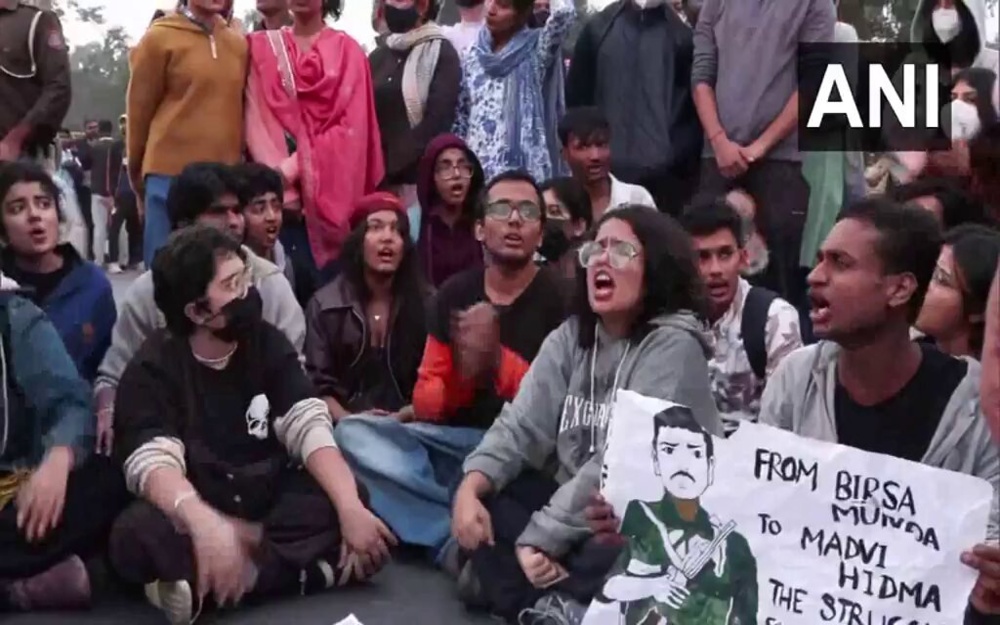
Maoist commander Madvi Hidma’s name evokes horror in Bharat’s security forces. Responsible for ambushes that killed scores of CRPF and police personnel in Sukma, Dantewada, and Bastar, Hidma epitomized the savagery of left-wing extremism. His violence was not ideological—it was terror weaponized against his own people.
Yet every time Maoists slaughter security forces, urban Naxal voices sing a familiar chorus: “State repression,” “class struggle,” “social justice.”
Not once do they mention the widows, the orphans, or the villages left trembling in grief.
Their ideological gymnastics seek to sanitize Hidma’s bloodstained record into a misunderstood revolution. But behind the vocabulary of “struggle” and “rights,” they conceal an indifference to human life—a moral corrosion that sees terrorists as heroes and soldiers as oppressors.
When Celebrating Death Becomes a Political Statement
Perhaps the most chilling sign of this ideological decay lies in the quiet celebrations that surface online when Bharatiya soldiers fall in Maoist or terror attacks. Posts dripping with sarcasm, “what else did the state expect,” or worse—veiled delight at the “collapse of fascism.”
To celebrate death is not dissent.
It is not protest.
It is moral perversion of the highest order.
These are the same voices that rely on the Constitution, the same institutions, and the same freedoms that the armed forces safeguard. They sip coffee in air-conditioned cafés, tweet revolutions, and sneer at the men and women who die to defend their comfort.
The irony is as thick as it is tragic.
Echoing the Enemy’s Script: Bharat’s Internal Propaganda Machine
Urban Naxals often appear to function as the domestic echo chamber for Bharat’s external adversaries. When Pakistan labels Bharat “fascist,” they repeat it. When separatists invent stories of genocide, they amplify them. When Maoist propaganda frames terrorists as “freedom fighters,” they translate it into English and sell it to Western media.
They don’t need foreign funding to act as a fifth column; ideology fuels them. They mistake their complicity for conscience.
Dissent Is Sacred, but Not When It Betrays the Nation
Bharat’s democracy thrives because it welcomes dissent. But dissent becomes profanity when it lionizes terrorists or celebrates the deaths of security forces. The right to question does not include the right to weaken the country’s moral and emotional foundations.
A nation can survive debate—but not when its intellectuals become apologists for its enemies. There is a difference between questioning authority and despising your own country. The urban Naxal narrative deliberately blurs that line.
The Real Threat Lies Within
Bharat’s biggest internal challenge today is not the gun in the forest but the pen in the newsroom that justifies it. The urban Naxal ecosystem may be small, but its influence on narrative, academia, and global perception is disproportionately large.
They aim not to fight the system, but to hollow it out from within. And every time society stays silent, they win a little more ground.
The Nation Deserves Clearer Voices
Bharat does not need fewer dissenters—it needs cleaner dissent. The Constitution, for which countless soldiers and citizens have sacrificed, deserves a citizenry capable of distinguishing between freedom and treachery.
Urban Naxalism is not a movement for justice—it is a masquerade of intellectual arrogance and moral decay. The time has come to expose it, debate it, and dismantle it with facts, not force.
A democracy that cannot defend its defenders will eventually lose the right to call itself one.
