
Ash Across Continents: Hayli Gubbi’s 12,000-Year Silence Ends with a Global Roar
“When the Earth Woke After 12,000 Years: Ethiopia’s Hayli Gubbi Volcano Sends Ash Across Continents”

Paromita Das
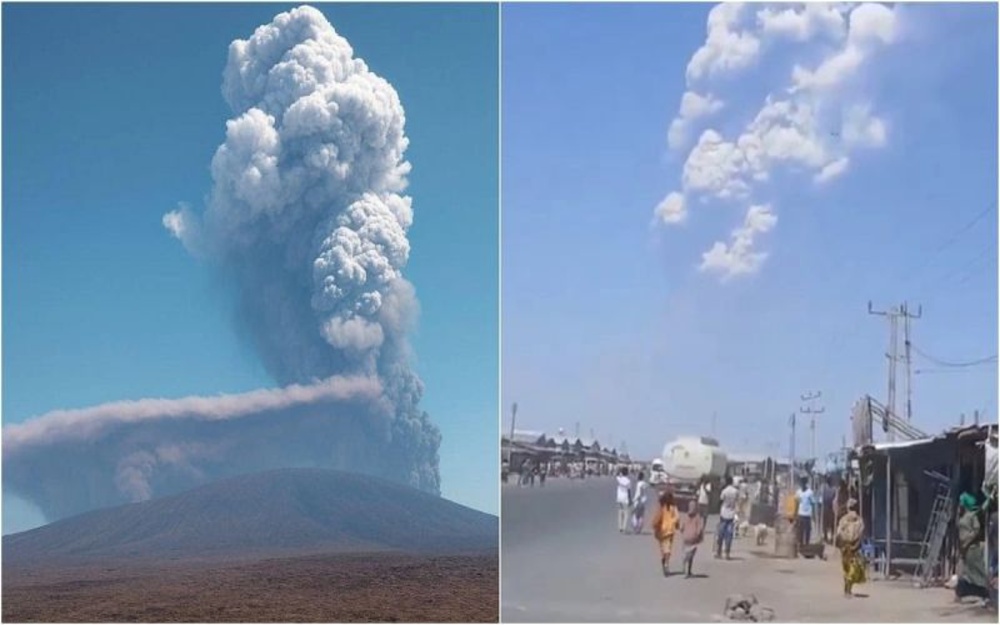
New Delhi, 27th November: The morning of November 23, 2025, will be remembered as a day when Earth reminded humankind of its raw, ancient power. In Ethiopia’s remote Afar region, the Hayli Gubbi volcano, which had slept in silence for nearly 12,000 years, suddenly erupted—sending a vast column of ash spiraling 15 kilometers into the sky. Within hours, the plume spread across the Red Sea, darkened skies over Yemen and Oman, drifted into Iran, and eventually reached Bharat’s northwestern frontier, turning what began as a regional geological event into a moment of global attention.
While the world’s eyes turned toward this sudden awakening of a prehistoric volcano, Bharat felt the ripple effects thousands of kilometers away. Flights were rerouted, airlines issued emergency advisories, and the Indian Meteorological Department (IMD) confirmed the arrival of fine volcanic ash over Gujarat, Rajasthan, Delhi, and Punjab. Fortunately, the ash remained at high altitudes, sparing cities from significant air-quality degradation. Yet, for scientists, this eruption represented not just an atmospheric phenomenon but a glimpse into the restless engine beneath our planet’s crust.
The Sleeping Giant: Hayli Gubbi’s Mysterious Past
Hidden within Ethiopia’s desolate Afar Depression, the Hayli Gubbi volcano is part of the Erta Ale range, a chain of volcanic structures marking the boundary where the African, Somali, and Arabian tectonic plates are slowly tearing away from each other. Despite its modest height of around 493 meters, Hayli Gubbi is anything but ordinary. Its structure—a shield volcano with deep magma channels—suggests a long and complex geological history.
For over 10 millennia, Hayli Gubbi remained dormant, its underground magma chambers sealed under thick crustal rock. But the rift zone beneath it has been geologically restless. Scientists believe that over time, fresh intrusions of magma from deep within the Earth built immense pressure beneath the sealed cap. Eventually, the crust could hold no longer.
The eruption that followed was explosive, a violent release of built-up gases and molten material that had been trapped for ages. In mere minutes, a jet of ash and sulfur dioxide pierced the stratosphere, where jet streams carried the material far beyond Ethiopia’s borders. The planet had reawakened one of its ancient voices.
Riding the Winds: How the Ash Reached Bharat
What made the Hayli Gubbi eruption extraordinary was not just its force but its reach. Within hours, satellite imagery from global meteorological agencies showed dense plumes sweeping across the Red Sea and into West Asia. Strong subtropical jet streams, moving at speeds of 100–120 km/h, transported the ash high above the Earth’s surface, where it began an astonishing transcontinental journey.
By the next day, the ash cloud had entered Bharatiya airspace, spreading across Rajasthan, Gujarat, north-west Maharashtra, and parts of Delhi-NCR. The IMD tracked the plume, noting that it remained well above 30,000 feet—far above the troposphere where weather systems and pollutants usually interact. This altitude protected the ground-level air quality but caused aviation alerts across several major routes.
Air India, IndiGo, Akasa Air, and KLM temporarily suspended or rerouted flights traversing West Asian and Arabian Sea air corridors, while Mumbai airport issued advisories about potential delays. Volcanic ash is a pilot’s nightmare—it can melt inside jet engines, obscure vision, and sandblast aircraft windows. Swift response and early warnings helped prevent any mishaps, demonstrating the coordination between Bharat’s aviation authorities and meteorological experts.
Beneath the Rift: The Science of a Sudden Awakening
To understand why Hayli Gubbi erupted after thousands of years, one must look deep beneath the Afar Rift, one of the few places on Earth where a new ocean may eventually form. Here, three tectonic plates continuously drift apart, stretching and thinning the crust. Magma, under immense pressure, seeps upward into these fractures.
For centuries, this molten rock gathered silently beneath Hayli Gubbi, sealed by solidified crustal layers. Gradually, heat, pressure, and volatile gases like sulfur dioxide accumulated—until the stress exceeded the crust’s strength. The resulting eruption was a textbook example of how dormant volcanoes can awaken with little warning, producing events that are both geologically fascinating and globally consequential.
What made Hayli Gubbi’s eruption particularly significant is its potential to reshape our understanding of volcanic dormancy. Scientists now speculate that other volcanoes in the Erta Ale chain could be quietly building similar pressures, making the Afar region a crucial zone for future observation.
Bharat’s Response: Calm Amid the Global Tremor
While the scale of Hayli Gubbi’s eruption captured international headlines, its tangible impact on Bharat remained modest. The ash layer never descended to breathable altitudes, meaning no measurable rise in PM2.5 or PM10 levels was recorded. Skies appeared hazy in parts of Rajasthan and Delhi, but this was largely optical—a thin veil of high-altitude ash scattering sunlight.
The IMD and Civil Aviation Ministry maintained constant surveillance, ensuring transparency and safety. By Tuesday evening, the plume had shifted eastward toward China, dissipating under changing jet stream patterns. What could have been a crisis turned into a successful demonstration of preparedness and inter-agency coordination.
A Wake-Up Call from Earth’s Deep Time
The Hayli Gubbi eruption may have spared lives and cities, but it delivers a profound message about human vulnerability in the face of natural processes that operate on scales we can barely comprehend. A volcano that last erupted when human civilization was just emerging has now reminded us that the planet’s interior is anything but dormant.
It also underscores the interconnectedness of modern systems. A geological event in East Africa disrupted aviation across Bharat and raised questions about climate, air safety, and global monitoring networks. Our world, increasingly interdependent, is more exposed than ever to nature’s faraway outbursts.
The Day the Sky Spoke in Ash
As the last traces of Hayli Gubbi’s ash drift beyond Asia, the world’s scientists will continue to study the event for months, parsing satellite data, gas emissions, and seismic patterns. For the rest of us, it stands as a stunning reminder that even in an age of satellites and supercomputers, the Earth still holds the power to surprise, awe, and humble us.
Twelve thousand years of silence ended with a column of fire and ash—and the world listened.
