
Modi’s Constitution Day Message: A Call for Duty, Democracy and the Dream of Viksit Bharat”
“On Constitution Day 2025, Prime Minister Modi’s heartfelt letter reaffirms faith in Bharat’s democratic spirit, urging citizens to balance rights with duties as the nation marches toward the vision of Viksit Bharat.”

Paromita Das
New Delhi, 26th November: On the morning of November 26, 2025, Bharat paused to remember a moment that changed its destiny—the adoption of the Constitution of Bharat in 1949. This year, as the nation celebrated Constitution Day, Prime Minister Narendra Modi reached out to the people with a deeply reflective letter that merged history, philosophy, and vision. It was not a routine message but a meditation on the living power of the Constitution—how it continues to shape lives, institutions, and Bharat’s collective journey toward a “Viksit Bharat” (Developed India).
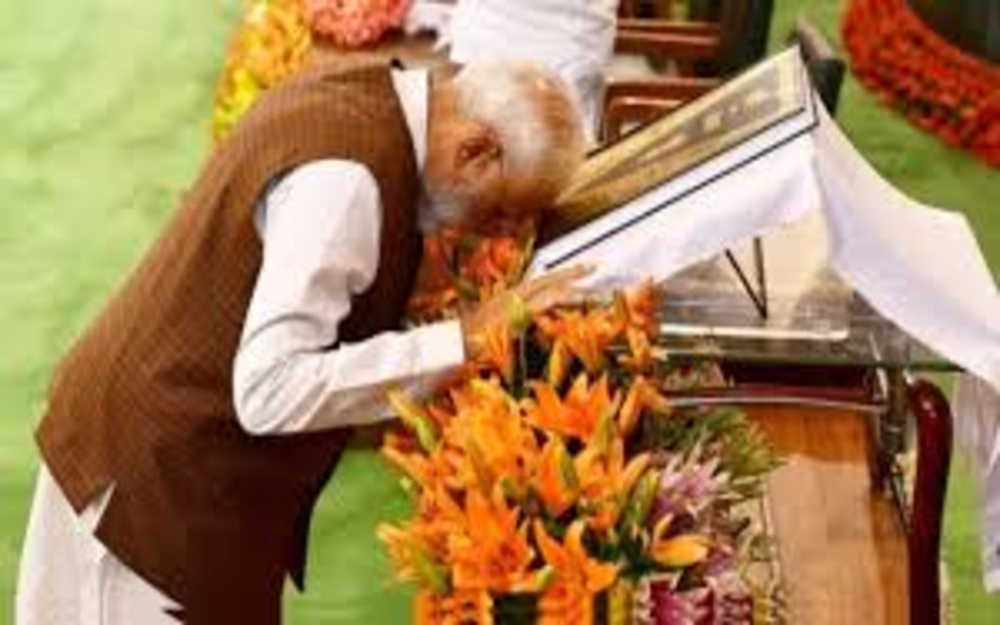
The Prime Minister’s letter, evocative and personal, wove together Bharat’s constitutional ideals and his own experiences in public life. By recalling his symbolic gestures—bowing before the Parliament in 2014 and lifting the Constitution to his forehead in 2019—Modi underlined the reverence he holds for the foundational document. It was a reminder that for him, democracy is not just an administrative framework but a sacred covenant between citizens and the State.


The Constitution as a Ladder of Aspiration
In his letter, Modi emphasised how the Constitution has opened doors of opportunity for countless Bharatiya from modest backgrounds. For a society long structured by inequality, this assertion was more than rhetoric—it reflected Bharat’s evolving democratic story. The Constitution, he said, allows every citizen to dream bigger, to imagine roles of responsibility, and to believe that merit and determination can triumph over birth and privilege.
This sentiment echoed the spirit of Dr B.R. Ambedkar’s vision, which sought not merely legal equality but genuine social mobility. Modi’s reflection linked that legacy to Bharat’s modern democratic landscape, where the idea of self-made leadership continues to grow stronger.
He also extended his gratitude to the framers of the Constitution, invoking the names of Dr Rajendra Prasad, Dr Babasaheb Ambedkar, and the women members of the Constituent Assembly, whose intellectual and moral courage helped shape a document far ahead of its time.
The Prime Minister recalled earlier commemorations—such as the Samvidhan Gaurav Yatra in Gujarat on the Constitution’s 60th anniversary, and the special parliamentary session held during its 75th year—moments that celebrated how deeply constitutional values have taken root in public consciousness.
Duties Before Rights: A Gandhian Refrain
One of the most striking aspects of Modi’s message was his emphasis on duties. Drawing from Article 51A and invoking Mahatma Gandhi’s philosophy, he reminded citizens that rights naturally follow from the honest performance of duties. This line of thought, often overshadowed by the discourse on rights, resonated with Gandhi’s belief that responsibility is the foundation of liberty.
Modi linked this moral principle to contemporary governance, arguing that social and economic progress depend not merely on laws but on civic consciousness. In a world preoccupied with entitlements, his reminder about duties was both timely and pointed—especially as Bharat navigates complex challenges of governance, growth, and equality.
The Prime Minister also contextualised Constitution Day within a wider tapestry of national milestones—the 150th birth anniversaries of Sardar Vallabhbhai Patel and Bhagwan Birsa Munda, the 150 years of Vande Mataram, and the 350th martyrdom anniversary of Guru Tegh Bahadur. These events, he noted, were reminders of Bharat’s civilisational duty to uphold unity, courage, and sacrifice—values embedded in the spirit of the Constitution.
Youth, Voting, and the Future of Democracy
Looking ahead, Modi’s letter pivoted toward the next generation—the inheritors of Bharat’s constitutional legacy. He noted that Bharat has already lived through a quarter of the 21st century and is now preparing for two centenaries: 100 years of Independence in 2047 and 100 years of the Constitution in 2049.
The Prime Minister urged citizens to view the present as a bridge between sacrifice and fulfilment, emphasising that the decisions made today will shape the Bharat of tomorrow. His appeal to strengthen democracy through participation was especially directed at young voters.
Modi suggested that schools and colleges celebrate Constitution Day by recognising those turning 18—a symbolic gesture that can nurture civic pride among first-time voters. In his words, voting is not just a right but a “ritual of democracy” that connects individual will with national destiny. Encouraging youth participation, he argued, ensures that the Constitution remains a living document—one that breathes through the actions of its citizens.
A Personal Touch, A National Message
In a world dominated by digital brevity, the Prime Minister’s personal letter stood out for its introspection and continuity with Bharat’s constitutional ethos. On his official handle on X (formerly Twitter), Modi wrote:
“On Constitution Day, we pay tribute to the framers of our Constitution. Their vision and foresight continue to motivate us in our pursuit of building a Viksit Bharat. Our Constitution gives utmost importance to human dignity, equality and liberty. While it empowers us with rights, it also reminds us of our duties as citizens.”
His tone was both reverent and forward-looking—a mix of gratitude for the past and optimism for the future.
A Renewal of the Republic’s Moral Compass
Modi’s Constitution Day message can be read as more than ceremonial communication; it reflects a philosophical and political positioning. In foregrounding duty over rights, the Prime Minister reframed citizenship as a moral responsibility rather than a mere legal entitlement. It is a call for civic maturity at a time when democracy globally faces the twin challenges of populism and apathy.
However, the emphasis on duties also invites reflection—how does a nation balance its moral appeals with the institutional accountability that rights ensure? The Prime Minister’s letter bridges that tension, arguing that Bharat’s strength lies in the synergy of both—duties that sustain rights, and rights that empower duties.
The Living Soul of a Nation
As Bharat observed Constitution Day 2025, Modi’s message served as a reminder that the Constitution is not a static document resting in the archives—it is a living soul that animates the Republic. The Prime Minister’s reflections tied the moral heritage of the freedom struggle with the aspirations of a modern, confident Bharat.
By invoking history, celebrating progress, and calling for renewed commitment, his letter turned Constitution Day into more than remembrance—it became an act of reaffirmation. In Modi’s words and gestures lay a simple yet profound truth: nations endure not only through their rights but through the collective conscience of their citizens.
