
Saffron Soars Over Ayodhya: Ram Mandir’s Flag Hoisting Marks Bharat’s Civilisational Reawakening
“Ayodhya’s Sacred Moment: Saffron Flag Rises Over Ram Mandir as Bharat Reclaims Its Civilisational Soul”

Paromita Das
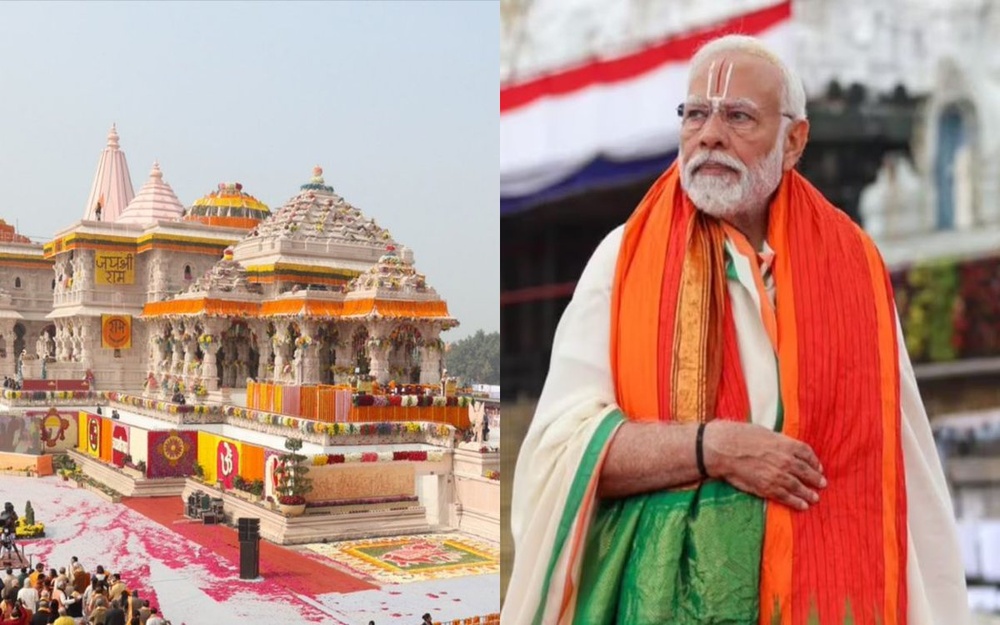
New Delhi, 26th November: On November 25, 2025, the holy city of Ayodhya witnessed a moment that somehow rose above time. The air was thick with piety, the ringing of temple bells reverberated within the holy city, and millions across Bharat and the world held their breath as the saffron flag-the Dharma Dhwaj-rose slowly up the 191-foot shikhara of the newly finished Shri Ram Janmabhoomi Mandir. It was not just a ritual but the culmination of centuries of faith, struggle, and unbroken resolve of a civilization reclaiming its spiritual nucleus.
When Prime Minister Narendra Modi and RSS chief Mohan Bhagwat collectively hoisted the flag amid Vedic chants, the act echoed much beyond the borders of Ayodhya. It symbolized the completion of a 500-year-long yagna-a spiritual journey that began in devotion, endured through struggle, and finally found fulfillment in triumph.
#WATCH | Ayodhya Dhwajarohan | PM Modi and RSS Sarsanghchalak Mohan Bhagwat ceremonially hoist the saffron flag on the Shikhar of the sacred Shri Ram Janmbhoomi Temple, symbolising the completion of the temple’s construction.
The right-angled triangular flag, measuring 10 feet… pic.twitter.com/Ip8mATz2DC
— ANI (@ANI) November 25, 2025
The Symbolism Behind the Saffron Dhwaj
The flag fluttering high above the temple was more than just cloth; it was a living symbol of Bharat’s timeless ideals. Three powerful emblems — Om, the Sun, and the Kovidara tree — are carried atop the Dharma Dhwaj, measuring 10 feet in height and 20 feet in length.
At the center was the sacred Om, signifying cosmic consciousness-the sound from which all creation emerged. The shining Sun evoked the glory of the Suryavansh lineage to which Lord Ram belonged: courage, brilliance, and righteous rule. The Kovidara tree, mentioned in the Valmiki Ramayan, bridged Ayodhya’s present with its mythic past-a living symbol of continuity, wisdom, and rootedness.
#WATCH | Ayodhya Dhwajarohan | PM Modi says, "… Aaj Sampurna Bharat, Sampurna Vishwa Ram-may hai. Har Ram Bhakt ke hriday mein adwitiya santosh hai. Aseem kritagyata hai. Apaar alaukik anand hai. Sadiyon ke ghaav bhar rahe hain. Sadiyon ki vedna aaj viraam paa rahi hai. Sadiyon… pic.twitter.com/iVD2hjlXLr
— ANI (@ANI) November 25, 2025
The hoisting of this flag was not a mere marking of completion of the temple, but it was a proclamation of Sanatan Dharma’s abiding values-discipline, sacrifice, and compassion-which continue to guide the collective soul of Bharat.
A Pilgrimage of Faith and Legacy
Ahead of the ceremony, Modi undertook a wide-ranging spiritual circuit through Ayodhya. He offered prayers at ancient temples dedicated to sages and divine figures from the Ramayana — Maharshi Vashishtha, Vishwamitra, Valmiki, and Mata Shabari among them — tracing the spiritual lineage that forms the very spine of Bharatiya civilisation.
At the Ram Lalla garbhagriha, an emotional Modi bowed his head before the deity. Here, amidst chants of “Jai Shri Ram” and the fragrance of sandalwood and marigold, the Prime Minister offered his prayers before the final act — the raising of the Dharma Dhwaj.
At high noon, during the holy Abhijit Muhurat — the very time associated with the divine union of Shri Ram and Mata Sita on Vivah Panchami — the saffron flag began its ascent. Assisted by the Bharatiya Army in an unprecedented engineering feat, the flag soared upwards until it caught the light, unfurling proudly against Ayodhya’s sky.
The moment marked the symbolic completion of the temple’s construction — the last ritual of Dhwajarohan, which in Hindu tradition is the end of consecration and the beginning of worship.
Voices of Reverence and Reflection
Addressing the gathering after the event, Prime Minister Modi said, “The world today is Ram-may – filled with the energy of Lord Ram.” Overcome with emotion, his voice trembling, he termed this event the closure of centuries-old wounds and the fulfillment of a collective dream. “The flame that burned for 500 years has now completed its yagna,” he said, “and the Dharma Dhwaj today marks the victory of faith, patience, and truth.”
RSS Sarsanghchalak Mohan Bhagwat seconded this when he termed the Dhwajarohan a homage to generations of sacrifice. “The flag of Ram Rajya has returned to its rightful place,” he said. “It once symbolised peace and prosperity in Ayodhya, and today it flies again over the same land, reminding us that Dharma never fades — it only awaits its time.”
#WATCH | Ayodhya Dhwajarohan | RSS Sarsanghchalak Mohan Bhagwat says, "This is a significant day for all of us. Numerous people saw a dream, numerous people made efforts, and numerous people made sacrifices. Their souls must be full today. Ashok ji (Ashok Singhal) must have felt… pic.twitter.com/QLXPWMn8b3
— ANI (@ANI) November 25, 2025
Uttar Pradesh Chief Minister Yogi Adityanath termed the moment “the embodiment of the faith and self-respect of 140 crore Bharatiya.” He said the temple and the flag together represented a spiritual and civilisational awakening. “The saffron flag,” he remarked, “is not just a symbol of victory-it is a reminder of the eternal light of Dharma that guides this nation.”
Later, CM Yogi presented Prime Minister Modi and RSS chief Bhagwat with miniature replicas of the saffron flag and the Ram Lalla idol, symbolic mementoes of an event which will live in Bharat’s historical memory for generations.
Ayodhya’s Cultural and Civilisational Renaissance
As the saffron flag waved against the afternoon sun, the atmosphere across Ayodhya turned electric. The devotees sang bhajans and the temple bells rang in rhythm as the streets of the ancient city glowed with saffron and marigold. The whole city seemed converted into a living temple.
The temple complex itself was a testament to Bharat’s unity in diversity: built in the traditional Nagara architectural style with intricate carvings narrating 87 episodes of the Valmiki Ramayana and 79 bronze panels depicting the broader cultural evolution of Bharat. Every stone, every sculpture, seemed to whisper the story of a civilisation that has endured and evolved over millennia.
A New Dawn Over an Ancient City
The Dhwajarohan at Ayodhya was not a religious event; it was a civilisational reawakening. Marking the end of one of the longest spiritual struggles recorded in history, this event heralded the rebirth of a national consciousness rooted in dharma and inclusiveness.
Rebuilding a temple for Bharat was not merely about rebuilding a temple but about rebuilding memory, faith in heritage, the continuity of its spiritual DNA, and proving that despite centuries of disruption, the soul of this civilisation remains unbroken.
The Flag That Will Never Fall
As the saffron flag fluttered atop the shikhara of Ram Mandir, it became more than a symbol-it was a promise. A promise that Ayodhya will be forever a beacon of Bharat’s spiritual essence, a city where faith and identity merge into one eternal light.
On that fateful Tuesday, Ayodhya celebrated something more than the completion of a mere temple; Ayodhya celebrated the victory of civilisation itself. The Dharma Dhwaj now stands not only over the shikhara but over the collective heart of a nation — a reminder that even as time wears away empires, faith, when rooted in truth, always rises again.
