
Prof. M.M. Goel Champions Needonomics in Healthcare at GIMS Greater Noida

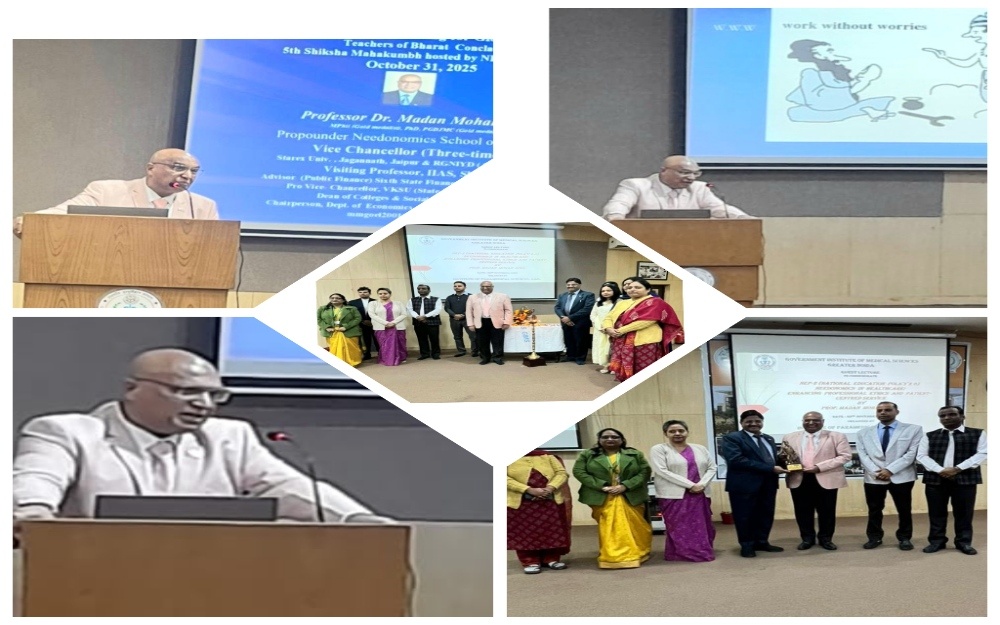
Greater Noida, 23rd November: The Institute of Paramedical Sciences at the Government Institute of Medical Sciences (GIMS), Greater Noida, hosted a guest lecture by Prof. Madan Mohan Goel, Propounder Needonomics, Former Vice-Chancellor (Thrice) and superannuated professor of Kurukshetra University. The lecture, titled “Needonomics in Healthcare: Enhancing Professional Ethics and Patient-Centered Service,” highlighted the urgent need for ethical, efficient, and compassionate healthcare delivery in India. The event was presided over by Dr. Brig. Rakesh Gupta, Director of GIMS, while Dr Manisha Singh ,Principal IPMS delivered the welcome address and Dr. Jaya Bharti, Vice principal IPMS presented a citation highlighting Prof. M.M. Goel’s achievements.
Addressing faculty members, paramedical staff, and students, Prof. Goel emphasized that healthcare-being a noble profession stands firmly on the pillars of compassion, responsibility, and service to humanity. With rising costs, limited resources, and increasing patient expectations, he stressed the importance of a value-based model that balances efficiency with ethics.
Prof. Goel explained that Needonomics, his pioneering philosophy, provides a practical framework for rethinking healthcare delivery. Rooted in need-based consumption, ethical decision-making, and responsible use of resources, Needonomics aims to restore integrity in healthcare and strengthen patient trust.
He underscored that healthcare practitioners—doctors, nurses, technicians, and paramedical workers—occupy positions of immense trust, and their decisions directly impact the lives and dignity of patients. A Needonomics-guided approach, Prof Goel said, ensures that medical interventions remain necessary, justifiable, and free from commercial influence.
Highlighting key principles, Prof. Goel explained how Needonomics strengthens professional ethics through honesty, accountability, and integrity; promotes patient-centered care by ensuring dignity, empathy, and clear communication; guides responsible use of technology by discouraging unnecessary diagnostics and overdependence; and reduces healthcare costs through rational drug use, essential tests, and efficient resource management. He emphasized empowering paramedical staff, the backbone of patient care, to minimize wastage, enhance coordination, and maintain discipline.
Prof. Goel urged healthcare institutions to cultivate a culture of mindful practice where patient welfare remains at the heart of every decision. He emphasized that adopting Needonomics is not merely theoretical—it is a practical necessity for creating a more humane, ethical, and sustainable healthcare system.
The lecture concluded with a call for integrating Needonomics into medical and paramedical education to nurture responsible caregivers and future-ready healthcare leaders.
