
US commission reports China behind disinformation campaign after Operation Sindoor

By Anjali Sharma
WASHINGTON – US-China Economic and Security Review Commission, a US Congress-created advisory body on Wednesday accused China of masterminding a disinformation campaign after Operation Sindoor, as part of its Gray Zone activities to use “fake social media accounts to propagate AI images of supposed ‘debris’ from planes.”
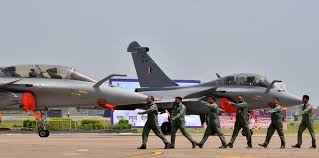
The Commission said in its annual report to Congress that “China initiated a disinformation campaign to hinder sales of French Rafale aircraft in favour of its own J-35s, using fake social media accounts to propagate AI images of supposed ‘debris’ from the planes that China’s weaponry destroyed”.
The report claimed that Beijing “opportunistically” leveraged the India-Pakistan conflict in May to “advertise the sophistication of its weapons, useful in the contexts of its ongoing border tensions with India and its expanding defence industry goals.”
India launched Operation Sindoor to retaliate against the Pahalgam attack in April that killed 26 civilians, striking terror installations and military targets inside Pakistan.
Indian Air Force Chief AP Singh revealed that Indian forces had destroyed five Pakistani fighter jets and one large airborne surveillance aircraft during Operation Sindoor.
Commission on India-China ties stated that there is an “asymmetry” between the two sides regarding the resolution of the border issue.
“China leverages high-level, well-publicized dialogues to reach partial resolution hoping to open the door for bilateral cooperation on trade and other areas by compartmentalizing the border issue without sacrificing its core interests,” while “India wants a sustainable solution to the border issues”
It emphasized “In recent years, the Indian government has increasingly recognized the seriousness of the threat posed by China at the border,”.
According to the report, the current terms of bilateral economic cooperation or border resolution agreements were “largely conceptual,” with few “specifics or follow-ups” announced by either side.
It argued that the expected succession of the Dalai Lama “will likely be a point of contention between the two neighbors.”
“It remains to be seen whether China’s and India’s 2025 commitments are a short-term function of India’s desire to hedge against tumult in trade negotiations with the United States or are a long-term shift toward normalization in bilateral relations,” it noted.
Prime Minister Narendra Modi travelled to China for the Shanghai Cooperation Organization Summit and met Chinese President Xi Jinping and Russian President Vladimir Putin after months of bilateral meetings, in August.
In Washington, the move was viewed as India hedged its bets after the relationship with the United States soured due to the imposition of 50% tariffs.
India-US relations have stabilized somewhat with the first tranche of the trade agreement expected to be announced soon.
