
Genetic Evidence of Indigenous Continuity from the Indus Valley
Rediscovering India's Roots

Poonam Sharma
For many decades, the mainstream historical narrative has downplayed deep original roots in the ancient civilizations of India. The so-called “Aryan invasion” has been a convenient explanation, suggesting that advanced culture, agriculture, and civilization came from outside rather than evolving indigenously. Modern science, however, is rewriting this story. Groundbreaking genetic research led by Harvard geneticist David Reich in concert with Indian archaeologist Vasant Shinde, among others, now shows that the Indus Valley Civilization remains the largest ancestral source for modern South Asians-not any group of external invaders.
The Genetic Breakthrough: Sequencing Rakhigarhi
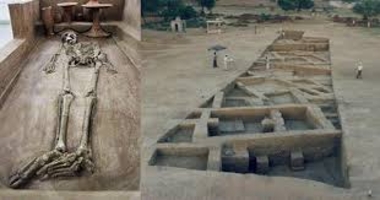
Probably one of the biggest challenges to studying the IVC has been its climate: typically, the heat and humidity of the subcontinent degrades ancient DNA beyond recovery. But then researchers persisted. After screening more than 60 skeletal samples, they finally succeeded in extracting ancient DNA from one sample-the ear bone from a woman who lived roughly 4,000–5,000 years ago-from Rakhigarhi, one of the largest Indus Valley Civilization sites.
In a landmark 2019 Cell paper, Reich, Shinde, and their collaborators reported that this Harappan individual belonged to a population that is the single largest source of ancestry for today’s South Asians.
What Does Her Genome Reveal?
The Rakhigarhi woman’s genome shows a distinctive and deeply rooted ancestry. Her DNA derives from two main lineages:
An Iranian-related ancestry, which did not represent the subsequent Neolithic farmers of the Fertile Crescent but instead derived directly from hunter-gatherers of the Iranian plateau more than 12,000 years ago.
A Southeast Asian hunter-gatherer component, which underlines that the Indus people did not represent any single outside population but attained a complex, locally rooted genetic heritage.
Importantly, the study found no detectable ancestry from steppe pastoralists-the supposed “Aryans”-in this ancient IVC individual.
Rethinking the Origin of Farming in South Asia
Conventional views are that agriculture reached South Asia through large-scale migration from the Fertile Crescent, modern-day Middle East. However, this study by Reich questions such a notion. Genetic data indicates that farming in South Asia was probably developed from within the region, or at least through the cultural diffusion of ideas rather than any mass movement of people.
In particular, the Iranian-related component in the IVC individual appears to separate prior to the spread of agriculture out of the Fertile Crescent.
This suggests that early South Asians did not passively inherit farming from Middle Eastern farmers; rather, they adapted, innovated, and evolved in their own context.
Impact on Modern South Asians: A Genetic Continuum
What does this mean for us today? According to the research, present-day South Asians are largely descended from two ancient source populations:
One such source is descendants of the IVC population, akin to the Rakhigarhi woman.
The other source involves the later influx from steppe pastoralists, but that influx appears modest in genetic terms: contributing, according to models, somewhere between 0% and 30% to modern South Asians.
Reich himself has stated that this mix of IVC-like people and a smaller contribution from steppe-derived populations is the genetic model which best fits most South Asians.
The IVC-like ancestry provides a bedrock for the genetic heritage of not only one but both major ancestral components known as the Ancestral North Indians and Ancestral South Indians.
Challenging the “Aryan Invasion” Theory
This genomic evidence is a strong blow to the classical “Aryan invasion” narrative. Until recently, textbooks and popular discourses in the West and India presumed a large-scale migration or, indeed, invasion of steppe or Aryan people who conferred civilization, language, and culture. However, the absence of steppe genes in the IVC individual suggests that the core Indus Valley population was already well established, genetically coherent, and locally rooted before any significant steppe influx., there is no archaeological or genetic evidence of a Bronze Age steppe civilization comparable in complexity to the IVC arriving in the subcontinent.
Reinforcing the Indigenous Narrative
These finds accord remarkably with the classical Indian traditions and ancient texts recording a continuous civilizational development rooted in Indian soil. Rather than being a fragmentary or borrowed culture, the IVC now appears to be at the genetic and cultural heart of South Asia.
The implications are profound:
Educational reform: Findings of this nature are to be integrated into the curricula of history textbooks to reflect an accurate picture of the ancient past of India—civilization comes and evolves within the subcontinent, not by simple outside introduction.
Cultural pride based on evidence: We can confidently reclaim a history of indigenous knowledge, agriculture, urbanism, and spiritual development validated not by mythology or tradition, but rather hard science.
Genetic continuity redefines identity and resists ideological constructs that seek to undermine the achievements of ancient Indians and present them as mere recipients of foreign influence; rather, this continuity underlines that our ancestors were original innovators.
Limitations and the Road Ahead
This write up is based on a single high-quality genome from Rakhigarhi. While the results are astounding, the authors themselves have mentioned that one sample cannot completely characterize a civilization as vast and complex . Further research with more subjects from multiple Indus Valley sites would provide a far richer, nuanced picture. Geneticists and archaeologists are already calling for deeper sampling across geography and time to understand the diversity within the civilization.
Conclusion:
A Civilizational Reawakening The work of David Reich, Vasant Shinde, and their teams offers a powerful corrective to several decades of misinterpretation. By showing that the Indus Valley Civilization is not some archaeological curiosity but the genetic foundation for modern South Asians, this research demands a historical reckoning. It is a moment of reawakening: a reminder that our civilizational roots are not borrowed or derivative but deep, indigenous, and continuing. As modern global scholarship increasingly aligns with the traditions of ancient India, it opens an opportunity for us to reclaim our true heritage-a heritage of innovation, self-reliance, knowledge, and spiritual depth. This is the time when historians, educators, and institutions need to reorder the story of India — no longer as a passive recipient of external waves but as a vibrant, self-evolving civilization whose genius has flowed uninterrupted through the millennia.
