
Supreme Court Pulls Up Punjab, Haryana Over Stubble Burning
CJI Gavai-led bench seeks detailed affidavits as Delhi-NCR air quality plunges to ‘severe’

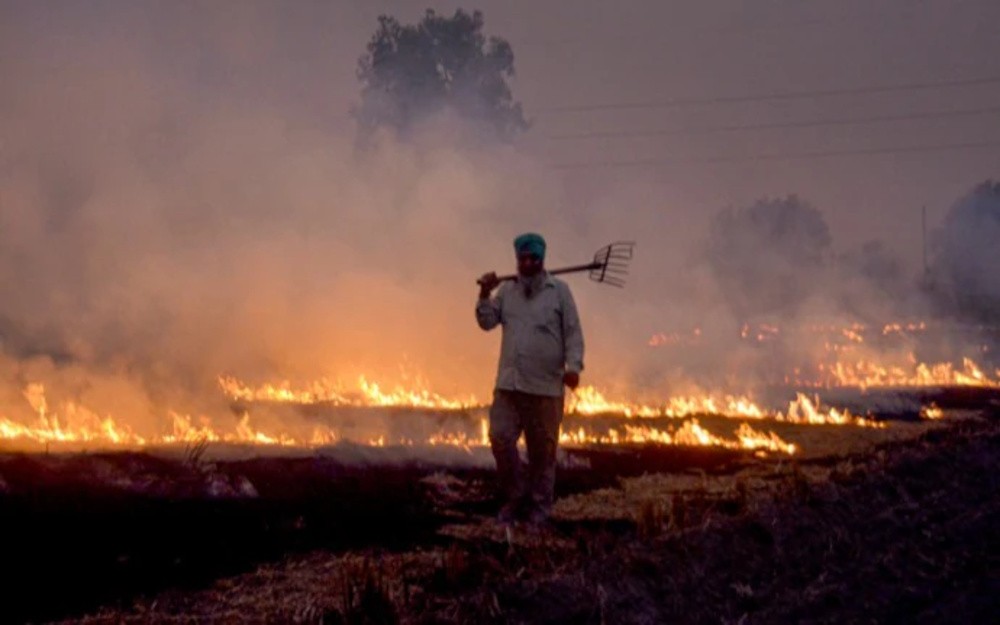
- The Supreme Court directed Punjab and Haryana to file affidavits on steps taken to curb stubble burning.
- Air quality in Delhi-NCR has dipped to the “severe” category despite GRAP-III measures.
- Senior advocates urged for immediate enforcement of GRAP-IV and suspension of dust-generating activities.
- The case will be heard again on Monday as the court reviews state responses.
GG News Bureau
New Delhi, 12th Nov: The Supreme Court on Wednesday directed the governments of Punjab and Haryana to file detailed affidavits specifying measures undertaken to prevent stubble burning, as the air quality across Delhi-NCR plummeted to “severe” levels.
A bench led by Chief Justice of India (CJI) BR Gavai, along with Justice K Vinod Chandran, expressed concern over the deteriorating air quality despite the enforcement of the Graded Response Action Plan (GRAP) in the region.
Senior advocate Gopal Sankaranarayanan informed the court that although GRAP-III was in effect, the alarming pollution levels demanded the immediate activation of GRAP-IV—the most stringent level of restrictions. “AQI has crossed 450 in several places. Even outside Court No. 10, drilling work is going on. Such activities must stop for a few days,” he submitted.
Amicus curiae Aparajita Singh also raised concerns about discrepancies in official air quality data, warning that the situation had become “very dangerous.”
Taking cognizance of the submissions, the court sought responses from Punjab and Haryana on the measures adopted to control stubble burning and scheduled the next hearing for Monday.
In its previous hearing in September, the top court had directed the Commission for Air Quality Management (CAQM) to detail its monitoring and enforcement strategies. It had also asked the Centre to consider imposing strict penalties, including arrests, to deter farmers from burning crop residue.
Despite repeated judicial directions, the apex court expressed dissatisfaction over the states’ inability to prevent the seasonal pollution surge caused by farm fires.
