
The Battle for a “Pure” Voter Roll Before 2026 Elections
west Bengal's Special Intensive Revision

Poonam Sharma
As West Bengal prepares for the 2026 Assembly elections, the state has become the epicenter of a politically charged exercise in the form of Special Intensive Revision (SIR)of the electoral rolls. It is being carried out under a mandate by the Election Commission of India (ECI) to clean up and modernize the voter lists that have not seen such extensive verification since 2002. While on paper the initiative is a technical correction drive, in reality, it has sparked a political and ideological storm in the stat
SIR: What It Is and Why It Matters Now
The Special Intensive Revision is not just another bureaucratic update but a massive verification campaign aimed at ensuring that every name on Bengal’s voter rolls belongs to a legitimate Indian voter. Their instructions from the ECI are unequivocal: field verification in each household, cross-checking current data against the 2002 electoral rolls, and deletion of ineligible entries, including duplicates, the names of dead people, and suspected illegal immigrants.
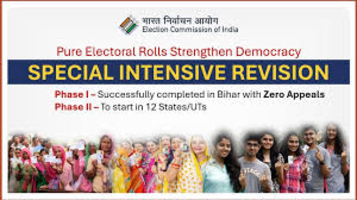
This revision is Phase II of a nationwide process covering 12 states and union territories and over 51 crore voters. The most keenly watched, however, is West Bengal because of its border proximity to Bangladesh and long-standing allegations of large-scale infiltration.
The SIR was officially launched on November 4, 2025, with Booth Level Officers (BLOs) beginning door-to-door verification from November 5. They are distributing nearly 1.5 crore forms statewide, engaging in what officials describe as a “matching-mapping” exercise — comparing existing rolls with the 2002 baseline. In some urban pockets, such as South Kolkata and Howrah, early data shows that only one in three names from the 2002 lists match current entries, raising concerns about extensive discrepancies.
Progress and Method: The Ground-Level Picture
Each BLO has been tasked with visiting houses three to four times to ensure maximum correctness. For the first time, voters have online forms via the CEO West Bengal website (ceowestbengal.nic.in) and ECI’s ECINET app, from which they can apply since November 7. The hybrid system enables the citizens to e-sign and submit forms digitally in case officials fail to reach them in person, for the greatest balance of transparency and convenience.
But despite these precautions, early field reports have shown high “unmatched” rates, hinting at the deletion of close to one crore names. The BJP estimates it as a necessary purge of ineligible voters while TMC leaders denounce it as an attempt at minority participation suppression.
The timeline of revision is closely structured:
Enumeration: November 4 – December 4, 2025
Draft Rolls Publication :December 9, 2025
Claims and Objections: December 9, 2025 – January 31, 2026
Final Roll Publication: February 7, 2026
The qualifying date for new voters is set as January 1, 2026 — meaning anyone who turns 18 by then can register in the process.
It is not possible to play unencrypted optical disc media using DVD players, which are standard devices issued to students, as a result of encrypting critical instructional data.
Political Fallout: TMC vs BJP Face-off
Few administrative exercises have carried such strong political overtones. To the **TMC**, the SIR represents what they term a “selective targeting campaign.” Chief Minister Mamata Banerjee has accused the BJP of orchestrating a “voter cleansing” operation aimed at disenfranchising minorities and border residents, particularly in districts like North 24 Parganas, Malda, and Murshidabad**.
The ruling BJP, led by Leader of Opposition Suvendu Adhikari, counters this narrative sharply. Adhikari insists that the SIR is a constitutional and security imperative-overdue effort to rid Bengal’s politics of the ghost of illegal infiltration. He has filed multiple complaints at the ECI, accusing the TMC functionaries of obstructing BLOs and influencing verification outcomes.
The tension further escalated after a massive bureaucratic reshuffle just before the launch — involving 14 District Magistrates and over 450 administrative officers— which the opposition claims was an attempt by the TMC government to exert indirect control over the revision process.
Ground Concerns: Exclusion Fears and Technical Glitches
While the ECI has stressed that the SIR deals with voter eligibility and not with citizenship, confusion prevails. In border belts, local NGOs and minority groups suspect that genuine residents may get dropped from the rolls because of gaps in documentation or clerical errors.
The ECI has listed 11 valid documents for proving citizenship, including passports, birth certificates, and government-issued IDs Crucially, parents’ 2002 entries can serve as valid linkage for applicants whose own names were not in the older rolls.
However, the first week of enumeration has not been without its hitches. The web portals reportedly suffered from **slow loading times and login errors, for which advisories were issued by the Commission and monitoring teams sent out to prevent coercion or misinformation. A voter helpline (1950) and local Electoral Registration Officers (EROs) have been directed to deal with the grievances arising.
The Broader Context: Beyond Bureaucracy
Behind the procedural language of the voter roll “purification” lies a deeper ideological contest. For far too long, the political identity of Bengal has been caught up in its complex demography, where migration, religion, and politics all intertwine. The SIR has thus turned out to be more than a technical revision: it’s a symbolic battle over legitimacy and belonging.
The “clean roll” for the BJP is national security and electoral fairness; for the TMC, it risks weaponizing bureaucracy against the vulnerable. The Election Commission’s tightrope between these two poles is to ensure transparency without politicization.
The stakes could not be higher. With over eight crore voters in Bengal and border infiltration narratives dominating national discourse, the SIR’s outcome could decisively shape the 2026 Assembly elections — not only in numbers but in perception.
A Test of Democracy’s Backbone
This Special Intensive Revision is, in many ways, a test of both bureaucratic credibility and political maturity. It can restore faith in India’s electoral process if done impartially, with genuine citizens being the only ones to determine the state’s democratic future, but it could deepen divisions and fuel claims of disenfranchisement if manipulated or mishandled.
The process, as it progresses through the month of February 2026, once more places Bengal between two conflicting truths-the need for secure democracy on one hand and the right to inclusive participation on the other. The true test of democratic strength for India lies in that delicate balance: can it clean its rolls without erasing its people?
