
Ease of Living Possible Only When Ease of Justice Ensured: PM Modi
At NALSA’s National Conference, PM launches Community Mediation Training Module, stresses tech-driven legal inclusion

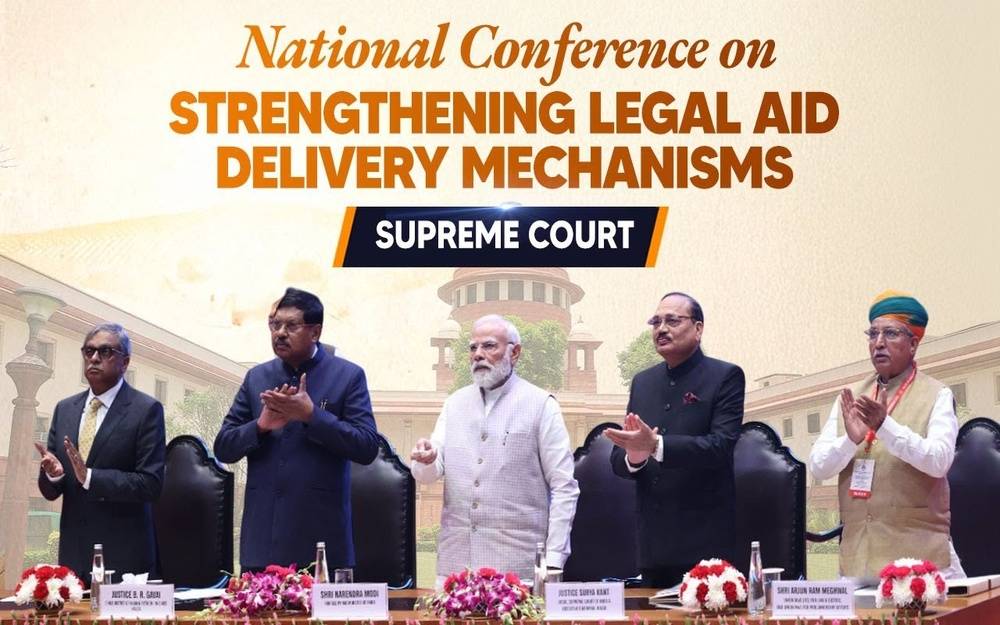
- PM Modi inaugurates the National Conference on “Strengthening Legal Aid Delivery Mechanisms” at the Supreme Court
- Launches NALSA’s Community Mediation Training Module to promote dialogue-based dispute resolution
- Highlights eCourts project, saying tech is transforming India’s justice delivery system
- Stresses making legal documents and judgments available in local languages to ensure accessibility
GG News Bureau
New Delhi, 8th Nov: Prime Minister Narendra Modi on Saturday inaugurated the National Conference on “Strengthening Legal Aid Delivery Mechanisms” at the Supreme Court of India, where he launched the Community Mediation Training Module developed by the National Legal Services Authority (NALSA).
Addressing the gathering, the Prime Minister said that “when justice is accessible to all, delivered in a timely manner, and reaches every individual regardless of social or financial background—that is when it truly becomes the foundation of social justice.” He added that ease of doing business and ease of living are incomplete without ensuring ease of justice, reaffirming his government’s commitment to judicial reforms.
PM Modi emphasized that legal aid mechanisms serve as a bridge between the judiciary and citizens, highlighting that under the Legal Aid Defence Counsel System, nearly 8 lakh criminal cases have been resolved in three years. He praised Lok Adalats and pre-litigation settlements for providing quick and affordable justice.
Discussing reforms, the Prime Minister said over 40,000 unnecessary compliances have been removed, 3,400 legal provisions decriminalized, and 1,500 obsolete laws repealed to promote ease of living.
Announcing the Community Mediation Training Module, Modi described it as a revival of India’s ancient tradition of dispute resolution through dialogue. “Mediation has always been part of our civilization; the new Mediation Act gives it a modern form,” he stated.
The Prime Minister also underscored the role of technology in transforming justice delivery. Citing the eCourts project, he said features such as e-filing, electronic summons, and virtual hearings have simplified court processes. He revealed that the government has allocated ₹7,000 crore for the project’s third phase, reflecting strong commitment to tech-driven justice.
PM Modi further stressed that legal awareness must reach the poor, women, and the elderly, urging law students to engage with rural communities and self-help groups to promote understanding of legal rights.
He also highlighted the importance of language accessibility in justice, noting that people must understand laws in their own language to ensure compliance and reduce litigation. Commending the Supreme Court for translating over 80,000 judgments into 18 Indian languages, he expressed confidence that similar efforts will expand to High Courts and district courts.
Concluding his address, the Prime Minister called on the judiciary, legal professionals, and policymakers to envision a future where India’s justice system aligns with its developed nation goals.
The conference, organized by NALSA, will run for two days and deliberate on critical issues including the Legal Aid Defense Counsel System, panel lawyers, para-legal volunteers, Lok Adalats, and financial management of legal services institutions.
Chief Justice of India Justice B.R. Gavai, Union Law Minister Arjun Ram Meghwal, and senior members of the judiciary were present at the event.
