
Revanth Reddy’s Remark Exposes Congress’s Communal Politics Crisis
"Examining the Sectarian Politics Behind Revanth Reddy’s Remark and Its Reflection of Congress’s Evolving Identity Crisis"

Paromita Das
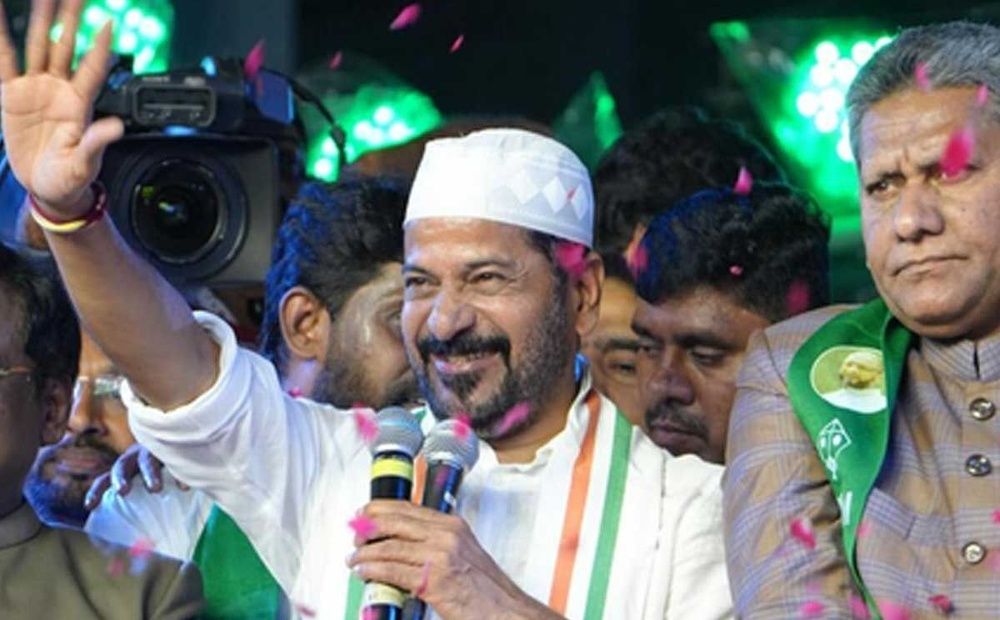
New Delhi, 8th November: The political temperature in Telangana soared when Chief Minister Revanth Reddy declared during his Jubilee Hills bypoll campaign, “Congress means Muslims, and Muslims mean Congress.”
What seemed like an election-time slogan quickly snowballed into a national debate about secularism, identity politics, and the Congress party’s changing character in contemporary Bharat.
Reddy’s words did more than spark controversy—they exposed a truth long whispered in political circles: that the Congress’s survival strategy has often leaned heavily on religious vote-bank politics. Coming just days before the November 11 bypoll, the remark was a calculated attempt to consolidate Muslim votes in a closely contested seat.
Telangana BJP President N. Ramchander Rao wasted no time calling out the statement, saying it reflected Congress’s “communal desperation” and history of divisive politics and riots. For many observers, the comment was not an isolated misstep but a symptom of a larger ideological drift within the party.
The Double Standards of Secular Politics
Revanth Reddy’s statement also shines a light on the inconsistencies within Bharat’s political discourse. When a BJP leader invokes Hindu identity, the Congress and its allies are quick to denounce it as communalism. Yet, when a Congress Chief Minister openly identifies his party with a single religious group, silence prevails.
This selective outrage exposes how “secularism” in India has often been selectively applied—more a political tool than a moral principle. By branding Congress as synonymous with Muslims, Reddy inadvertently questioned the very inclusive nationalism that the party once claimed to champion.
In his defence, Reddy argued that Congress governments have historically empowered minorities by giving them “big posts and opportunities.” But critics say this approach promotes representation without reform—a form of governance driven by appeasement, not performance. It risks alienating other communities and undermining the broader idea of a unified Bharat built on equal opportunity for all.
A Pattern Across States: Congress and Minority Appeasement
The Telangana episode is not an outlier. Similar trends have emerged across other states, exposing the party’s deep dependence on minority vote banks.
In Kerala, CPI(M) Chief Minister Pinarayi Vijayan accused Congress of being subservient to the Indian Union Muslim League (IUML), alleging that the League effectively dictated candidate choices and strategy. In West Bengal, the Congress aligned with the Indian Secular Front (ISF)—a party led by cleric Pirzada Abbas Siddiqui—despite internal dissent from senior leaders.
Such alliances have fueled questions about the Congress’s ideological coherence. Once the torchbearer of secular nationalism, the party now seems increasingly willing to compromise on its principles for short-term electoral gains.
This drift is not new. Former Prime Minister Dr. Manmohan Singh’s statement that minorities, particularly Muslims, should have the “first claim on national resources” marked a significant departure from Congress’s earlier commitment to equal opportunity and merit-based development. Critics argue that this mindset entrenches entitlement rather than empowerment, fostering division instead of unity.
The Consequences: A Shrinking Congress and a Divided Democracy
The Congress’s over-reliance on identity politics has contributed to its shrinking national footprint. By appealing primarily to religious sentiments, it risks alienating India’s rising youth, middle class, and aspirational voters who prioritize development, governance, and opportunity over symbolism.
This vacuum has been swiftly filled by other political forces claiming the mantle of nationalism and inclusive growth. Ironically, Congress’s brand of selective secularism has helped strengthen the very majoritarian narratives it claims to oppose.
When politics is reduced to appeasement, both democracy and pluralism suffer. What once was a party of national unity now faces the perception of being a fragmented coalition of vote banks.
A Call for Recalibration: Can Congress Rediscover Its Core?
Revanth Reddy’s remark may have been tactical, but it exposes a deeper existential crisis within the Congress. For a party that once embodied India’s secular promise, defining itself through sectarian identity signals a loss of ideological direction.
If the Congress hopes to remain relevant, it must rebuild around inclusive governance, equitable growth, and national integration—principles that transcend communal divides. Bharat’s youth are looking for credible leadership, not communal posturing.
The choice before the Congress is stark: reform or retreat.
Bharat’s Democratic Crossroads
The Telangana controversy is more than a state-level political storm—it reflects the broader struggle for the soul of Bharatiya democracy. As the Congress continues to lean on identity-driven politics, it risks deepening societal fractures at a time when unity and pluralism are most vital.
The coming elections will test not just the party’s electoral prospects, but also whether Bharat’s democracy can rise above identity and return to the ideals of integrity, inclusion, and accountability that once defined it.
