
Bihar 2025: Tejashwi’s Bold Welfare Push vs Nitish’s Legacy
“Bihar Election 2025: Tejashwi Yadav’s Bold Mandate Challenges Nitish Kumar’s Women Welfare Legacy.”

Paromita Das
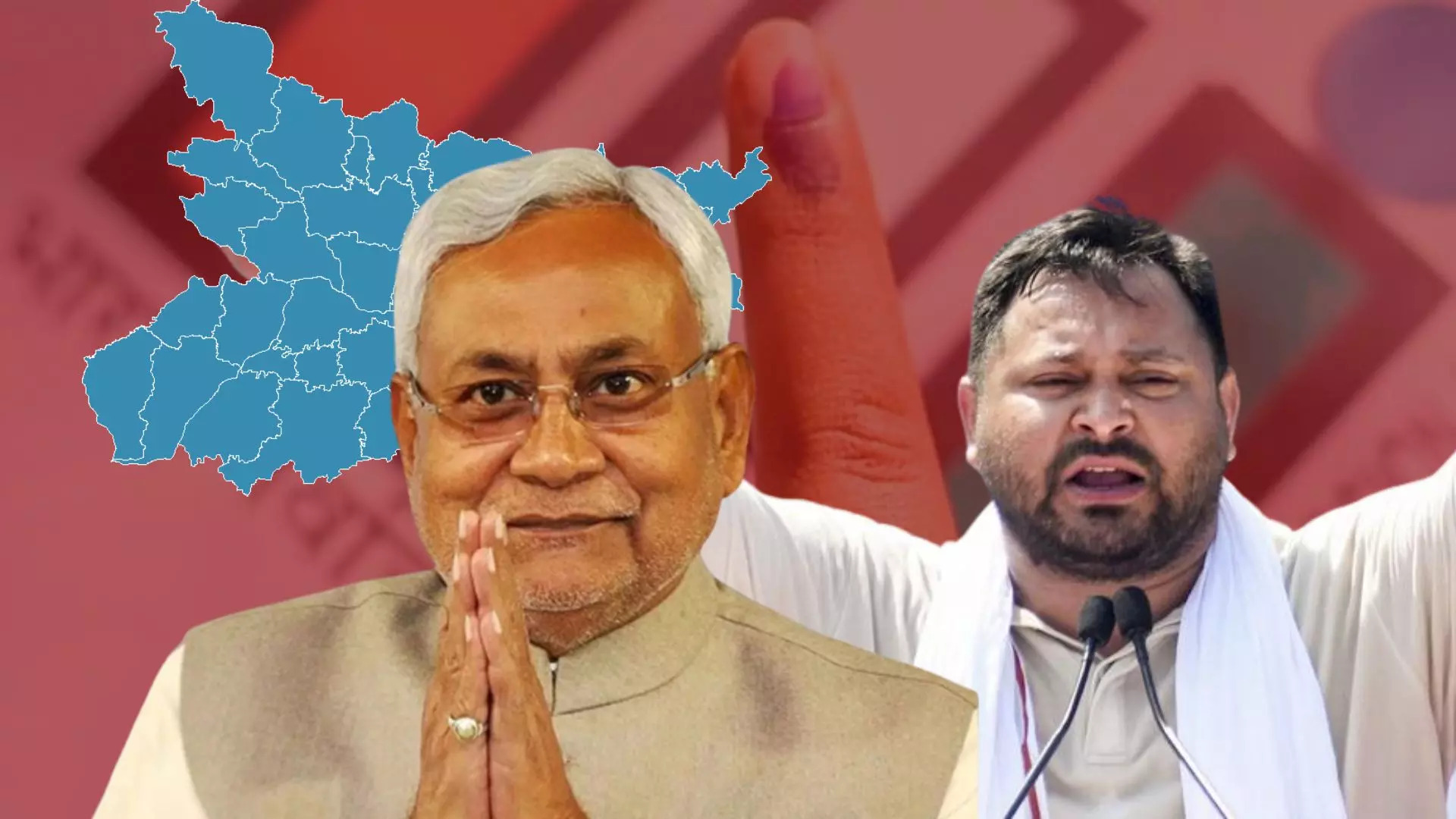
New Delhi, 4th November: As Bihar’s 2025 assembly elections approach, a fierce contest unfolds between the ruling coalition led by Nitish Kumar and the opposition Mahagathbandhan spearheaded by Rashtriya Janata Dal’s (RJD) Tejashwi Yadav. The political battlefield is charged with promises aimed at farmers, women, and government employees — fundamental blocs that define Bihar’s socio-economic fabric. Tejashwi’s recent announcement marks a political crescendo with an expansive, welfare-centric agenda poised to outpace existing government commitments, intensifying the debate over who truly champions the grassroots in Bihar.
Tejashwi’s Promise: A Transformational Welfare Push

Tejashwi Yadav, Mahagathbandhan’s chief ministerial face, unveiled a sweeping welfare agenda that seeks to directly empower Bihar’s backbone — its farmers, women, and government workers. Foremost among the proposals is the promise to provide farmers with a bonus of Rs 300 per quintal on paddy and Rs 400 per quintal on wheat above the existing Minimum Support Price (MSP). This ordeal to augment MSP comes against the backdrop of the Union Cabinet’s recent increase in MSP for Rabi crops for 2026-27, signaling an inflation-indexed, supply-side protection for farmers across Bharat.
Moreover, Tejashwi pledges free electricity for irrigation — a significant relief for Bihar’s agrarian community that faces both financial and infrastructural challenges. For women, his flagship scheme, Mai Bahin Maan Yojana, promises a one-time transfer of Rs 30,000 on Makar Sankranti, representing a full year’s support designed to alleviate economic distress amidst rising inflation. This commitment expands on the monthly Rs 2,500 envisioned under the scheme, condensing the benefit into a single impactful transaction symbolizing a new economic start.
Tejashwi also promises preferential treatment for government employees by restricting transfers within a 70-kilometre radius from their home cadre — a humanitarian nod to addressing repetitive grievances in public service postings that disrupt families and livelihoods.
Nitish Kumar’s Rs 10,000 Women’s Pledge

In contrast, the incumbent Nitish Kumar government undertook to credit Rs 10,000 directly into accounts of 25 lakh women earlier in 2025, under an entrepreneurship and self-employment initiative. This amount, though significant, is largely framed as seed capital to spur economic activity among women entrepreneurs rather than direct welfare aid.
Nitish’s policy promotes entrepreneurship, self-reliance, and employment generation, reflecting a developmental model seeking to reshape Bihar’s economy through skill and business rather than direct cash transfers. However, the quantum and timing of the transfer under the RJD’s plan arguably carry deeper immediate relief and emotional resonance, given the lump sum is timed to coincide with Makar Sankranti, a culturally significant festival symbolizing new beginnings.
The Larger Economic and Political Context

The increased MSPs for Rabi crops, including wheat at Rs 2585 per quintal and bonuses that cover margins exceeding production costs by 50-109%, project an encouraging scenario for Bharatiya farmers generally. Within this context, Tejashwi’s promise to add Rs 300-400 bonuses above MSP demonstrates an aggressive pro-agriculture stance tailored to Bihar’s pressing needs.
The RJD’s pledge to restore the Old Pension Scheme and localize government employee transfers reflects an attempt to rectify what many perceive as neglect towards public servants during Nitish’s tenure. These promises aim to consolidate a wide voter base spanning rural farmers, government employees, and women — demographics that form the electoral backbone of Bihar.
Welfare vs Empowerment Models

Tejashwi’s strategy centers on immediate welfare delivery — direct cash transfers, higher crop prices, and tangible subsidies like free irrigation electricity. This model aligns with political rhetoric emphasizing economic relief amidst inflation and agrarian distress. In contrast, Nitish Kumar’s approach leans towards empowerment via entrepreneurship support and phased assistance, aiming at long-term economic transformation but arguably offering less immediate cash relief.
The electoral success of either model depends on Bihar’s voters’ priorities — whether transient economic relief trumps structural developmental schemes or vice versa. Additionally, the sharp timing and volume of Tejashwi’s one-time ₹30,000 disbursement positions his campaign to capture the emotional and financial urgency felt by many women in the state.
Welfare Promises Alone Are Not Enough

While Tejashwi Yadav’s welfare package is undoubtedly bold and tailored to address Bihar’s immediate socio-economic pressures, such promises come with fiscal and administrative challenges. Delivering Rs 30,000 as a lump sum and sustaining free electricity for irrigation would require robust financial planning, transparency, and efficient governance — areas where previous Bihar governments have faced criticism.
Nitish Kumar’s model, focusing on entrepreneurship and targeted assistance, while less dramatic, attempts to balance welfare with sustainable development. Ultimately, Bihar’s voters may seek a hybrid outcome — immediate relief coupled with sustained empowerment. Both parties must therefore include strong implementation frameworks alongside promises to build trust beyond election cycles.
Bihar’s Electoral Choice — Relief Today or Reform Tomorrow?
As Bihar stands at the crossroads in 2025, Tejashwi Yadav’s expansive welfare agenda challenges the established developmental policies under Nitish Kumar. The contest highlights a classic democratic tension: should governance prioritize direct, immediate economic relief or foster gradual structural empowerment through entrepreneurship and skill development?
The upcoming election will test Bihar’s electorate preference — between Tejashwi’s promise of ₹30,000 for women, higher bonuses on crops, and free power against Nitish Kumar’s ₹10,000 welfare credit combined with entrepreneurship-driven welfare. Both agendas speak to Bihar’s urgent developmental needs but through divergent pathways. Ultimately, sustainable progress in Bihar demands harmonizing both relief and reform to build a resilient economy for its diverse population.
