
Between Gujarat and 1984: Rahul Gandhi’s Politics of Selective Morality
“In a recent high-stakes interview, Rahul Gandhi dodged key questions on Gujarat, 1984 riots and his own party’s role—revealing deeper leadership gaps.”


Dr. Kumar Rakesh
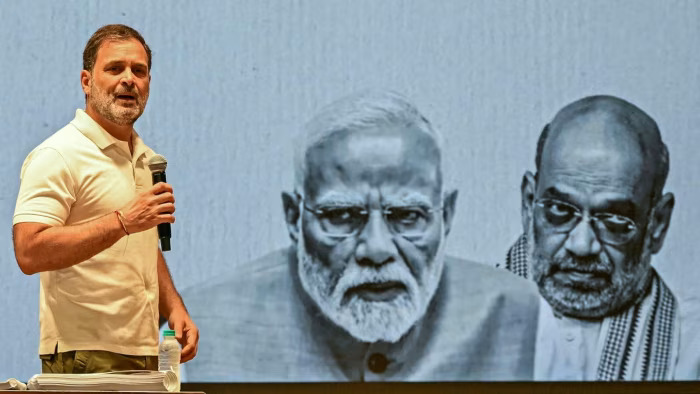
Rahul Gandhi’s political journey has always oscillated between moments of promise and stretches of puzzling indecision. Each time he steps into the national spotlight, expectations surge — that he will finally rise above the Congress’s past shadows and define a new era of leadership. Yet, time and again, what emerges is a portrait of a leader who critiques others eloquently but falters when the same lens of accountability is turned toward himself. His recent televised conversation, in which he revisited subjects like the Gujarat riots, the 1984 anti-Sikh carnage, and the Congress’s internal dynamics, captured this contradiction vividly. Beneath the rhetoric of moral superiority and democratic renewal lies a deeper discomfort with personal and institutional accountability.
The 1984 Shadow: A Test of Moral Courage

The 1984 riots remain the most enduring stain on the Congress’s moral fabric. For decades, victims have sought not just justice but a gesture of remorse from those who symbolically represent the Congress’s legacy. Rahul Gandhi’s acknowledgment that “some Congressmen were probably involved” appeared, at first glance, like a long-awaited admission. But it was a carefully measured half-truth — one that skirted personal accountability and denied emotional closure to victims.
Rather than confronting the party’s historical complicity, Gandhi distanced himself from it, suggesting that “a legal process” had already dealt with the matter. In doing so, he reduced one of independent Bharat’s darkest episodes to a bureaucratic footnote. Leadership, however, demands more than procedural acknowledgment — it calls for moral ownership. Gandhi’s refusal to apologise, personally or on behalf of his party, not only reflects a missed opportunity but also reveals a deeper flaw: the inability to reconcile empathy with responsibility.
The Gujarat Paradox: Selective Moral Outrage

Rahul Gandhi’s stance on the Gujarat riots illustrates his selective approach to moral accountability. While he is uncompromising in blaming the then-state administration for the 2002 violence, he remains hesitant to apply the same ethical standards to his own political inheritance. His assertion that “the government of Gujarat was involved” contradicts judicial verdicts that cleared Narendra Modi of direct culpability.
This insistence on a narrative that courts have dismissed underscores Gandhi’s political instinct to sustain moral contrast — positioning himself as the voice of compassion against a regime painted as complicit. Yet, by refusing to engage with inconvenient truths within his own party’s past, he weakens the very moral ground he seeks to occupy. The problem isn’t that Gandhi condemns Gujarat; it’s that he does so selectively, without the courage to look inward at the moral lapses of 1984.
A Crisis of Conviction: Words Without Weight

Across the interview, Gandhi projected an image of a leader still searching for coherence. His responses lacked ideological clarity — meandering between abstract idealism and rhetorical self-defence. When confronted with questions about governance, inflation, or internal party reform, his answers drifted toward generalities about “building structures” and “empowering the youth.”
These are familiar tropes in Gandhi’s lexicon — phrases that sound visionary but collapse under scrutiny. They echo his broader political problem: a reluctance to inhabit the hard space of governance and accountability. In a country hungry for clarity, such evasiveness can easily be mistaken for indifference. What Gandhi calls introspection often comes across as intellectual escapism, a retreat into ideas when the moment demands conviction.
Dynasty, Degrees, and Deflection

Rahul Gandhi insists he is “absolutely against dynasty,” even as his political identity remains inseparable from the Nehru-Gandhi legacy. This contradiction defines much of his public perception — the rebel prince who cannot abandon his palace. His academic qualifications, too, have been a source of controversy, often raised by his critics to question his credibility. Instead of addressing these challenges directly and decisively, Gandhi’s strategy has been to shrug them off, as though such details are beneath the dignity of a larger mission.
Yet in modern politics, where authenticity is the currency of credibility, silence becomes complicity. By refusing to clarify even basic personal details, Gandhi feeds the perception of arrogance — that accountability is for others, not for him. In a digital age where transparency defines leadership, that is an unsustainable position.
Leadership by Avoidance

What emerges from the broader picture is a leader caught between his aspiration to transform Bharatiya politics and his inability to confront uncomfortable truths. Gandhi often speaks about “doing the real work within the party machine,” but that work rarely translates into visible political results. His refusal to engage in direct public debates — particularly with Prime Minister Narendra Modi — reinforces the image of a leader more comfortable with conceptual discussions than with concrete political combat.
This is not a question of intellectual capacity but of political temperament. Gandhi sees politics as an arena for moral persuasion; his opponents see it as a contest of performance and accountability. In the clash between these two philosophies, Gandhi repeatedly ends up appearing hesitant, even evasive.
The Missing Ingredient — Accountability

Rahul Gandhi’s dilemma is not that he lacks ideas or sincerity. It is that his sincerity often lacks courage. He speaks of compassion, democracy, and truth, but avoids the moments where truth demands personal cost. His refusal to apologies for 1984, his selective moralism over Gujarat, and his deflections on issues of transparency reveal a leader still unwilling to bear the full weight of leadership.
Until Gandhi learns to match moral posturing with moral accountability, his vision for a “new politics” will remain trapped in the language of good intentions. Bharat’s electorate no longer rewards ambiguity. It demands clarity — even if uncomfortable.
The Mirror Rahul Gandhi Must Face
Rahul Gandhi often says that Bharat needs to rediscover truth and empathy in its politics. He is right. But truth begins with self-reflection, not projection. If Gandhi wishes to be the moral alternative to what he calls the “politics of hate,” he must first embody the accountability he seeks in others.
Until he learns to say, “Yes, we failed,” instead of “Some people probably did wrong,” his message will continue to sound hollow. Leadership is not about who points fingers louder — it is about who dares to turn the mirror inward. Rahul Gandhi’s political redemption, if it ever comes, will begin not with another slogan but with a simple, unqualified apology.
About Author -:
Dr. Kumar Rakesh, Sr Journalist, Writer, Political Analyst, Broadcaster has been active in journalism and writing for approximately 35 years. He has worked in several esteemed media organizations in Bharat and has been instrumental in creating 9 TV news channels in the country. Through his career, he has had the opportunity to travel to over 50 countries, reporting and writing on various topics. Dr. Rakesh has received numerous accolades and honors both in Bharat and internationally for his contributions to the field of Media & Communications. Currently, he has been serving as the Editorial Chairman of Global Governance News Group & Samagra Bharat Media Group, New Delhi & 20 countries. contact – at krakesh8@gmail.com
