
Why Netaji’s Death Still Haunts Bharat: VP’s Revelations Explored
“Netaji Subhas Chandra Bose Death Mystery: Vice President’s Shocking Claim Rekindles Nation’s Greatest Enigma.”

Paromita Das
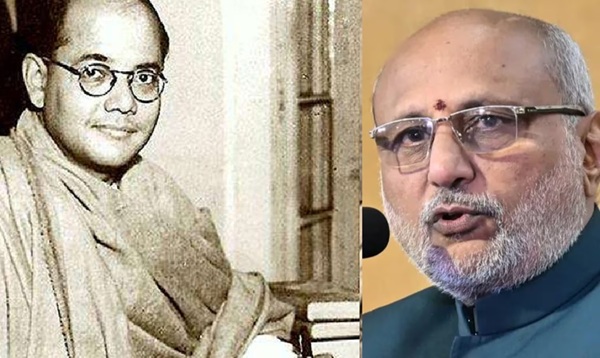
New Delhi, 1st November: When a nation’s iconic freedom fighter disappears into the mists of history, leaving official accounts shrouded in secrecy and doubt, the line between fact and legend blurs into a captivating mystery. The alleged death of Netaji Subhas Chandra Bose in a plane crash on August 18, 1945, stands as Bharat’s most enduring and unsettling historical riddle. Official versions tell of his fatal injuries and cremation in Taipei, yet whispers of secret survival, clandestine meetings, and hidden lives have persisted for eighty years. This mystery has now surged back into public discourse with Vice President C.P. Radhakrishnan’s recent assertion that Bose did not perish in the crash—a belief rooted in the testimony of Tamil nationalist leader Pasumpon Muthuramalinga Thevar, who claimed to have met Bose long after 1945. The Vice President’s words cast fresh light on a narrative long dominated by official silence and conspiracy, challenging Bharat to revisit the truth behind its greatest patriot’s fate.
Radhakrishnan’s Reverence and Thevar’s Testimony

Addressing the Pasumpon Muthuramalinga Thevar Guru Puja, Vice President Radhakrishnan expressed personal conviction, though without direct evidence, that Bose survived the crash. His faith in Thevar’s word emanates from Thevar’s lifelong reputation for truthfulness and spiritual dedication. Thevar, a trusted lieutenant and close associate of Bose in the Forward Bloc, had fiercely maintained that Bose remained alive and would one day return—claims he made publicly, electrifying his followers in Tamil Nadu. This region’s profound attachment to Bose is inseparable from Thevar’s persistent message, which intertwined political loyalty with deep spirituality.
#WATCH | Ramanathapuram, Tamil Nadu | Vice President CP Radhakrishnan says, "Pasumpon Muthuramalinga Thevar was the most trusted lieutenant of Netaji Subhash Chandra Bose. I even today believe, though I do not have any evidence with me, that Netaji Subhash Chandra Bose did not… pic.twitter.com/m1ClvRV3iw
— ANI (@ANI) October 30, 2025
Prominent researchers such as Anuj Dhar support this narrative, referencing testimonies including Thevar’s secret meeting with Bose around 1950 and congruent clues from enigmatic figures like the so-called Gumnami Baba who lived in secrecy. These accounts challenge the official story and align with minority reports and commissions that have questioned the plane crash verdict.
The State of Historical Inquiry: Contradictions and Unanswered Questions

Bharat has commissioned three official inquiries into Bose’s death: two early investigations affirmed the plane crash theory, while the Mukherjee Commission later disputed it, citing witness inconsistencies and lack of conclusive physical proof. The conflicting conclusions reflect the difficulty of unraveling a carefully veiled truth.
Further complicating matters, declassified intelligence files from the 1940s—both Bharatiya and international—indicate surveillance and mystery surrounding Bose’s activities after the supposed death date. A crucial French intelligence report from 1947, unearthed by historian J.B.P. More, explicitly states Bose’s whereabouts remained unknown, contradicting the rapid declarations of his demise by British and Japanese authorities. It refers to Bose as having “escaped from Indochina,” a claim reinforcing the possibility of survival beyond official timelines.
Cultural Resonance and Political Sensitivities

Beyond forensic investigations, Bose’s death mystery resonates deeply within Bharat’s cultural and political spheres. For many in Tamil Nadu and beyond, Bose symbolizes resistance, sacrifice, and unfulfilled promise. Thevar’s life mission to keep Bose’s spirit alive underscores the emotional undercurrents of this mystery. It is an expression not just of historical curiosity but of collective identity and spiritual faith.
Yet, successive Bharatiya governments have shown reluctance to definitively solve or reopen the investigation, perhaps wary of reopening political fault lines or tampering with established national narratives. The reticence has only fueled various conspiracy theories ranging from secret survival to government cover-ups.
Embracing Complexity Over Convenient Closure

The enduring enigma of Netaji’s death teaches a vital lesson about the complexity of history and memory, especially relating to national icons. Simplified or sanitized accounts rarely capture the nuances and contradictions that define real human events. Vice President Radhakrishnan’s invocation of Thevar’s testimony and the corroborating archival evidence invite Bharat to embrace uncertainty rather than force easy conclusions.
History is not merely a record of facts but a field shaped by belief, politics, and identity. The story of Bose’s mysterious fate reminds us that some legends survive because they embody something larger than themselves—hope, courage, and the unyielding desire for freedom.
An Unfinished Chapter in Bharat’s Freedom Struggle
Netaji Subhas Chandra Bose’s disappearance remains a potent symbol of Bharat’s unresolved past. The Vice President’s recent remarks revive crucial questions about the truth and compel renewed inquiry into one of the nation’s greatest mysteries. Whether Bose died in that Taihoku plane crash or lived a secret life thereafter, his legacy transcends his physical fate—he continues to inspire, provoke, and haunt the collective consciousness.
As Bharat charts its future, confronting this unfinished chapter with intellectual honesty and openness could enrich its democratic discourse and national memory. For now, the story of Netaji’s death is less about closure and more about the enduring spirit of a patriot who continues to live in the hearts and minds of millions.
