
Einstein Kept Gandhi’s Portrait in His Study as a Symbol of Moral Courage

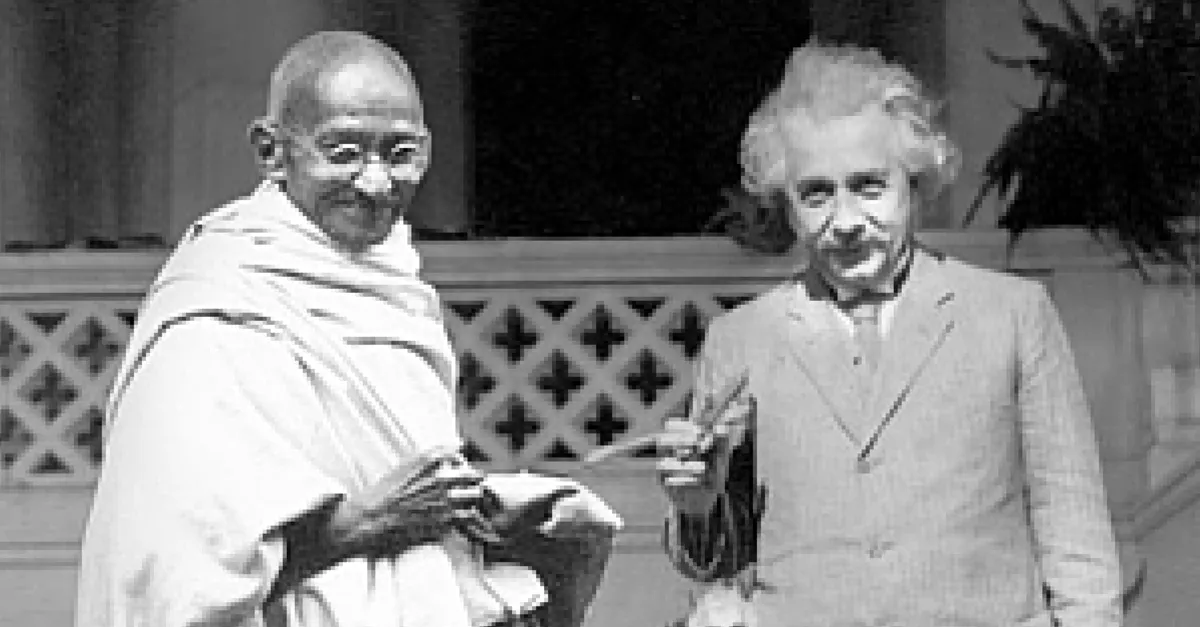
Princeton, New Jersey: Few know that Albert Einstein, one of the greatest scientific minds in history, kept a portrait of Mahatma Gandhi in his study at 112 Mercer Street, Princeton, alongside those of physicists Michael Faraday and James Clerk Maxwell. Gandhi’s photograph stood as a testament to Einstein’s deep reverence for the Indian leader’s philosophy of non-violence and moral courage.
In his early years, Einstein’s study walls were adorned with portraits of scientists such as Isaac Newton and James Clerk Maxwell. However, after witnessing the violence and destruction across the world, he decided to replace them with portraits of Gandhi and Albert Schweitzer. Explaining this shift, Einstein remarked, “The time has come to replace the picture of success with the picture of service.”
Einstein regarded Gandhi as “the greatest political genius of our time,” believing that Gandhi represented “a higher conception of human relationships in the political field during an age of moral decay.” He was deeply moved by Gandhi’s ability to bring about social and political transformation through non-violent resistance, particularly after the Salt March of 1930.
On September 27, 1931, Einstein wrote a heartfelt letter to Gandhi: “You have shown through your works that it is possible to succeed without resorting to violence.”
Gandhi replied from London on October 18, 1931, expressing his wish to meet Einstein, ideally at his ashram — though the meeting never took place.
Einstein’s decision to display Gandhi’s photograph in his study carried profound symbolism. On Gandhi’s 70th birthday in 1939, Einstein famously said,
“Generations to come will scarce believe that such a one as this ever in flesh and blood walked upon this earth.”
Although the two never met in person, their correspondence reflected mutual admiration and a shared belief in the power of truth and peace. For Einstein, Gandhi’s portrait remained a daily reminder that moral strength and non-violent resistance can transform the world — just as his own scientific discoveries transformed humanity’s understanding of the universe.
