
Home Ministry Directs Border States to Demolish Illegal Religious Buildings
Within 30 km of India's Borders

Poonam Sharma
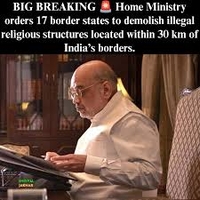
In a major initiative to ensure national security and protect the demographic contours of border areas, the Union Home Ministry has directed 17 border states to identify and dismantle all illegal religious structures in a 30-kilometer radius of India’s international borders. The move, labeled as a “preventive security measure”, comes against the backdrop of growing apprehensions about demographic manipulation, illegal infiltration, radicalisation, and foreign-funded religious expansion in sensitive border areas.
The directive was this week sent to Chief Secretaries and Directors General of Police (DGPs) of all those states bordering Pakistan, China, Nepal, Bhutan, Bangladesh and Myanmar, said sources in the Ministry. These include Punjab, Jammu & Kashmir, Himachal Pradesh, Uttarakhand, Uttar Pradesh, Bihar, Sikkim, West Bengal, Assam, Arunachal Pradesh, Nagaland, Manipur, Mizoram, Tripura, Meghalaya, Gujarat and Rajasthan.
Why the Directive?
The Home Ministry has referred to various inputs of intelligence that reveal instant, uncontrolled development of mosques, mazars, churches and other places of worship in some sensitive border areas, more so in eastern and northern states.
Authorities claim that most of these buildings have been constructed without land documents, permissions or local administrative sanction, usually on government or forest land. Intelligence reports claim that the illegal buildings are being utilised as fronts for infiltration corridors, activities of radicalisation, and housing for illegal immigrants from the other side of the border.
A high-ranking security official claimed,
Over the last ten years, there has been an apparent trend of illegal and unplanned religious buildings proliferating along strategic border belts. These buildings are not only a violation of land and administrative rules but have obvious security consequences.”
The 30 km Security Belt
According to the new directive, all state governments have been directed to conduct a detailed mapping and survey of all religious establishments within 30 km of the international border. These include establishments constructed on:
Government or panchayat land
Forest lands
Road sides or highways
Riverine belts and fencing border zones
Once detected, district governments must ensure the legality of such constructions and make a time-frame plan of removal in consultation with local police and paramilitary forces.
The Centre has also asked states to keep fresh construction work under close observation and stop any illegal addition. New constructions will need strict clearances from state administration and central security agencies.
Pattern of Illegal Constructions
The problem of unauthorized religious buildings has been prominently seen in border states of Bangladesh and Nepal, where population shifts have increased over the past few years. In Assam and West Bengal, a number of mosques and madrassas were said to have been constructed on occupied land. In Uttar Pradesh’s Terai region, unauthorized madrasas and shrines have appeared in vulnerable localities over the last two decades.
Security outfits have also raised alarm at the utilization of religious fronts for funding by foreign sources, usually channeled through NGOs or private trusts having connections with organizations overseas. This has put alarm bells in the border intelligence bodies and the National Investigation Agency (NIA).
Illegal constructions along the fencing in Punjab and Jammu border regions have also been associated with routes of smuggling, such as drugs and weapons.
State Governments Under Pressure
The Home Ministry letter has brought the state governments under strict scrutiny. The states have been asked to provide fortnightly action-taken reports. The Ministry also established a high-level monitoring cell to monitor progress and respond to law-and-order issues during demolition drives.
A senior official said,
“States can no longer turn a blind eye to this. If they don’t step in, the Centre will act by means of security and intelligence coordination. Management of borders isn’t merely about fencing — it’s also about protecting the socio-cultural fabric.”
A number of states consider Assam, Gujarat and Punjab among them, have already carried out initial surveys. Assam Chief Minister Himanta Biswa Sarma has welcomed the move in public, terming it “a long overdue step to secure national borders from demographic threats.”
Balancing Law and Sensitivity
Even as the government has stressed zero tolerance to illegal constructions, it has also ordered administrations to approach sensitive demolitions cautiously so as not to escalate communal tensions. Legal religious establishments with proper papers and long-term history will not be touched.
Officials explained that the exercise is not against any particular community but is aimed at removing encroachments and closing security gaps that can be used by anti-national forces.
This has to do with the rule of law and security of the country, and not with religion,” said a Home Ministry spokesperson.
Strategic Importance
The 30 km buffer around India’s international borders is not only a geographical line — it’s a demographic and strategic buffer. Infiltration networks, smuggling rings, and ideological expansion tend to start targeting these areas first to establish local footholds.
By eliminating illegal encroachments, the government wants to:
Prevent religious space misuse for anti-national activities
Block infiltration networks and illegal settlements
Maintain demographic balance in sensitive border belts
Strengthen legal and administrative control of border states
Improve intelligence monitoring and physical security
A National Security Priority
This order is one of a series of measures within a national security strategy being rolled out under the Ministry’s Border Area Development and Security Strategy. It is one of several steps, including enhanced fencing, additional deployment of BSF troops, sophisticated surveillance systems, and tight vetting of foreign funds to religious and cultural institutions.
The eviction campaign is likely to attract close scrutiny nationally and internationally due to its delicacy. Nevertheless, security experts opined it is imperative to avoid borderland destabilization.
“Borders are not merely defended by troops and machine guns — they are defended by demographic power, legal domination, and cultural solidity. Illegal religious expansion along borders undermines all three. The government’s action sends a message that such loopholes will not be allowed anymore.”
