
Dattopant Thengadi :The Visionary Who Branded the Age of Swadeshi

Poonam Sharma
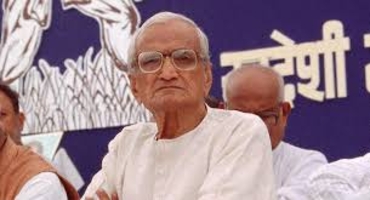
There are certain names in the grand narrative of contemporary India that don’t just appear in history— they make it. One such name is Shri Dattopant Bapurao Thengadi, a person whose existence wasn’t marked by roles of authority but by the power of his thoughts. A firm nationalist, a dedicated social worker, a profound thinker, and a calculated institution builder—Thengadi was the man who provided India with a fresh voice of self-reliance when the nation was finding it difficult to decide upon its economic direction.
Thengadi founded three of India’s most important nationalist movements—the Bharatiya Mazdoor Sangh (BMS), the Bharatiya Kisan Sangh (BKS) and the Swadeshi Jagran Manch (SJM)—all of which are influential forces in Indian civil society even after several decades since their founding. Through these institutions, he created a parallel universe of workers, farmers, and economic intellectuals devoted not to foreign models of growth but to India’s own cultural and civilizational ideals.
A Life of Discipline and Vision
Born on November 10, 1920, in the Vidarbha province of Maharashtra, Thengadi was an academic scholarship holder who opted for service to the nation rather than personal ambition. Early in life, he was attracted to the Rashtriya Swayamsevak Sangh (RSS), where he received both intellectual stimulation and a disciplined approach to nation-building.
Contrary to most of his contemporaries who looked for political roles, Thengadi was a believer in institution-building. He felt that if India had to stand firm, there had to be indigenous models of labour organization, agricultural development, and economic policy. It was based on the conviction that strength does not come from copying but from self-definition.
The Birth of a National Workers’ Movement
During the 1950s and 60s, India’s trade union movement was characterized by ideologies that were brought in from outside—Marxism, socialism, and other left trends. Political parties extended to the labor unions, and workers were held hostage to power politics and not empowerment.
It was in this atmosphere that Dattopant Thengadi started the Bharatiya Mazdoor Sangh in 1955. He wanted a non-political labor movement, deeply embedded in Indian philosophy of cooperation, harmony, and dignity of labor.
Unlike militant unions that thrived on strikes and confrontation, BMS promoted dialogue, responsibility, and national interest. It grew rapidly and today stands as India’s largest trade union, a testament to the power of Thengadi’s vision.
Giving Voice to the Farmers
Thengadi realized that the soul of India lay in its villages. In 1979, he established the Bharatiya Kisan Sangh to organize and mobilize farmers not as a vote bank but as custodians of the food security of India and its traditional wisdom.
The BKS was not just an agitational vehicle. It was a movement of consciousness, focusing on sustainable farming, respect for nature, and rural pride. According to Thengadi, the farmers need not be mere recipients of subsidies but also decision makers in agricultural policy.
By way of BKS, he provided an platform to crores of farmers which was free of party politics and loyal to Bharatiya values of collective prosperity.
The Swadeshi Call: Economic Nationalism with a Soul
Perhaps the most powerful articulation of Thengadi’s vision came in 1991, when the Indian economy opened up to liberalization. While many celebrated uncritically, Thengadi raised a voice of caution. He sounded the conch shell of Swadeshi through the Swadeshi Jagran Manch, a platform that urged India to modernize without compromising its economic sovereignty.
Swadeshi, to Thengadi, was not isolationism. It was a defiant declaration of self-reliance, an appeal to build world competitiveness without compromising national interests. He cautioned that unthinking imitations of Western models would drain India’s economic and cultural independence.
His sentiments ring forcefully today as the world grapples with the cost of overreliance on international supply chains and India leads the push for ‘Atmanirbhar Bharat’ (Self-Reliant India)—a notion Thengadi had advocated decades ago.
A Thinker Ahead of His Time
Thengadi was commonly referred to as a “silent strategist”. He was not an over-reactive orator but a long-sighted architect. He was of the opinion that long-term transformation involves discipline, clear thinking, and robust institutions.
He operated in the background to foster leadership instead of controlling it. People who knew him remember his mastery over history, economics, and philosophy, his unshakeable belief in nationalist thinking, and humility.
His work exhibits an unusual combination of economic pragmatism and cultural moorings. He was inspired by India’s civilizational ethos, Gandhian philosophy, and integral humanism—a political philosophy spread by Deendayal Upadhyaya.
Legacy That Inspires Even Today
Dattopant Thengadi died on October 14, 2004, but his legacy inspires India’s socio-economic thinking even today. Organizations he established have become mass movements with a presence in each and every nook and corner of the country.
At present, when India talks about “Vocal for Local” and “Atmanirbhar Bharat”, it is following the path Thengadi had laid a long time ago. His vision presents a paradigm of development that fuses modernity with heritage, globalization with self-reliance, and growth with cultural dignity.
A Beacon of Self-Reliance
In an era dominated by global capital and external influences, Thengadi’s message is more relevant than ever: “India must grow on its own terms.” His life reminds us that national strength is built not by copying others but by believing in oneself.
Dattopant Thengadi was more than a trade unionist, more than an economist, more than an organizer. He was a visionary who gave India the intellectual and institutional tools to remain sovereign in a globalized world.
As the Swadeshi Jagran Manch and allied movements continue to influence national policy, Thengadi’s quiet revolution stands as a towering example of how one man’s conviction can shape the destiny of a nation.
