
A New Era Begins: Navi Mumbai Airport Lands in Style
“Mumbai’s Lotus-Inspired NMIA Sets New Standards in Connectivity, Design, and Sustainability.”

Paromita Das
New Delhi, 11th October: The dawn of a new aviation era unfolds over Mumbai, where the lotus-shaped Navi Mumbai International Airport (NMIA) opened its doors—ushered in by Prime Minister Narendra Modi on October 8—as a game-changer in Bharat’s infrastructure narrative. Unlike any airport seen before, NMIA is neither a mere extension nor a clone of its predecessors. It pulses with innovation, artistry, and self-reliance, reflecting the bold, futuristic spirit now guiding Bharatiya development. As air connectivity becomes the linchpin of urban growth and global trade, the NMIA stands poised to turn Mumbai into a dual-airport giant and redefine the passenger experience.
A Global Gateway Unveiled

Mumbai’s struggle with air congestion has stretched the limits of its sole international portal, Chhatrapati Shivaji Maharaj International Airport (CSMIA), which handles over 50 million passengers each year—far beyond its intended capacity. NMIA is the long-awaited solution: a vast, state-of-the-art greenfield airport in Ulwe, covering 1,160 hectares and designed to process 20 million passengers annually in Phase 1, with a scale-up plan to accommodate a staggering 90 million after expansion. Backed by Navi Mumbai International Airport Private Limited—a partnership between Adani Airports Holdings (74%) and CIDCO (26%)—the project is among Bharat’s largest public-private endeavors, with ₹20,000 crore invested in the first phase and ₹30,000 crore slated for future growth.
Architectural Marvel Inspired by the Lotus

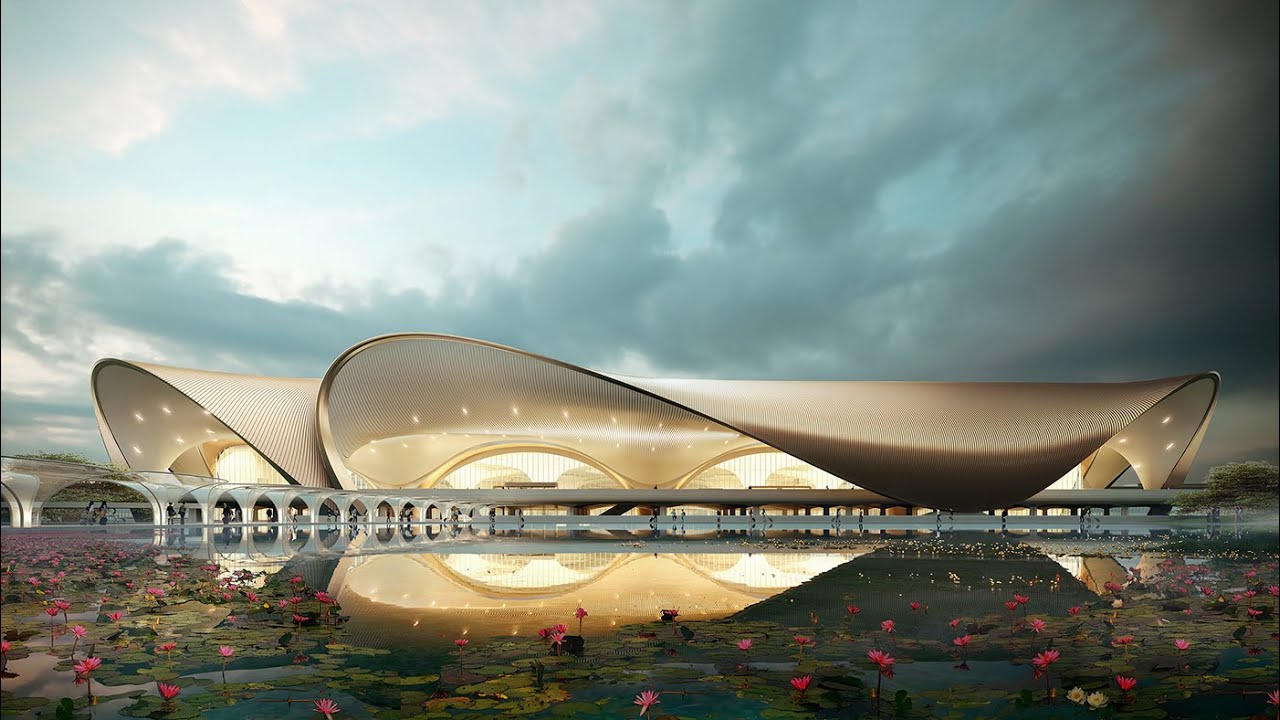
Envisioned by Zaha Hadid Architects, the NMIA terminal is more than a transit hub—it is a tribute to national pride and regenerative ambition. The terminal’s lotus inspiration runs deep: twelve sculpted columns echo petal forms, while seventeen mega-columns anchor canopies that spread like leaves across a vast, 2,34,000-square-meter floor area. This union of aesthetics and function shapes an airport where sustainable elements and Bharatiya artistry coexist. Efficiency is at its heart, boasting a fully digital setup that replaces paper and queues with 5G-powered IoT, real-time baggage tracking, and seamless Digi Yatra integration for contactless passage. The inaugural runway, measuring 3,700 meters and built to Code F specifications, can welcome even the giant Airbus A380, with plans for four terminals and a second parallel runway.
Multimodal Connectivity: Bharat’s First

The NMIA’s connectivity blueprint breaks new ground in Bharatiya transport planning. Fast routes—the Trans Harbour Link, Sion-Panvel Highway, and Ulwe Coastal Road—deliver quick access from all corners of Mumbai’s sprawling metropolitan region. Metro Line 1 links Belapur to Pendhar, with Metro Line 8 soon set to join CSMIA and NMIA. Water taxi and high-speed rail services will further extend the reach, forging Bharat’s first true multimodal airport. Proximity to commercial heavyweights like JNPT and the MIDC Taloja industrial belt turns the airport into a logistical powerhouse, synchronizing the movement of goods with the flow of business.
Passenger Experience: Comfort, Culture, and Convenience

NMIA’s terminal is engineered for the modern traveler, blending speed, comfort, and cultural immersion. With 66 check-in counters, 22 self-baggage drop points, and 29 aerobridges, passengers breeze through formalities. Business lounges for VIPs and a transit hotel underscore NMIA’s status as an international player. Families enjoy interactive exhibits and dedicated play areas, while retail and dining goes digital—meals ordered via app and delivered anywhere in the building. The commercial space includes 1,800 square meters of duty-free shopping—offering a retail experience rivaling the world’s top airports. Even baggage gets an upgrade, with home delivery and repair services built into the passenger journey.
Sustainability and Green Innovation

What truly distinguishes NMIA, however, is its green commitment. Targeting 47 MW of solar power, it leads a quiet revolution in energy sourcing. Water harvesting, recycling, and energy-efficient fixtures reduce its environmental footprint, while passive cooling harnesses architectural ingenuity for lower energy bills. Electric vehicles dominate the tarmac, and the building’s rockfill construction techniques stabilize ground and limit erosion. An Automated People Mover will circle all future terminals, and the Category II Instrument Landing System ensures safe touch-downs in low-visibility conditions—including fog and heavy monsoon. With these features, NMIA signals a shift from concrete monstrosities to ecological masterpieces.
Cargo and Economic Impact

The airport’s cargo terminal thrives as a backbone for Bharat’s logistics ambitions. Beginning with the capacity for half a million metric tonnes—set to scale to 3.2 million—NMIA’s automated warehouses and dedicated freighter stands supercharge 24/7 operations. Meeting strict IATA CEIV standards, the airport can handle sensitive goods like pharmaceuticals and perishables, linking with JNPT to form a South Asian export-import hub. Its presence, at the overlap of industry and shipping, will multiply economic opportunities and cement Mumbai’s place in regional supply chains.
Airline Strategy and Operational Rollout

When NMIA commences flights in December 2025, operations will begin with one runway and terminal, scaling up both passenger count and carrier diversity. Initially, 42 aircraft stands and 10 hourly movements will set the pace, before increasing to 40 within months. Early partners include IndiGo, Akasa Air, and Air India Express, with the latter launching routes to connect fifteen Bharatiya cities. By mid-2026, a broader network of 55 daily flights and expanded international reach will put NMIA on the global aviation map.
Redefining Bharat’s Aviation Future

The NMIA does not merely relieve Mumbai’s congestion—it sets the template for every future Bharatiya airport. Its fusion of high technology, sustainable design, and cultural symbolism marks a new mindset: Bharat no longer builds for necessity, but for excellence and global parity. As urban expansion outpaces the legacy infrastructure, the NMIA exemplifies the Atmanirbhar Bharat ideal—a self-reliant, innovative Bharat ready for leadership in the world stage. Every detail, down to the digital meal ordering and nature-inspired cooling, is a quiet assertion of something bigger: a promise that Bharat’s infrastructure can compete, inspire, and endure.
A New Age Takes Flight
The inauguration of Navi Mumbai International Airport signals much more than the opening of another runway—it is the beginning of a transformation. As a landmark for design, sustainability, and connectivity, NMIA will serve as both catalyst and symbol for Bharat’s rise in global aviation. In a city where space and speed are in perpetual demand, this airport doesn’t just accommodate travelers; it invites them to witness Bharat’s aspirational leap. For every passenger departing from or arriving in Navi Mumbai, NMIA will be a reminder: the future of Bharatiya infrastructure is bold, brilliant, and boundless.
