
John Clarke, Michel Devoret, John Martinis wins 2025 Nobel Prize in Physics

By Anjali Sharma
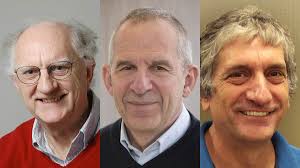
WASHINGTON – The Royal Swedish Academy of Sciences on Tuesday announced that John Clarke, Michel H. Devoret, and John M. Martinis will share 2025 Nobel Prize in Physics Nobel.
The scientists from the United States have won the prize for their experiments that made quantum physics visible on a chip.
The academy noted that their work has opened new possibilities for the future of ever-growing quantum technology. This ranges from quantum computers to ultra-secure communication systems and advanced sensors.
Clarke is from the University of California, Berkeley; Devoret is associated with Yale University and the University of California, Santa Barbara; and Martinis also works at the University of California, Santa Barbara.
They will share the prize money of 11 million Swedish kronor (approx. 1.04 crore INR).
According to the Nobel Committee, three were recognised “for the discovery of macroscopic quantum mechanical tunnelling and energy quantisation in an electric circuit.”
Their experiments proved that the strange and delicate world of quantum mechanics could also be seen in systems large enough to handle, not just in the tiny world of atoms and particles.
Quantum mechanics describes how particles behave at the smallest possible scale. One of its most famous phenomena is ‘tunnelling’.
There particles can pass through barriers that they normally shouldn’t be able to cross. This idea has long fascinated scientists. But until now, it had rarely been demonstrated clearly in larger, visible systems.
The Nobel-winning team designed an electrical circuit that could be held in one’s hand, yet it behaved like a quantum system. Their experiment showed two key things: that particles could tunnel through barriers inside the circuit and that the system had discrete or “quantised” energy levels.
Olle Eriksson, Chair of the Nobel Committee for Physics said “This discovery brings quantum mechanics from the microscopic to the macroscopic world,”
“It is wonderful to see how this century-old theory continues to surprise us. Quantum mechanics is not just mysterious. It is the foundation of all modern digital technology.”
The academy noted that much of today’s digital world already relies on quantum effects.
The tiny transistors inside computer chips work because of quantum principles.
The laureates’ work pushes that boundary even further toward a new era of quantum computing. The data could be processed a lot faster and more securely than ever before.
John J. Hopfield and Geoffrey E. Hinton, pioneers of artificial intelligence, for their research on machine learning and neural networks were the winner of 2024.
