
Ladakh on Fire: How a Historic Victory Spiralled into Violence
“From folded hands of gratitude in 2019 to streets engulfed in flames in 2024, Ladakh’s political journey has taken a turbulent path.”

Paromita Das
New Delhi, 27th September: In August 2019, the air in Ladakh was filled with celebration. The region had finally achieved what its people had sought for over seven decades: Union Territory status. Sonam Wangchuk, an activist and educator revered in the region, expressed his gratitude to Prime Minister Narendra Modi with folded hands, calling it a fulfillment of Ladakh’s “long-standing dream.” The announcement was seen as the culmination of countless petitions, protests, and sacrifices made by generations of Ladakhis who had long wished to be freed from the shadow of Jammu and Kashmir. Songs and dances marked that historic moment, and the promise of a brighter, more autonomous future seemed within reach.
THANK YOU PRIME MINISTER
Ladakh thanks @narendramodi @PMOIndia
for fulfilling Ladakh's longstanding dream.
It was exactly 30 years ago in August 1989 that Ladakhi leaders launched a movement for UT status. Thank you all who helped in this democratic decentralization! 🙏🙏🙏 pic.twitter.com/X7pmJ5zZin— Sonam Wangchuk (@Wangchuk66) August 5, 2019
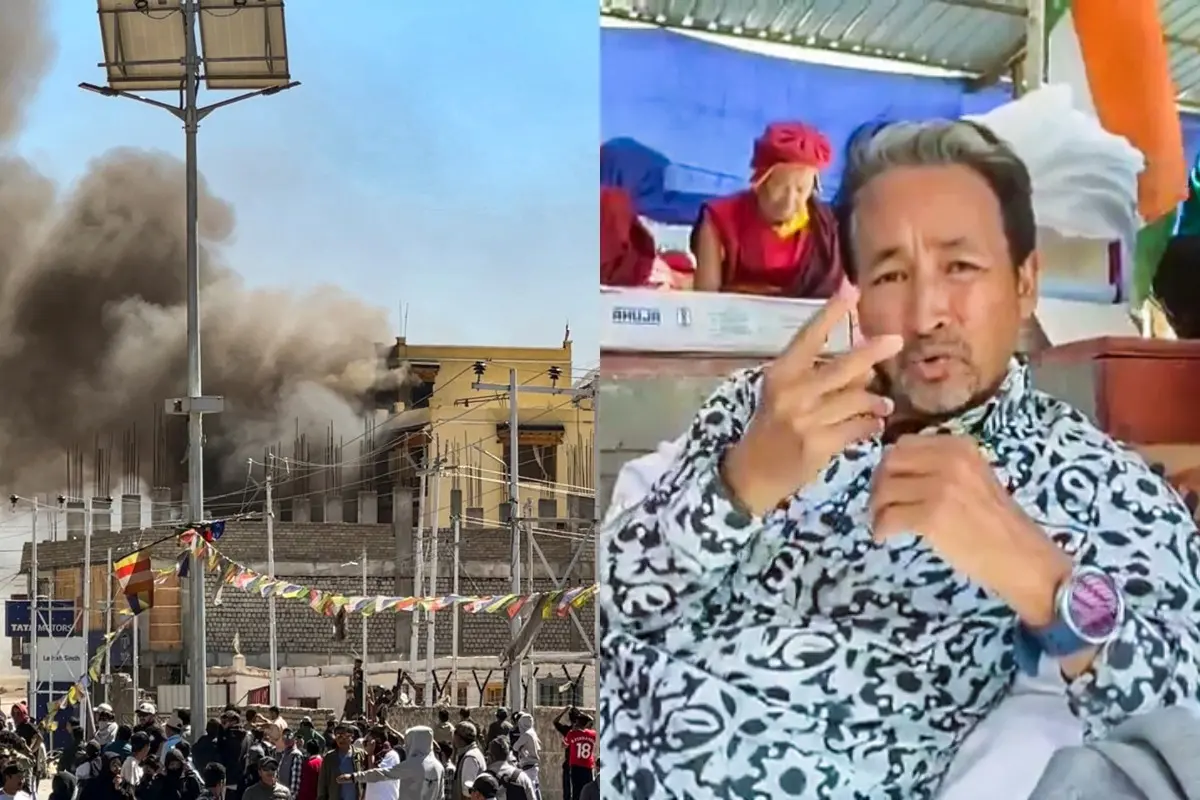
Fast forward five years, however, and Ladakh tells a very different story. The same Wangchuk who once thanked the central government is now being accused of inciting unrest. What was once a symbol of peace and progress has been engulfed by stone-pelting, arson, and deadly violence, leaving four people dead and many others injured. Streets that had once echoed with celebrations are now scarred by flames and anger. The question that lingers is not just how Ladakh arrived at this point, but whether this chaos was inevitable or deliberately orchestrated.
#Ladakh to become Union territory without legislature; people celebrate in Leh Main Bazaar pic.twitter.com/dTWxYtHcDB
— DD News (@DDNewslive) August 6, 2019
The Long Road to Union Territory Status

To understand Ladakh’s turmoil, one must first appreciate the depth of its historical struggle. Calls for autonomy were not sudden or opportunistic but rooted in decades of aspiration. As early as 1949, Ladakhi leaders appealed to Prime Minister Jawaharlal Nehru for self-governance, citing the region’s unique culture, geography, and challenges. Through the 1960s, leaders such as Kushok Bakula Rinpoche spearheaded peaceful movements to carve out a distinct political identity for Ladakh.
This demand reached its peak in 1989, when widespread protests led by the Ladakh Buddhist Association pushed the central government to respond. While Union Territory status was not granted at that time, the creation of the Ladakh Autonomous Hill Development Council in 1995 was seen as a partial victory. Yet the dream remained incomplete. Even in 2016, the All Religious Joint Action Committee reaffirmed this aspiration, reminding Delhi that the demand was alive and persistent.
The Modi government’s 2019 decision to abrogate Article 370 and bifurcate Jammu and Kashmir into two Union Territories was thus greeted with enthusiasm. For Ladakh, it was more than a political move; it was a recognition of their decades-long plea.
The Changing Role of Sonam Wangchuk

Wangchuk’s role in this journey is complex. In 2019, his heartfelt gratitude embodied the collective joy of Ladakhis who saw in him a credible voice of reason and hope. But as years passed, optimism gave way to suspicion. Concerns began to emerge that Union Territory status without legislative powers left the region vulnerable. Fears spread that Ladakh’s fragile ecosystem and tribal identity could be compromised by unchecked corporate entry and migration from outside.
In early 2023, Wangchuk began his symbolic outdoor protests, braving sub-zero temperatures to demand constitutional safeguards for Ladakh. His hunger strikes captured national attention, drawing sympathy and support. By 2024, the protests had expanded, with the Leh Apex Body and the Kargil Democratic Alliance joining in. What began as a demand for greater protection, however, soon spiraled into confrontation.
On September 24, 2024, Ladakh descended into violence. Protesters clashed with security forces, BJP offices were set ablaze, and vehicles torched. What should have been a negotiation over rights and identity turned into a battlefield. Images and videos surfaced showing a Congress councilor openly inciting violence while wielding weapons. Though Wangchuk maintained his hunger strike, his rhetoric and refusal to de-escalate were interpreted by critics as fanning the flames rather than calming them.
The Sixth Schedule and the Push for Statehood

At the heart of the current agitation lies the demand for full statehood and inclusion of Ladakh under the Sixth Schedule of the Constitution. For many locals, this is not simply a political aspiration but a safeguard for their cultural survival. The Sixth Schedule grants tribal regions special protection over their land and resources, shielding them from demographic shifts and economic exploitation.
The central government has shown some openness, reportedly agreeing to consider two out of four demands presented by Ladakhi leaders: the creation of a Public Service Commission and two parliamentary seats. However, the bigger asks—full statehood and Sixth Schedule inclusion—remain undecided. Union Home Minister Amit Shah held multiple meetings with Ladakhi delegations and assured them of protections, yet the protests escalated before any concrete settlement could emerge. The timing of the violence has therefore raised suspicions that unrest was less about unresolved issues and more about political manoeuvring.
Democracy Demands Dialogue, Not Disorder

The tragedy of Ladakh is not just the loss of life or the sight of its serene valleys engulfed in smoke; it is the betrayal of the spirit of peaceful struggle that defined its journey for decades. Wangchuk’s evolution from a messenger of hope to a figure accused of stirring unrest highlights the dangerous temptation of romanticizing revolt. His references to the Arab Spring or Nepal’s Gen Z protests may inspire activists, but they also invite violence, which rarely strengthens a cause in a democracy.
Protests rooted in genuine fears deserve to be heard, yet the path chosen by agitators undermines their legitimacy. Violence erodes sympathy, alienates allies, and complicates negotiations. The central government, on its part, must recognize the urgency of Ladakh’s identity concerns and fast-track meaningful safeguards. But for Wangchuk and his supporters, the lesson is clear: dialogue, however slow, is still the only road that leads to sustainable change.
Ladakh at a Crossroads
Ladakh today finds itself at a decisive crossroads. In 2019, it celebrated recognition; in 2024, it mourns bloodshed. The choice before its people and leaders is stark. They can either engage in constructive dialogue that ensures both development and preservation of identity, or they can let anger and violence dictate their future, risking everything they once fought for.
History will not be kind to those who trade peace for chaos. Sonam Wangchuk, once a symbol of Ladakhi pride, stands at a pivotal juncture. If he continues down a path that fuels disorder, he may be remembered not as the man who helped Ladakh secure its dream, but as the one who led it into turmoil.
For a region that has waited decades for recognition, the answer must lie not in fire and stones but in steady, patient negotiation. Ladakh’s story is too important, too fragile, to be consumed by unrest. Its people deserve progress that honors their sacrifices, not destruction that diminishes them.
