
Bangladeshi interim leader Yunus warns Gaza ‘genocide’ and Rohingya crisis

By Anjali Sharma
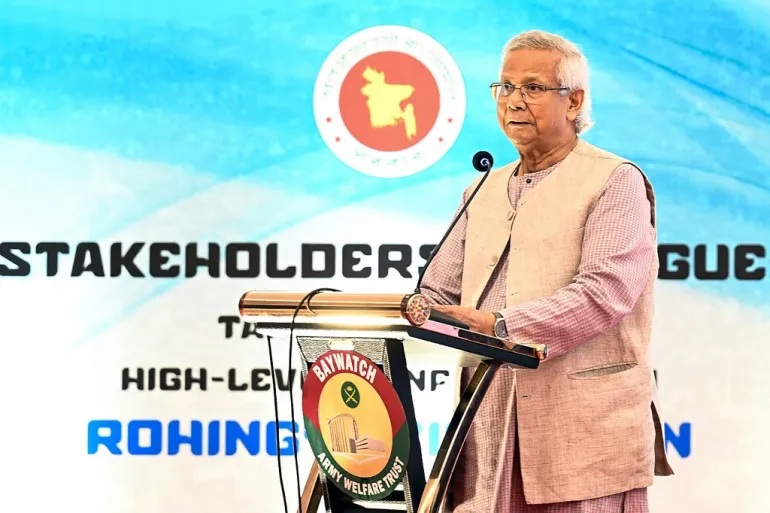
UNITED NATIONS – Bangladesh’s interim Chief Adviser Muhammad Yunus on Friday addressed the the 80th session of the United Nations General Assembly since the Gen Z-led uprising toppled Sheikh Hasina’s 15-year rule and send her to exile in India
There were protests outside the UN headquarters at the time of his arrival.
The supporters of former Prime Minister Sheikh Hasina demonstrated against the interim leader Yunus, whose government has been in power since the unrest, is steering the country until the general elections expected next year.
Supporters voiced their opposition to current interim leader Muhammad Yunus, media reported.
These demonstrations reflect the ongoing political turmoil in Bangladesh, with protesters questioned Yunus’s legitimacy and expressed concerns over human rights and minority persecution.
The critics accused Yunus’s government of allowing attacks on minorities, especially Hindus, with some linking this to radical Islamist groups like Jamaat-e-Islami.
Yunus blamed India for hosting Hasina, strained bilateral expressed concerns about minority safety in Bangladesh. Yunus linked Hasina’s rule to student protests and unrest, seeking extradition for alleged crimes.
He told delegates reflected on Bangladesh’s political transformation, that “Last year, in this august assembly, I spoke to you from a country that had just witnessed a popular uprising. I shared with you our aspirations for transformation. Today, I stand here to tell you how far we have come on that journey. Out of every 100 people on this planet, nearly three live in Bangladesh.”
He said Bangladesh’s significance did not lie in its numbers or geography but in the resilience of its people.
“Our story matters because it is a reminder of the extraordinary power of ordinary people. It matters because it inspires hope among nations everywhere, that no matter how deep the crisis, no matter how impossible the solution may seem, the path to renewal is never lost,” he added.
On the economy, Yunus highlighted the role of migrant workers.
According to the International Organization for Migration, 7.1 million Bangladeshis live abroad, contributing about USD 18 billion in remittances in 2019.
“Their contribution is not only vital for Bangladesh, but it is equally valuable for host countries where they provide essential services in high demand. Migration is therefore mutually beneficial: good for us, good for them,” he said.
He urged host nations to “ensure empathy and protection.”
Yunus also aligned Bangladesh with the findings of a UN human rights commission on Gaza.
“We do agree with the UN independent international inquiry commission that we are witnessing a genocide happening live,” he said.
“Unfortunately, on behalf of humanity, we are not doing enough to stop it. If this continues, neither future generations nor history will forgive us.”
He voiced alarm over Myanmar’s protracted crisis.
“The ongoing conflict in our neighbouring country, Myanmar, has created a situation of deep concern for the entire region,” Yunus said.
He stressed ing that persecution of the Rohingya continued in Rakhine State. He called for a political settlement with all ethnic stakeholders, ensuring the Rohingya are integrated “with equal rights as equal citizens.”
Yunus warned that international aid for Rohingya refugees was dwindling.
He cited the World Food Programme, he noted “Without urgent new funding, monthly rations may have to be halved to a paltry $6 per person,” which could exacerbate hunger, malnutrition and desperation.
Yunus underscored the interconnected nature of crises worldwide.
“We must remember that the challenges ahead cannot be made by any single country alone, and we must also remember that in today’s world where one nation falls into crisis. When crisis erupts in one corner of the globe, the security of the whole world is put at risk,” he added.
