
Beyond the Downpour: How Kolkata’s Drainage and Politics Failed
“Rain, Politics, and Resilience: How Kolkata’s Heaviest Downpour in 40 Years Derailed Durga Puja”

Paromita Das
New Delhi, 26th September: On Tuesday, 23rd September, Kolkata woke up to a disaster it hadn’t witnessed in nearly four decades—an unprecedented downpour that submerged roads, railways, and entire neighbourhoods at the height of Durga Puja preparations. The city was left paralysed, with 251.4 mm of rainfall in less than 24 hours, claiming eleven lives and stranding thousands. But even as citizens battled waist-deep water, power cuts, and flooded homes, another storm was brewing—a political one.
Chief Minister Mamata Banerjee blamed the Centre, citing poor dredging of the Farakka Barrage and mismanagement by central agencies as key reasons for the flooding. The BJP, in turn, slammed the state government, calling out Kolkata’s “decades of corruption and poor drainage” for the chaos. In the middle of a humanitarian crisis, political blame games overshadowed collective action, leaving residents to wonder—was the deluge truly just nature’s fury, or partly a man-made disaster?
The Scale of the Deluge

For the 15 million residents of Kolkata, the night was one of chaos. Streets turned into rivers, cars floated aimlessly, and metro tracks disappeared beneath sheets of water. In areas like Garia, the rainfall touched a staggering 332 mm, while the northern suburbs received close to 195 mm. The city’s famed resilience was put to the test, but this time, nature’s fury overwhelmed it.
Eleven lives were tragically lost, nine due to electrocution caused by unattended live wires, exposing the city’s lack of disaster preparedness. Entire neighborhoods plunged into darkness as power was cut off to prevent further casualties. Families waded through waist-deep water, while thousands found themselves stranded indoors with little relief in sight.
Mamata Banerjee’s Standpoint: Beyond the Rain

West Bengal Chief Minister Mamata Banerjee minced no words in her response. While acknowledging the unprecedented scale of the downpour, she pointed fingers at external factors beyond the state’s control. According to her, inadequate dredging of the Farakka Barrage had reduced the Ganga’s holding capacity, aggravating waterlogging in Kolkata. She further accused central agencies like the Damodar Valley Corporation (DVC) of worsening the situation by unilaterally releasing excess water.
Her words carried both frustration and defiance: “This is nature’s fury. Nobody can stop water from entering Bengal from outside.” She also lashed out at political rivals for exploiting the crisis, asserting that instead of supporting relief efforts, opponents were spreading misinformation for political mileage.
Political Blame Game in the Middle of a Crisis

The tragedy quickly became a battleground of political accusations. The Bharatiya Janata Party (BJP) sharply criticised the ruling Trinamool Congress (TMC), holding it responsible for Kolkata’s poor drainage system. Their official statement argued that years of corruption in the Kolkata Municipal Corporation had left the city ill-prepared for such an extreme event.
The clash of narratives between the state government and the Centre is not new in Bengal’s political landscape. However, this disaster starkly revealed how disaster management often becomes entangled in political tussles, leaving ordinary citizens to bear the brunt.
A City Brought to a Standstill

Perhaps the most jarring impact of the downpour was on transport and daily life. Metro services were halted in sections of the Blue Line, while local train services from Sealdah, Howrah, and Kolkata stations suffered massive disruptions. Even flights faced delays due to waterlogged runways.
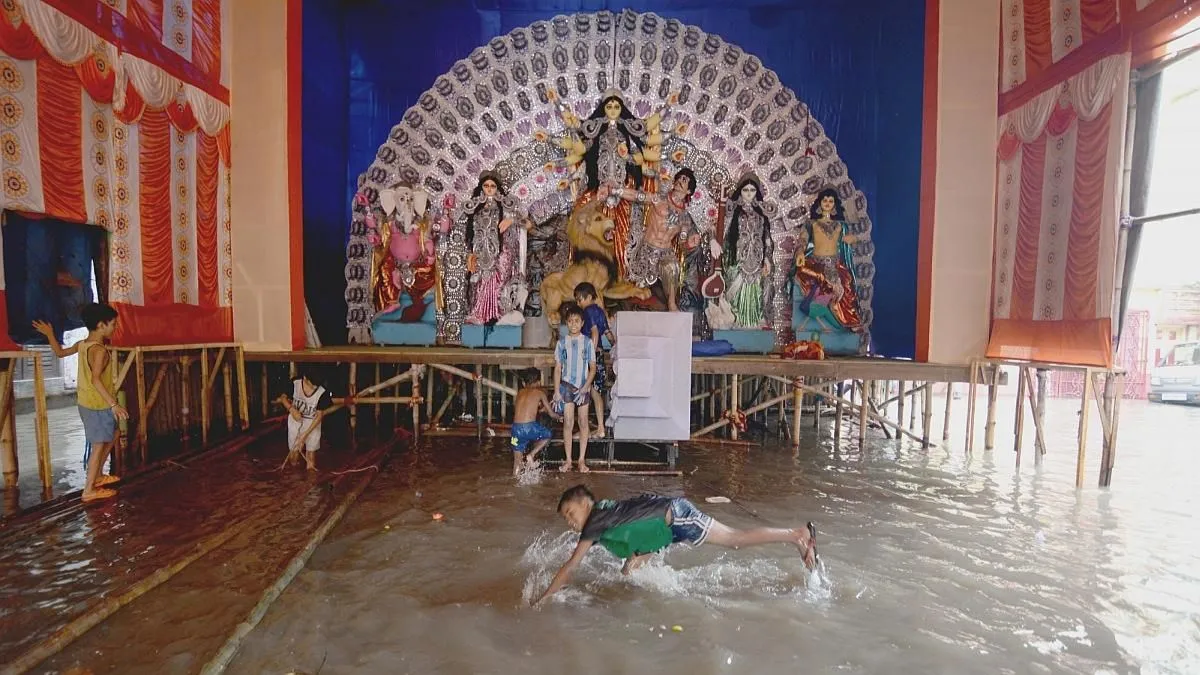
For a city on the cusp of Durga Puja celebrations, the timing could not have been worse. Nearly 3,000 puja pandals were submerged, pandal structures were destroyed, and festival organisers were left unsure if the celebrations could continue as planned. The cultural heart of Kolkata was dealt a painful blow just days before its grandest festival.
Nature’s Wrath or Man-Made Disaster?

While the downpour itself was undeniably extreme, one cannot ignore the systemic failures that worsened its impact. Kolkata has long struggled with drainage bottlenecks, unplanned urbanization, and poor infrastructure maintenance. The lack of preparedness—exemplified by preventable electrocution deaths—reflects a deeper malaise in the city’s disaster response.
Moreover, the political blame-shifting, though predictable, highlights a disturbing reality: when natural disasters strike, citizens are often left abandoned between administrative inefficiency and political grandstanding.
This calamity should serve as a wake-up call. Climate change is making extreme rainfall events more frequent, and unless urban infrastructure is redesigned with resilience in mind, such tragedies will only repeat.
A Test of Resilience
The September 23rd deluge will be remembered not just as one of the heaviest downpours in Kolkata’s recent history but also as a moment of reckoning. For the people, it was a test of endurance and resilience; for the authorities, a reminder that disaster preparedness cannot be an afterthought.
As Durga Puja approaches, the city will try to reclaim its festive spirit, but the scars of this disaster will not fade quickly. The larger question, however, remains—will this crisis push leaders and planners to build a climate-resilient Kolkata, or will it become yet another entry in the city’s long list of forgotten floods?
