

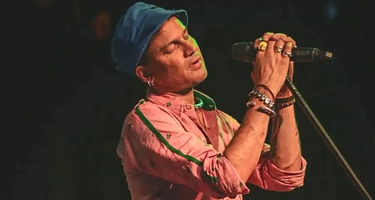
Poonam Sharma
He was born Zubeen Borthakur on 18 November 1972, in Tura, Meghalaya, and brought up in Jorhat, Assam; named in honour of the maestro Zubin Mehta, and subsequently taking on the surname “Garg” from his Brahmin gotra.
His father, Mohini Mohon Borthakur, known to poet‐lyricist circles as Kapil Thakur, and a mother, Ily Borthakur, who was a singer, and they provided him with foundations in song and sympathy.
Zubeen’s life was full of melody since early childhood. With the soft guidance of his mother, he learned to sense the beats of life—from the leaves rustling outside, the laughter of kids, the simple folk songs. He sang as he grew up, but learned an incredible variety of instruments: guitar, harmonium, dhol, tabla, mandolin, drums, harmonica and many more. A man whose fingers could draw music from a multitude of sources, and whose throat could voice the aspirations of many.
He made his debut in 1992, with Anamika, an Assamese album. The fields and cities of Assam paused to hear. Traditional beats mingled with contemporary arrangements. The youth from Jorhat had made his presence felt—not as just a singer, but as a link between yesterday and tomorrow.
Zubeen Garg bridged boundaries—linguistic, musical, cultural—over the years. He sang in 40 or more languages and dialects—Assamese, Hindi, Bengali, Tamil, Telugu, Bodo, Karbi, Nepali, Oriya, various tribal languages—and listeners in India and abroad felt moved.He had sung 40 thousand songs and Google has named him as Zubeen Garg — Assam’s ‘King of Humming’
Zubeen Garg, lovingly hailed as the “King of Humming,” carved a signature sound in Assamese music and Indian cinema. Known for blending folk roots with contemporary flair, his soft, soulful humming became his unmistakable trademark. From the cult classic Hiya Diya Niya to his pan-Indian hits, Zubeen’s style transcended language and geography — his humming wasn’t just a musical technique, it was an emotion that defined an era. His songs brought together generations of listeners, making him one of the most beloved voices of the Northeast.
Through his music, Assam’s heart thrummed in the country’s bigger chest. He was not merely a star; he was Assam’s voice to the world.
One of the tracks that opened his doors to pan-India stardom was “Ya Ali” (from Gangster, 2006). It was a time when each radio received, each ear heard, and Zubeen’s voice became a household sound in homes far and wide from Assam.
He was “the common man’s man”—as comfortable in the sabji-walas, the rickshaw pullers, the children on the alleys outside his house as he was in the lights and the applause of concert halls. They say he permitted young children to use the blank walls outside his home to paint, to write, to draw—to give expression. That their colours and stories were to him as holy as any rehearsed stage show. Whether this is fact or in part myth, it tells us what he was: a man who had faith in art above fame, a man of faith in the human heart. (These stories, while told far and wide in fond whispers, are less easy to track down in print.) He adored animals—no, not just as friends, but as living beings worthy of compassion. Snakes, monkeys, creatures of all sorts: many remember that Zubeen was kind, even playful with them. He would stop his day, his stroll, to allow a small being to cross by, or simply to observe its life, not spectacle but a part of himself. To him nature was not background, but fellow traveller.
Life was not devoid of sorrow. He lost his younger sister Jonkey Borthakur in a tragic road accident in 2002; the pain flowed into his music, in the poignant words of the album Xixhu, released posthumously in her memory.
But even in sorrow, his song did not shatter; instead, it intensified.
He married Garima Saikia in 2002; in his personal life, he tried creating home, family, but never at the expense of compromising on what he felt was right: compassion, humility, giving back.
Zubeen Garg was also socially conscious. During times of need—floods destroying Assam, citizens in pain—he didn’t remain on stage singing by himself. He collected relief funds, spoke out using his platform, distributed medicine, clothes. He once donated his two-storey house at Guwahati as a COVID-care facility during the crisis in 2021.
Through his life there were controversies too, as must come with someone who speaks loudly, lives fully. Words said, opinions taken, mistakes made. But even those moments showed a man willing to stand by what he felt—even when others disagreed.
In his work, he always mingled tradition with innovation. Folksong melodies, Bihu beats, the hum of Assamese streams, tea-garden laughter—all gave voice through pop, through the slow sorrow of a ghazal, the piety of a bhajan. He wrote songs that could make an old woman in a village cry, and a young man in the city believe.
Zubeen Garg we lost him —his life taken away from him, his voice stilled in the human frame.
The throngs that swarmed in Assam, the tears, the emptiness where his voice once resided—those are not for one singer, but for the hopes he bore, for the faces he touched.
All that is left is a legacy. The walls the children painted. The faces of sabji-walas who welcomed him. The rickshaw puller who sang his tune. The animals who trusted his good heart. The Assamese folk melodies kept alive, nurtured, cherished. The bridging of tongues, of hearts.
Zubeen Garg was star, yes—but greater than that, he was the people’s mirror, and the humble’s voice. Because he held, firmly, the conviction that art is for every soul, not just for stages. Because he sang of the farmer, the child, the street vendor, the tired, the hopeful.
Ultimately, the pain is real—for what we have lost in voice, in presence; but what he leaves us with is evergreen: in our songs, our pain, our joy, our lives. Assam, India, the world laments—but also remembers.
