

By Anjali Sharma
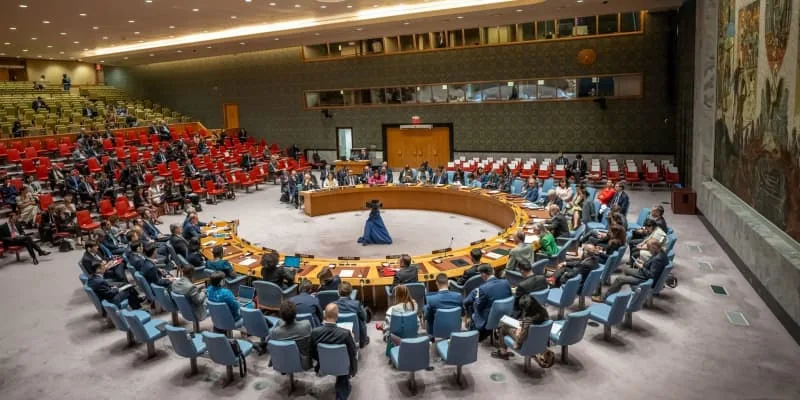
UNITED NATIONS – UN Security Council on Friday rejected a proposal to continue sanctions relief for Iran under the 2015 nuclear deal in a vote that revealed deep divisions over the so-called “snapback” process.
The text presented by the Council president, the Republic of Korea received only4 votes in favour, from Russia, China, Algeria, and Pakistan, failed to secure the 9 required votes for adoption.
Denmark, France, Greece, Panama, Sierra Leone, Slovenia, Somalia, the United Kingdom, and the United States voted against. Guyana and the Republic of Korea abstained.
The resolution would have terminated UN sanctions imposed on Iran prior to the 2015 Joint Comprehensive Plan of Action if the text had been adopted, thereby preserving the sanctions relief provided to Tehran under the deal.
The resolution 2231, which endorsed the JCPOA in July 2015, set out the process by which UN sanctions would be lifted, while established a mechanism to reimpose them in case of “significant non-performance” by any of its participants – China, France, Germany, Russia, the UK, the US, the European Union and Iran.
Council president must within 30 days, put a draft resolution to the vote for sanctions relief to continue under paragraph 11, if one of the signatories notifies the Council of a significant breach.
If the draft is not adopted, the previous UN sanctions are automatically re-imposed meant that unless the Council explicitly votes to keep sanctions relief in place, previous UN sanctions are automatically restored.
Russia raised a point of order, rejected the European claim to trigger the snapback mechanism.
Russian Ambassador Vassily Nebenzia said that there were no legal, political or procedural reasons to allow the “snapback” mechanism or to vote on the draft resolution, and accused France, Germany and UK of acting outside both resolution 2231 and the JCPOA.
He said the three had failed to follow the dispute settlement mechanism and instead imposed unilateral sanctions against Iran, which he described as “illegal”.
Ambassador Nebenzia said that “Attempts on the part of the European countries to present the situation as though they have the right to activate the punitive provisions of prior resolutions failing to fulfill their own obligations cannot hold water”.
Chinese Ambassador to the UN FU Cong said “major discrepancies” existed between Council members over the snapback and warned that a rushed vote could “exacerbate State confrontation”, complicating efforts to resolve the issue diplomatically.
British Ambassador Barbara Woodward countered, stated that the E3 (the European participants of the JCPOA) decision to invoke snapback was “entirely legal, justified, wide and consistent with the requirements of resolution 2231.”
She cited the 28 August 2025 notification submitted by France, Germany and the UK: “All that is required to trigger snapback is…a notification by a JCPOA participant state of an issue that it believes constitutes significant non-performance of commitments under the JCPOA,” she said.
French envoy spoke before the vote, cited Iran’s escalating nuclear programme and its reduced cooperation with the International Atomic Energy Agency.
Ambassador Jérôme Bonnafont said Iran had accumulated enriched uranium stockpiles far higher than the limit set by the agreement and restricted IAEA access to key facilities.
He called the snapback mechanism necessary to preserve international peace and security, and the integrity of the global non-proliferation regime.
