
Rahul Gandhi’s Misstep in Bihar: A Campaign That Helped BJP
“Congress’s ‘Voter Adhikar Yatra’ in Bihar was meant to expose vote theft and project Tejashwi Yadav, but controversies, poor strategy, and hollow politics turned it into a gift for PM Modi.”

Paromita Das
New Delhi, 5th September: Bharatiya democracy thrives on the push and pull between government and opposition. But in recent years, the opposition, particularly the Congress, has reduced itself to a politics of spectacle rather than substance. Instead of offering a credible alternative, it has leaned on gimmicks, controversies, and hollow slogans that not only fail to convince voters but often backfire. The recently concluded ‘Voter Adhikar Yatra’ in Bihar, led by Rahul Gandhi, was a prime example. Marketed as a campaign to expose “vote theft,” the yatra quickly descended into controversy, disunity, and public disinterest. In the end, it delivered an unintended victory to Prime Minister Narendra Modi and the BJP.
A Grand Journey That Went Nowhere

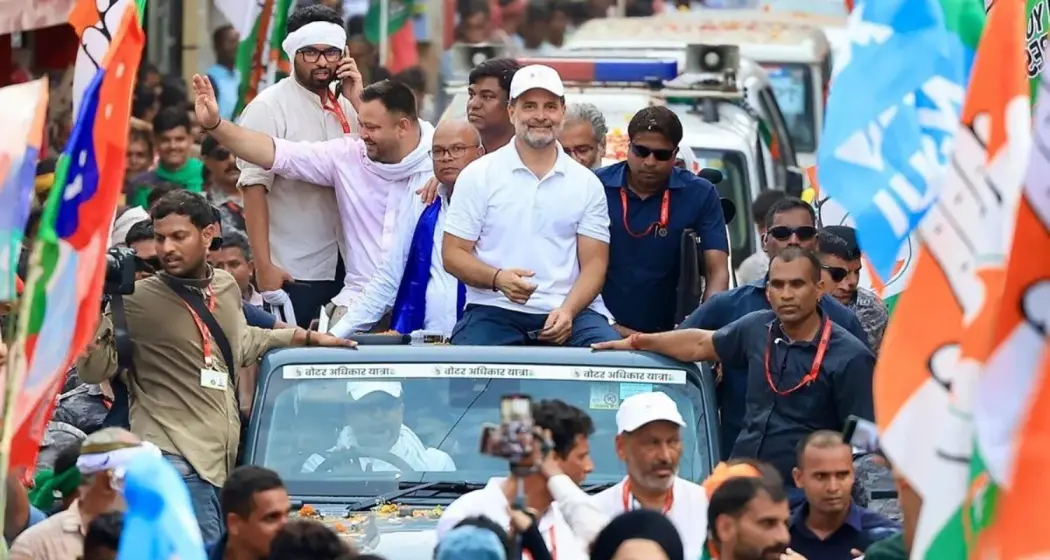
The yatra was meant to be bold in scope, with Rahul Gandhi covering 23 districts, more than 1,300 kilometers, and 67 constituencies in just 16 days. The declared purpose was twofold: to make “vote theft” a burning issue in Bihar and to project Tejashwi Yadav as the face of the opposition alliance. Yet, from the very beginning, the campaign seemed tone-deaf.
On the ground, ordinary Biharis did not buy into the Congress narrative. Rather than sympathizing with accusations of stolen votes, many locals supported the Special Intensive Revision Exercise (SIR), which they saw as a necessary step to cleanse electoral rolls of outsiders, infiltrators, and bogus voters. By ignoring this sentiment, Congress alienated the very communities it hoped to mobilize.
The other goal of the yatra—elevating Tejashwi Yadav as a credible challenger to Nitish Kumar—was also lost. Instead of giving Tejashwi space to shine, Rahul Gandhi turned the spotlight squarely on himself. Bike rides staged for Instagram reels, carefully posed photo-ops, and soundbites for the media made the exercise appear more like a personal PR campaign than a collective political mission. What should have been Tejashwi’s stage to present himself as a youthful alternative to the ruling leadership became a showcase of Rahul Gandhi’s self-promotion.
Rahul Gandhi’s Overshadowing Presence

For RJD, this misstep was deeply damaging. Tejashwi Yadav had been gradually building credibility by talking about jobs, education, and development—the very issues that resonate with Bihar’s youth. The Congress-imposed agenda of “vote theft” diluted this momentum. Worse still, Rahul Gandhi’s refusal to clearly endorse Tejashwi as the alliance’s chief ministerial candidate exposed cracks within the coalition.
Behind the scenes, Congress began demanding a larger share of seats than initially agreed upon, reportedly seeking more than 40 constituencies. This not only aggravated tensions with the RJD but also revealed that the Congress was more interested in bargaining power than in building a unified opposition. Instead of emerging as a cohesive bloc, the alliance looked divided, confused, and unprepared.
When Controversy Becomes the Message

If poor planning weakened the yatra, controversies buried it. The most damaging episode unfolded in Darbhanga, when an individual on stage hurled obscene abuses at Prime Minister Modi’s late mother. The video spread like wildfire, provoking outrage across Bharat. Modi’s emotional response—calling it not just an insult to his mother but to the dignity of all mothers of Bihar—struck a deep chord. What should have been Congress’s rallying point turned into a powerful wave of sympathy for the Prime Minister.
As if this was not enough, the alliance was further haunted by its association with Tamil Nadu Chief Minister MK Stalin. Old remarks from DMK leaders mocking Biharis as “toilet cleaners” and labeling Sanatan Dharma as a disease resurfaced, stirring fresh resentment. Smaller embarrassments, such as the sidelining of Pappu Yadav and the unexplained disappearance of Kanhaiya Kumar mid-yatra, added to the impression of a campaign in disarray. Instead of projecting unity and strength, the opposition appeared fractured and directionless.
The Collapse of Credibility

In Bihar, where young voters crave opportunities and older voters remain wary of the “jungle raj” era, credibility is everything. Tejashwi Yadav had painstakingly carved out space for himself by focusing on development. But by allowing Congress to hijack the agenda, he lost his strongest appeal.
The final act of the yatra symbolized its collapse. Originally envisioned as a massive rally at Patna’s Gandhi Maidan, the campaign limped to a close with a lackluster roadshow. What began as a grand plan ended in a whimper, leaving even Congress sympathizers acknowledging that little had been achieved beyond minor organizational revival.
The tragedy of the opposition lies not in its lack of energy but in its lack of vision. A politics built on gimmicks, staged theatrics, and personal attacks cannot inspire trust. Bharatiya voters want solutions, not spectacles. Until Congress and its allies recognize this truth, they will remain their own worst enemy—handing every misstep as free political capital to Narendra Modi.
When Failure Becomes Advantage

The bitter irony of the ‘Voter Adhikar Yatra’ is that it accomplished precisely the opposite of what it set out to do. Rahul Gandhi’s theatrics, the alliance’s internal squabbles, and the damaging controversies handed the BJP a narrative advantage. Modi emerged not weakened but strengthened, painted as a leader wronged by personal insults and buoyed by public sympathy.
Rather than empowering its ally RJD, the Congress overshadowed Tejashwi Yadav and weakened his credibility among young voters. Rather than building opposition unity, it exposed divisions. And rather than denting the BJP, it provided Modi and his party with fresh ammunition as elections approach.
A Yatra That Backfired
The ‘Voter Adhikar Yatra’ in Bihar was supposed to showcase strength, unity, and leadership. Instead, it highlighted weakness, disunity, and confusion. Poor strategy, damaging controversies, and an overbearing Congress presence ensured that the campaign collapsed under its own contradictions.
In the end, the yatra did not harm the BJP; it fortified it. It did not elevate Tejashwi Yadav; it overshadowed him. And it did not present a credible opposition; it revealed a hollow one. For Bharatiya democracy to thrive, the opposition must rise above gimmicks and rediscover the art of serious politics. Until then, campaigns like this will continue to backfire, leaving the ruling party stronger than ever.
