
Silver Spoons, Empty Ethics: How the Opposition Lost Its Way
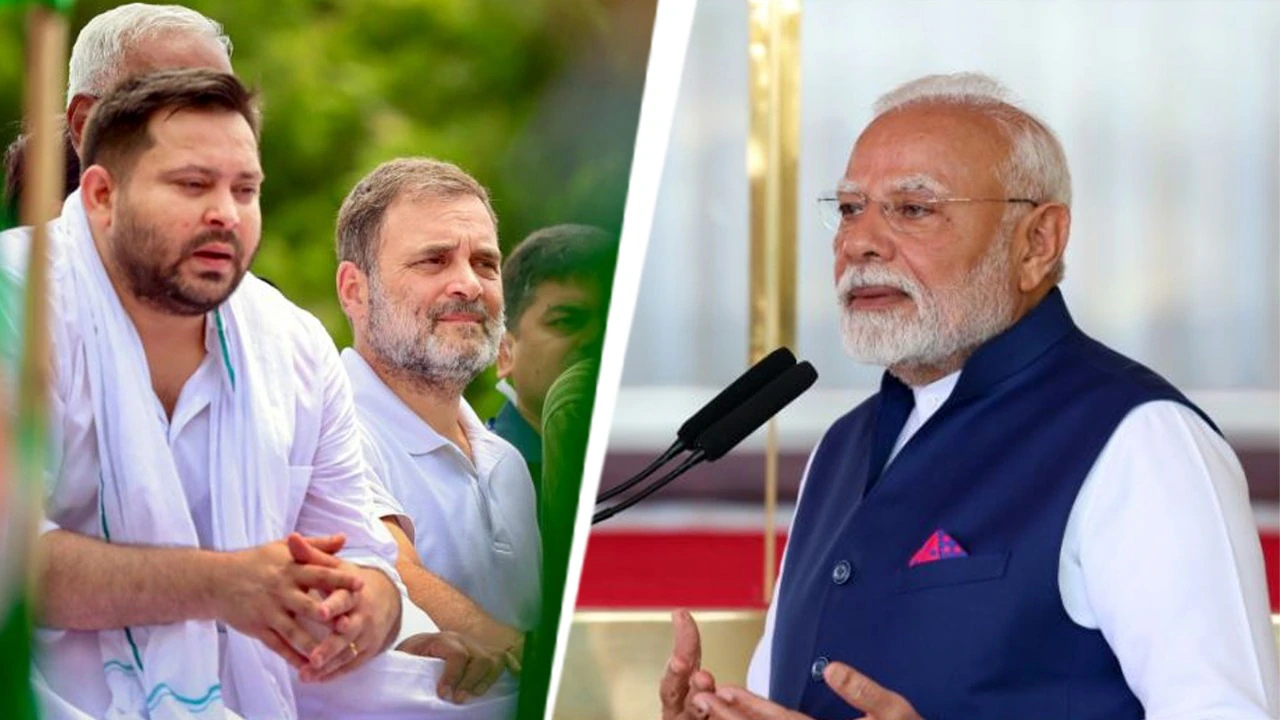
“Rahul Gandhi and Tejashwi Yadav, the so-called PM candidates, prove that silver spoons cannot buy ethics—or decency.”

Paromita Das
New Delhi, 4th September: In the theater of Bharatiya politics, the latest act performed by the so-called new-age Opposition leaders Rahul Gandhi and Tejashwi Yadav is less about governance and more about spectacle, and unfortunately, it’s a spectacle that insults the very soul of democratic discourse. Hailing themselves as future Prime Ministers of Bharat, these “namdaars” have chosen a path where inherited privilege becomes a tool for political mischief rather than public service.
Recent events in Bihar, where alleged derogatory remarks were made against Prime Minister Narendra Modi’s late mother during a political rally, have brought this contradiction into sharp relief. Leaders with foreign degrees, silver spoons, and seemingly endless opportunities, demonstrated in one stroke that pedigree does not equate to principle. Instead, it highlighted a penchant for personal attacks that even the most hardened political cynics would find shocking.
From Silver Spoons to Moral Bankruptcy

It is a curious case of modern politics: the opposition parades its elite credentials and international education as badges of credibility, yet when it comes to basic ethics, decency, and respect, they fall spectacularly short. Rahul Gandhi and Tejashwi Yadav, who aspire to lead Bharat, seem to believe that political inheritance—rather than hard work or moral integrity—qualifies them for office.
Prime Minister Modi’s remarks on these “namdaars” capture this irony perfectly: born with a silver spoon in their mouths, they are incapable of understanding the struggles of a poor mother, the sacrifices of a self-made leader, or the pain of ordinary citizens. Yet, in a bizarre twist of political theatre, they choose to insult a grieving family rather than engage with issues of development, governance, or policy.
The New-age Opposition: Masters of Insult, Not Leadership

If politics were a test of civility, the Opposition would flunk spectacularly. From Bihar to Delhi, the so-called PM candidates have displayed a pattern: personal attacks, derogatory remarks, and a shocking disregard for moral boundaries. Former Union Ministers Smriti Irani and Raksha Khadse, along with BJP leaders like Aparajita Sarangi, have rightly condemned this behavior, reminding the public that political decency is not optional—it is a duty.
Union Minister Anupriya Patel put it succinctly: “In Bharat, mothers are worshipped. To drag a mother into politics is the petty politics of a privileged class who have no understanding of struggle or empathy.” Indeed, when a nation sees those aspiring to the highest office behaves like entitled teenagers, it is a sad reflection on the priorities of the Opposition.
Satire Meets Reality: Lessons for the Public

There is, however, a silver lining in this political farce. The public, especially women voters in Bihar, have shown that they will not tolerate moral vacuums in leadership. The NDA’s statewide bandh in Bihar on September 4 demonstrates the collective sentiment: abuses and insults may generate temporary headlines, but they cannot substitute accountability, vision, or governance.
In an era where youth look up to political leaders for inspiration, the antics of the “namdaars” serve as a cautionary tale. A foreign degree, family legacy, or elite upbringing cannot substitute for empathy, ethics, or the courage to engage with real issues. For younger generations watching, the lesson is clear: leadership is not inherited—it is earned.
Privilege Is Not a Substitute for Leadership

The political antics of Rahul Gandhi and Tejashwi Yadav exemplify everything that modern Bharatiya politics must reject: entitlement, personal attacks, and moral vacuity. These so-called leaders have mistaken politics for a stage where insult is applauded and empathy is irrelevant. Yet, the country sees through the facade. Leadership is measured not by lineage or pedigree but by courage, integrity, and the ability to rise above pettiness.
The challenge is for Bharat’s electorate to demand better, to hold leaders accountable, and to remind these privileged heirs that politics is a platform for service, not spectacle. Perhaps then, the nation can finally see a generation of leaders who inspire through vision rather than provoke through insult.
Namdaars, Take Note
As the Opposition flaunts its silver spoons and foreign degrees, the people of Bharat are watching—and judging. Insults may create a stir, but they cannot conceal incompetence, lack of empathy, or moral weakness. The so-called PM candidates of Bharat, Rahul Gandhi and Tejashwi Yadav, may inherit power, but they will not inherit respect unless they learn the first lesson of politics: decency costs nothing, yet it earns everything.
