
Cambodian Monks Trump’s Nobel and Xi Jinping’s Dangerous Script

Poonam Sharma
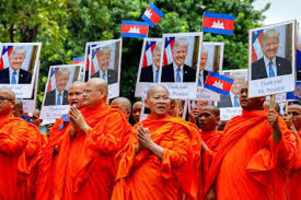
To the untrained eye, the photographs appeared to be surreal. Cambodian Buddhist monks—tens of thousands—walking in the streets with signs, praying in favor of Donald Trump winning the Nobel Peace Prize. Tales even went so far as to assert that Cambodian Prime Minister Hun Sen himself nominated Trump, with up to 70,000 monks speaking out on his behalf.
But the pageantry wasn’t sitting well. With anyone familiar with Buddhist doctrine, monks are not to be involved in politics. Even more egregious: today’s Cambodia is one of Beijing’s most intimiate proxy states. What are the chances, then, that monks there would come out en masse for an American president in the midst of a growingly fraught U.S.–China confrontation?
The solution, it seems, might not be in Cambodia, though—but in Beijing.
The Trap of “Honor”
It was not a grassroots rally of Cambodian monks, however, but a meticulously staged one orchestrated by the Chinese Communist Party (CCP), says Chinese dissident scholars and political insiders. The mastermind behind this campaign is a strategy that Xi Jinping and Vladimir Putin have supposedly hatched to manipulate Donald Trump throughout his presidency.
The CCP’s International Liaison Department (ILD), its secret “party diplomacy” branch, was responsible for implementing united front activities overseas. The ILD usually aimed at left-leaning political parties and groups in the West. But since Trump’s second presidential election win, the department submitted a special report to the Politburo.
That report concluded that Trump could not be bribed monetarily, nor could he be readily compromised by women. Rather, the analysts said, they found something else: the allure of “honor.” And in the eyes of the West, no honor shines brighter than the Nobel Peace Prize.
So the chanting of the monks in Phnom Penh was part of a much larger strategy: to persuade Trump that worldwide adoration—and the Nobel itself—was within grasp if he played along with Beijing and Moscow’s script.
Taiwan as the Prize
The CCP calculation was cold-blooded. If Trump thought there was a Nobel Peace Prize in store for him for making peace—whether in Ukraine or along the Taiwan Strait—he might exchange American leverage on Taiwan.
Cambodia, heavily reliant on China, was made an easy backdrop for this drama. How better to seed the notion than to present Trump with “grassroots” devotion in a surprising Asian nation, all bound up in the promise of peace?
But inside sources say that the ruse ran deeper. Xi and Putin were not merely holding out symbolic inducements. They were constructing a strategic deal to remake the world order.
The Xi–Putin Pact
Beijing and Moscow’s “no limits” alliance has long concerned Western capitals. But Chinese political elites’ own confidants say the deal is even grimmer than is commonly imagined.
The CCP purportedly agreed to back Russia’s bid to reestablish dominance over its old Soviet empire, including the Baltic states and Central Asia. In turn, Putin has promised complete backing for Beijing when it strikes against Taiwan.
This alliance is why Putin has been so obstinate at the negotiating table when it comes to ceasefire talks for Ukraine. His stonewalling is not just a matter of warfighting dynamics—it is about keeping the Moscow–Beijing axis in place. For Putin, a humiliating ceasefire would break his bond with Xi. For Xi, assisting Putin in standing up to Western pressure keeps the alliance going until he needs it most: the Taiwan crisis.
Why Trump’s Strategy Has Stalled
Donald Trump’s strategy for the Ukraine conflict has been blunt. He tried to negotiate a ceasefire that would draw Russia out of its embrace with China, so that the United States would be able to focus its might on Beijing.
But thus far, the strategy hasn’t panned out. Beijing still supports Putin, even going so far as to suggest acting as a guarantor in any peace agreement after the war. Kyiv dismissed that notion outright—but the fact that it was suggested at all speaks volumes about how tightly Xi and Putin coordinate.
If Trump forces Ukraine into a disadvantageous ceasefire, it may divide NATO, undermine transatlantic solidarity, and give Xi and Putin precisely what they desire: a divided West.
The Nobel as a Weapon
This is where the Nobel Prize trap reoccurs. Both Putin and Xi, insider accounts tell us, made some version of the same statement to Trump: “If you were president, this war would never have occurred.” Xi even threw in a Taiwan twist: “So long as you remain U.S. president, I will never invade Taiwan.”
Both assurances offered the same bait—peace, and the Nobel accolades that could ensue.
But Trump himself, in a recent Fox News interview, appeared to brush aside the Nobel myth, declaring that his real motivation was to “increase his chances of going to heaven.” Whether that is sincere or political posturing is questionable, but it indicates that he knows how to read the trap Beijing set.
The Real Pressure Point: Xi Jinping
So what is the intelligent way forward? Experts such as Professor Yuan believe that Trump—or any American administration—need not bother to try to charm Putin into calling a truce. As long as Xi Jinping is standing behind him, Putin doesn’t have any reason to negotiate.
The pivot is in Beijing. Absent Chinese economic, technological, and diplomatic backing, Russia’s war against Ukraine would falter. If Xi Jinping’s hold on power can be shaken—via tariffs, economic leverage, or factional rivalry within the CCP—the Moscow–Beijing nexus may break apart without any effort from Ukraine.
Indeed, many of Xi’s rivals inside the party reportedly dislike his close embrace of Russia. The “no limits” partnership is Xi’s personal project, not a consensus position. That creates an opportunity for the United States to drive wedges inside the CCP itself.
Breaking the Script
The lesson of the Cambodian monks is simple: do not take the bait. The Nobel Peace Prize campaign was not an accident, nor was it a genuine show of Buddhist solidarity. It was a script written in Beijing, designed to flatter Trump’s vanity and steer U.S. policy toward concessions on Taiwan and Ukraine.
The path to peace does not run through Putin’s Kremlin—it runs through Xi’s Zhongnanhai compound in Beijing. Break Xi’s alliance with Moscow, and the war in Ukraine could end far more quickly than any Nobel campaign in Phnom Penh could promise.
For Trump, or for any American president, the test is not only to withstand the temptation of glory but to see where the true battlefield is. The Nobel Peace Prize may glow enticingly, but it is a golden trap. Geopolitical stability is the real prize—and that demands fracturing Xi Jinping’s perilous script before it is too late.
