
Bharat vs. Tariffs: Why SCO 2025 Could Redraw the World Order
“SCO 2025 in Tianjin: How Trump’s Double Tariffs on Bharat Are Reshaping Trade, Challenging U.S. Economic Colonisation, and Accelerating a Multipolar Global Order”

Paromita Das
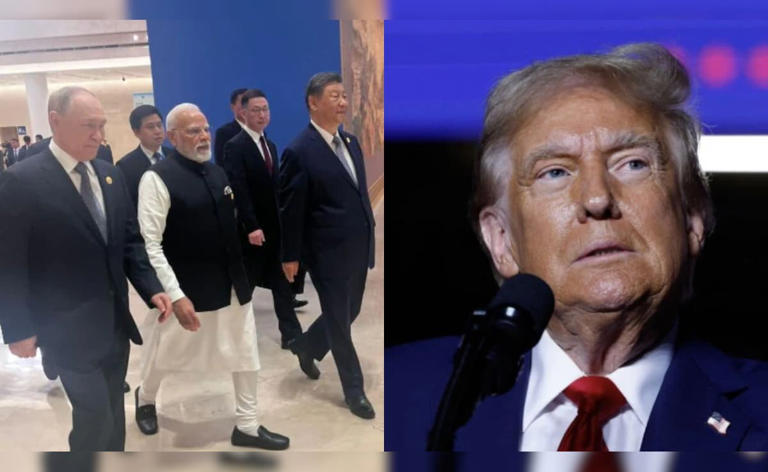
New Delhi, 2nd September: The global spotlight has turned firmly toward the SCO 2025 Summit in Tianjin, where geopolitics and economics collided in dramatic fashion. The spark was lit thousands of miles away when former U.S. President Donald Trump announced double tariffs on Bharat—a move that reverberated far beyond trade. Suddenly, the summit was not just another diplomatic gathering; it became the testing ground for whether the world is truly witnessing the birth of a new global order.
For decades, America’s dominance has been maintained not merely by military might, but through a system of economic colonisation—weaponising tariffs, sanctions, debt, and the dollar. But in Tianjin, the cracks in that system were laid bare, with Bharat standing at the centre of the pushback.
The Tariff That Rattled the World

Trump’s decision to impose double tariffs on Bharat struck at the heart of a rising power that the U.S. can no longer ignore. Unlike smaller nations of the past, Bharat is the world’s fifth-largest economy, a manufacturing hub, and a technological force. Punitive tariffs on such a nation were not simply an economic maneuver—they were an attempt to reassert U.S. dominance at a time when its grip on global trade is slipping.
The reaction was swift. At SCO 2025, Prime Minister Narendra Modi framed the tariffs not just as a bilateral dispute, but as part of a wider pattern of economic bullying. His speech resonated with countries that had long endured similar tactics—from Latin America’s “Lost Decade” of debt dependency to Africa’s farmers crushed by subsidised U.S. grain. This time, however, the victim was not a vulnerable nation but a rising global power.
The Hypocrisy of American Protectionism

The irony of Trump’s tariffs lies in America’s own history. The United States, which today lectures the world about free trade, built its economic strength on protectionism. In the 19th century, high tariffs shielded American industries from European competition. By the 1930s, the Smoot-Hawley Act raised duties on over 20,000 goods, triggering retaliations that deepened the Great Depression.
This pattern—protection at home, free trade abroad—became the template for America’s global dominance. The rhetoric of “open markets” concealed the reality of exploitation, with Washington reaping profits while others bore the costs. Trump’s tariffs on Bharat revive this old playbook, but in a world that is no longer willing to play along.
From Tianjin to Multipolarity

At Tianjin, Modi seized the moment to highlight the broader stakes. The tariff war was framed not as a clash of two nations, but as a test of the global system itself. Could the world accept economic coercion as the new normal? Or would it unite in resistance?
The response from other powers was telling. Russia, under heavy sanctions, has already pivoted toward Asia, rerouting energy exports and trading in local currencies. China has pushed back against U.S. tariffs while promoting yuan-based trade. The Middle East, led by Saudi Arabia and the UAE, is openly exploring oil sales in currencies other than the dollar. And the expansion of BRICS+ signals a collective determination to build financial systems outside U.S. control.
Bharat’s defiance at SCO 2025 gave this movement both momentum and legitimacy. In many ways, Bharat became the voice of a rising Global South, determined to reject the exploitative economic order of the past century.
A World Beyond Dollar Hegemony

Perhaps the most profound shift underway is the steady decline of the U.S. dollar’s supremacy. In 2001, the dollar accounted for nearly 90% of global reserves; today, it has fallen below 58% and continues to slide. Nations are increasingly trading in local currencies, building alternative payment systems, and resisting sanctions that once crippled economies.
Trump’s tariffs, meant to protect American industries, may ironically accelerate this de-dollarisation. By targeting Bharat—a key trading partner for Asia, Africa, and Europe—the U.S. risks pushing more nations into the arms of alternate financial blocs. In this sense, the tariff war could become the very catalyst that unravels America’s greatest instrument of global control.
The Mask Has Fallen

For decades, the United States managed to disguise its economic colonisation as “development aid,” “policy advice,” or “free trade.” But the façade has cracked. The double tariffs on Bharat strip away any remaining illusions of fairness. What remains is naked self-interest, revealed to allies and adversaries alike.
Bharat’s emergence as a pillar of resistance is crucial. It shows that the age of quiet compliance is over. By standing firm, Bharat signals that economic coercion will be met not with submission but with counter-strategies, alliances, and resilience. This is not just Bharat’s fight—it is the fight of every nation that has endured decades of economic exploitation under the guise of global order.
A New Order Rising
The SCO 2025 summit in Tianjin may well be remembered as the moment the multipolar world became irreversible. Trump’s tariffs on Bharat, intended as a show of American strength, instead highlighted U.S. weakness. They exposed the contradictions of a system that demands obedience while offering exploitation.
What follows may not be an immediate collapse of American power, but a gradual reordering of the world—one where the Global South refuses to remain a silent victim, where BRICS+ builds alternatives, and where Bharat plays a central role in shaping a fairer order.
If history has a sense of irony, it is this: America, born in rebellion against colonialism, perfected economic colonisation. And now, through its own excesses, it may have lit the fuse for a world free of its grip. The global order is shifting—and this time, the elephant will march on its own path, carrying much of the Global South with it.
