
Modi’s Tokyo-Beijing Gambit: Bharat’s Big Bet on an Asia-First Future
“Prime Minister Narendra Modi’s back-to-back visits to Japan and China highlight Bharat’s Asia-first economic map. As Washington lashes out with tariffs and accusations, Bharat is quietly recalibrating global trade linkages.”

Paromita Das
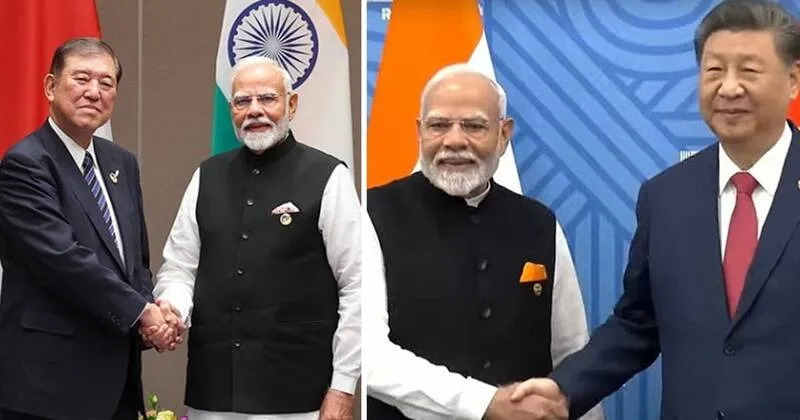
New Delhi, 1st September: When Prime Minister Narendra Modi landed in Tokyo and Beijing back-to-back, the timing was not coincidental. The world economy is in flux: supply chains are shifting, tariffs are surging, and geopolitical rivalries are redefining trade maps. Against this backdrop, Bharat’s engagement with Asia looks less like a diplomatic detour and more like a calculated strategy.
Washington, however, seems rattled. Under Donald Trump’s political orbit, voices like Peter Navarro have accused Bharat of everything from enabling Russia’s war in Ukraine to sectarian policymaking. He even went so far as to label the conflict “Modi’s war” and posted a saffron-tinted image of Modi to underscore the claim. The optics may be loud, but the strategy behind them is remarkably shallow.
Bharat is under no obligation to act as anyone’s proxy. Instead, it is sketching an Asia-first economic map with Japan as a trusted partner and RCEP—the world’s largest trade bloc—as a future option. This quiet pivot explains both the optimism in Asia and the frustration in Washington.
Japan: Beyond Symbolism, Towards Industrial Scale

Tokyo remains central to Bharat’s industrial ambitions. Modi’s message in Japan was clear: “Make in India, Make for the World” is not mere rhetoric—it is an investment invitation. With advanced manufacturing, semiconductors, defense cooperation, and high-speed rail on the agenda, Japan is already doubling down on Bharat’s industrial base.
The Japanese government and corporations have steadily invested in Bharat’s ports, freight corridors, metro networks, and green technologies. Unlike many partners, Tokyo also provides a consistent diplomatic cushion on China, making Japan both an economic and strategic counterbalance.
For Bharat, Japanese FDI and co-production aren’t just about jobs and technology transfer. They are a hedge against punitive tariffs from the U.S. and a lever to re-enter global trade agreements from a position of strength. By deepening Indo-Japanese networks, Bharat can strengthen its bargaining power in any future RCEP discussions.
China: Compartmentalizing Without Compromising

Bharat’s outreach to China is not a thaw in the traditional sense—it’s compartmentalization. Security and territorial disputes remain tightly ring-fenced, but on trade and markets, pragmatism takes over.
The reality is stark: Asia’s demand scale is too vast for Bharat to ignore. New Delhi recognizes that engaging Beijing commercially while maintaining border vigilance is not a contradiction but a necessity.
Washington, however, sees this differently. Many in the U.S. establishment want Bharat locked into a permanent anti-China stance. That won’t happen. Bharat prefers issue-based coalitions: the Quad for security, BRICS and SCO for multipolar balancing, and bilateral trade for economic pragmatism. In this choreography, beginning with Beijing and intensifying with Tokyo is a deliberate sequence—one that Washington may find unsettling.
Navarro’s Misstep: Tariffs, Slogans, and Saffron

Peter Navarro’s recent public interventions expose the shallowness of Washington’s pressure tactics. By accusing Bharat of laundering Russian oil, defending 50% tariffs on Bharatiya exports, and branding Ukraine’s tragedy as “Modi’s war,” he has reduced strategy to soundbites.
Three problems stand out:
- Energy Security ≠ Warmongering – Bharat’s discounted Russian oil imports were about inflation control, not ideological alignment. The G7’s price cap itself acknowledged the need for supply stability.
- Tariff Blackmail Backfires – Slapping tariffs to “teach Bharat a lesson” may appease a domestic political base but pushes Bharat closer to Japan, ASEAN, and RCEP-driven supply chains.
- The Saffron Dog Whistle – Ending a policy rant with Modi’s saffron photo was not policy—it was provocation. It suggested sectarian intent where there is, in fact, economic calculus. Such gestures only diminish U.S. credibility across Bharat’s political spectrum.
Navarro’s approach, in short, is more inflammatory than strategic. It alienates a sovereign partner while making America look insecure about Bharat’s independence.
RCEP: The Trade Engine Bharat Cannot Ignore

The Regional Comprehensive Economic Partnership (RCEP), a 15-member Asia-Pacific bloc led by ASEAN, is already reshaping global supply chains. Bharat famously walked away in 2019, fearing Chinese dumping and risks to vulnerable sectors like dairy and MSMEs. Those concerns were real, but time has moved on.
With RCEP’s tariff reductions already in motion and U.S. tariffs rising, Delhi now faces a crucial question: does staying out help Bharat more, or does a conditional re-entry provide leverage?
Re-entry need not mean capitulation. Bharat could negotiate safeguards, tougher rules of origin, and sectoral protections while benefiting from Asian supply-chain integration. Done right, this would shield rural industries at home while boosting manufacturing competitiveness abroad.
At a time when Washington uses tariffs as weapons, Asia offers Bharat not just market access but strategic scale.
Why Washington Is Really Uneasy

Strip away the noise, and Washington’s frustration boils down to three concerns:
- Loss of Leverage – If Bharat locks in deeper supply chains with Japan and Asia, the U.S. loses its tariff stick as a bargaining tool.
- Narrative Control – Branding the Ukraine war as “Modi’s war” is less about accuracy and more about shifting blame.
- Fear of a Non-Western Order – With Xi hosting Putin and Modi, and Tokyo aligning with Delhi, an Asia-centric order emerges—one where Washington is not in the driver’s seat.
Tariffs and taunts, however, won’t change this reality.
Bharat’s Independent Path
From China’s corridors to Tokyo’s boardrooms, Modi’s visits underscore an Bharat confident in charting its own course. By strengthening Asia-first trade routes and cautiously weighing RCEP re-entry, Bharat is not bending to either Washington or Beijing. It is carving out strategic autonomy.
The U.S. has two choices: work with Bharat as an equal partner or lash out with accusations and tariffs. Peter Navarro chose the latter, reducing policy to saffron imagery and angry soundbites. Bharat need not dignify that with escalation.
Instead, it must stay the course—building Make in India, Make for the World, deepening Asian ties, and engaging the West without dependency. That independence is precisely why some in Washington are “going mad.”
