

Poonam Sharma
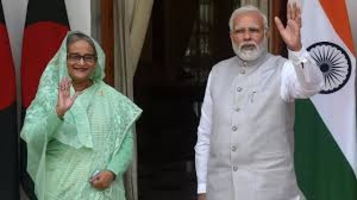
Indian policymakers and the public have been presented a uniform narrative for years—that Sheikh Hasina, the veteran Prime Minister of Bangladesh and daughter of Sheikh Mujibur Rahman, is India’s best friend in Dhaka. Right from Indira Gandhi to Narendra Modi, successive governments of India have dealt with the Mujib-Hasina family as “Bharat’s natural friend.” However, a closer examination indicates that this perception may be closer to myth than fact. And far from being a faithful ally, Hasina’s politics—opportunistic, Islamic-appeasing, and survivalist for the high command—have made Bangladesh a hotbed of radicalism and Hindu persecution, and critically endangered India’s long-term security, especially in Assam and the Northeast.
The Myth of “Bharat’s Friend”
The origins of the “India’s friend” mythology are traced to 1971, when India was instrumental in Bangladesh’s liberation war. Hasina’s father, Sheikh Mujibur Rahman, was described as owing a debt to India’s sacrifice and hence a natural friend. In the passage of time, this description extended to Hasina herself, especially during her first stint in office between 2009 and 2025. New Delhi viewed her as an anchor figure who could ensure that Bangladesh would never become a launchpad for the separatist movement or anti-India militancy.
But this strategic assumption has proved erroneous. In actuality, Hasina’s politics have tended to diverge from Indian security and cultural interests more than once. Her actions always betray that she was not loyal to India, nor even to secularism, but to holding on to power at any cost.
Silence on Hindu Persecution
One of the most conspicuous inconsistencies in Hasina’s so-called friendship with India has been her failure to utter a word about the systematized persecution of Hindus in Bangladesh. Despite India consistently raising the issue, her government let Islamic mobs and groups perpetrate violence on minorities—setting temples ablaze, grabbing land, and driving Hindus out across the border.
Rather than containing Islamist extremism, Hasina harvested it. She wooed Islamist clerics to gain electoral acceptability, insisting in parliament that Bangladesh would be ruled according to the “Medina Charter” and assuring that no anti-Islam bills would be introduced. In order to pacify fundamentalists, she ousted liberal voices within her party and constructed more than 560 “model mosques.” By honoring madrasa instructors at the national level, she entrenched Islamic conservatism further.
In effect, Hasina chose to sacrifice Bangladesh’s secular identity—and its Hindu minority—for political survival. India, meanwhile, looked away, still believing in the illusion of her friendship.
Islamism in Power: A Hidden Reality
While the Awami League presented itself as secular, the actual narrative during Hasina’s tenure was one of silent empowerment of Jamaat-e-Islami and Islamist networks. Officially banned since 1971, Jamaat cadres infiltrated state institutions—the bureaucracy, police, judiciary, and even the armed forces. Hasina either didn’t or wouldn’t dismantle this entrenched Islamist apparatus.
By the time she fell from power in 2025, Jamaat-e-Islami’s influence was stronger than ever. The irony is stark: while Hasina posed as India’s shield against radicalism, her governance created fertile ground for its expansion. Bangladesh today is arguably more Islamist than it was two decades ago.
Assam and the Security Spillover
For India, and especially for Assam and the Northeast, this reality is something to be alarmed about. The open border has been a channel of illegal migration from Bangladesh long enough to change Assam’s demographic profile. Something that was once brushed off as scare-mongering is now starkly visible: the gradual increase of Islamic radical networks in border areas.
Bangladesh’s inability to curb anti-India operations has direct implications. Separatist groups, arms runners, and extremist preachers take advantage of this weakness. If Bangladesh is soon taken over by Islamist politics—trends indicate this—the fantasy of converting Assam into an Islamic base will cease to be beyond imagination. The plan is already being sketched on the other side.
Hasina’s Strategic Calculations
Why then did India persist in supporting Hasina in spite of such warning signs? The reasons lie in realpolitik. To New Delhi, she was a reliable partner in contrast to the uncertainty of BNP or Jamaat-dominated governments. Hasina did make some strategic gestures—like taking action against anti-India rebels taking refuge in Bangladesh. But these were tactical and not ideological. She understood that maintaining India’s favor entailed financial support, diplomatic support, and global legitimacy.
Hasina’s “friendship” was never about shared values; it was about exploiting India’s anxieties. She used India as a crutch to secure her authoritarian rule while simultaneously deepening Bangladesh’s Islamic identity for domestic survival.
From Indira to Modi: Continuity of Misconception
The issue is not Hasina alone. Indian governments in succession from Indira Gandhi to Narendra Modi succumbed to the same trap of seeing the Mujib family as dependable. The half-century-old myth of “Bharat’s friend” has hindered a hard-eyed evaluation of Bangladesh’s domestic dynamics. This strategic myopia has exposed India to the very dangers that it tried to avert.
The Collapse of the Illusion
With Hasina currently deposed and in hiding in India, the breakdown of this fantasy is clear. Her political defeat reveals the weakness of India’s Bangladesh policy, which over-identified with a single family and neglected larger social changes. Now, as Jamaat-e-Islami and Islamist forces gain power, India has a more unfriendly Bangladesh than ever.
For Assam and the Northeast, the consequences are existential. Demographic change, extremism, and cross-border terrorism are not far-off possibilities but present-day dangers. Unless India readjusts its strategy—beyond the Hasina-Mujib myth—it will keep paying the price of misplaced trust.
Time for Realism
Sheikh Hasina was never really “India’s friend.” She was either an opportunistic partner at best or a political opportunist who emboldened forces ideologically opposed to India at worst. The killing of Hindus, the ascent of Jamaat-e-Islami, and the Islamist hardening of Bangladeshi politics all occurred on her watch. And still, India welcomed her with “five-star hospitality” blinded by the fantasy of strategic convenience.
Now, with the situation going from bad to worse in Bangladesh, India has to face facts. The Mujib-Hasina legacy is not a mantle of honor but an albatross. India’s future security—particularly in Assam—is tied to shaking off this illusion and having a harder, more realistic policy towards Dhaka.
