
PM Modi Opens Game-Changer Aunta-Simaria Bridge on Ganga
“The Aunta-Simaria six-lane bridge, inaugurated by PM Modi, is set to transform Bihar’s connectivity and economy, linking Patna with Begusarai while reducing travel distance, boosting trade, and strengthening North-South integration.”

Shivani Singh
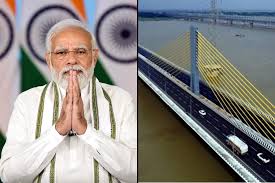
New Delhi, 29th August: On 22nd August 2025, Prime Minister Narendra Damodar Das Modi inaugurated the much-awaited Aunta-Simaria Ganga Bridge, marking a historic milestone in India’s infrastructure journey. Stretching across the holy river Ganga, this iconic six-lane bridge is not just a feat of engineering brilliance but also a symbol of India’s growing focus on connectivity, regional development, and cultural pride.
At 8.15 kilometers long, with a 1.86 km main bridge and 6.3 km of approach roads on National Highway 31, the project has been built with an investment of ₹1,870 crore. Standing parallel to the aging Rajendra Setu—a two-lane rail-cum-road bridge that faced frequent closures—the Aunta-Simaria Bridge represents a modern, durable, and ambitious step forward. It directly links Mokama in Patna district with Simaria in Begusarai, thereby creating a vital corridor that redefines North-South Bihar connectivity.
Building the Economic Artery of Bihar
The Aunta-Simaria Bridge is not just concrete and steel—it is an economic artery that promises to transform the landscape of Bihar. For decades, commuters and traders endured the painful bottlenecks on Rajendra Setu, often stuck in traffic jams that lasted an entire day or forced detours adding more than 100 kilometers to travel. The new six-lane bridge has eliminated these roadblocks, reducing travel time and costs significantly.
By directly connecting North Bihar to South Bihar, the project is expected to boost industrial trade between Patna and Begusarai, two of the state’s most industrially vibrant districts. Faster logistics will naturally translate into higher efficiency, reduced fuel consumption, and lower transport costs, creating a ripple effect across the economy.
Moreover, the bridge is poised to unlock Bihar’s tourism potential. Simaria Dham, a sacred pilgrimage site, now enjoys seamless connectivity, inviting greater footfall and energizing the rural economy. In essence, the bridge is not only a passage for goods and vehicles but also a gateway to cultural, social, and economic revitalization.
Beyond Connectivity: A Political and Cultural Statement
Infrastructure inaugurations under the Modi government have increasingly become spectacles of both development and cultural symbolism—and the Aunta-Simaria bridge was no exception. The ceremony was more than a ribbon-cutting event; it was a grand cultural showcase attended by top leaders and celebrated with regional pride.
PM Modi’s choice of attire and gestures spoke volumes. Draped in Bihar’s traditional gamchha, he aligned himself with the cultural identity of the state. The atmosphere was further enriched by the soulful notes of Sharda Sinha’s iconic “Chhath Geet”, evoking nostalgia and resonating deeply with Bihar’s traditions. Perhaps the most striking element was the Prime Minister’s address in Magahi dialect, where he bowed to the holy city of Gaya with the words “Pavitra nagri Gayaji ke hum pranam karain chhi”. Such linguistic intimacy reinforced the sense that the project was not merely about roads and bridges but about building emotional bridges with people.
The timing of the inauguration was also politically significant. With Bihar’s assembly elections scheduled later in the year, the bridge’s unveiling served as a powerful reminder of the government’s focus on development. It combined tangible infrastructure with symbolic cultural outreach, sending a calculated message of progress and pride.
The Strategic Vision: Infrastructure as Transformation
The inauguration of the Aunta-Simaria Bridge fits into the larger vision of the Modi government—where infrastructure is seen as the backbone of economic growth. Projects like these are not isolated achievements but part of a larger framework of reforms that emphasize “Reform, Perform, and Transform.”
By addressing a decades-old infrastructure bottleneck, the government has shown its ability to deliver solutions where past administrations faltered. The seamless connectivity created by this bridge is expected to improve Bihar’s industrial competitiveness and attract future investments.
Furthermore, it reflects how infrastructure projects can simultaneously serve political, economic, and cultural functions. On one hand, it enhances logistics and trade; on the other, it strengthens cultural roots and political narratives. This blend of progress with tradition has become a hallmark of Modi’s governance model.
A Bridge Between Past Neglect and Future Aspirations
The Aunta-Simaria Bridge is more than an engineering structure—it is a statement of intent. For years, Bihar’s development story was marred by neglect and stagnation, with critical infrastructure projects either delayed or abandoned. This bridge not only rectifies past oversight but also sets a benchmark for future aspirations.
By reducing distances, facilitating trade, boosting tourism, and easing daily commutes, it carries the potential to reshape Bihar’s economic destiny. At the same time, its inauguration, rich in cultural and political undertones, reflects the Modi government’s ability to craft a narrative of inclusive development—one that appeals to both the pragmatic needs and the emotional sentiments of people.
Bihar’s Road to Transformation
The Aunta-Simaria Ganga Bridge will undoubtedly be remembered as a landmark of modern Bihar. It represents a convergence of engineering innovation, cultural identity, and political foresight. While its immediate benefits lie in improved connectivity and economic opportunities, its broader impact is symbolic—it signals a new era where Bihar can aspire to shed its image of backwardness and emerge as a hub of growth and development.
As the world looks at India as a rising power, projects like this bridge underscore how infrastructure can be the foundation of both economic prosperity and social cohesion. Bihar’s journey is far from complete, but with milestones like the Aunta-Simaria Bridge, it has certainly taken a decisive step forward.
