
Mahua Moitra’s Threat to Amit Shah: A Blow to Democracy
why Mahua Moitra's Beheading Remark Should Be Condemned

Poonam Sharma
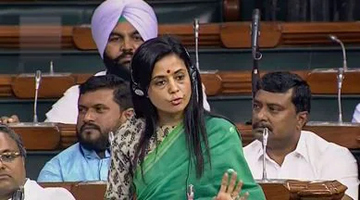
In a healthy democracy, the elected get the power of speech. Words are not just personal opinions but mirror the institutions that they represent. However, over the last few years, the Indian political scene has seen a troubling move away from parliamentary decorum towards words that slide perilously close to incitement. The latest instance is that of Trinamool Congress (TMC) MP Mahua Moitra, who threatened to “behead” Union Home Minister Amit Shah.
Such words are not just unbefitting of an elected parliamentarian but highly corrosive to the democratic fabric. It symbolizes a new trend where people’s chosen leaders shed some serious thought and instead resort to intimidation, personal abuse, and even veiled threats of violence. This cannot be written off as a mere gaffe of the tongue or a partisan exaggeration. It marks the normalization of verbal extremism in the public arena—something that all citizens across political parties must universally deplore.
The Deterioration of Political Elegance
Indian politics has always been characterized by passionate orations and acrimonious disagreements. Ideological leaders of all hues—Atal Bihari Vajpayee, Indira Gandhi, or Pranab Mukherjee—had intense arguments, but hardly did they bring in an aura of violence in their speech. What we see today is not passionate democracy but irresponsible populism.
By resorting to imagery of physical violence against one of the country’s highest constitutional representatives, Moitra has brought parliamentary debate down to street-level sloganeering. More egregiously, such utterances don’t stay in back rooms or assembly halls but get rapidly shared on social media, further dividing citizens and empowering fringe elements who take political rhetoric at face value.
Leadership by Intimidation: A Dangerous Trend
The heart of representative democracy is persuasion. A leader has to argue, persuade, and rally public opinion—not intimidate opponents. But when intimidation is a weapon, it is a sign of desperation and moral bankruptcy. The use of threats instead of ideas indicates the intellectual emptiness of politics that survives only on outrage.
Unfortunately, this is not an isolated case. Over the past decade, Indian political discourse has been littered with personal slurs, casteist barbs, sexist jibes, and now, outright threats of violence. Instead of constructive criticism of government policies, the opposition often resorts to personal attacks on leaders. This undermines the credibility of opposition parties, who are essential in holding the government accountable but lose moral standing when they descend into abusive politics.
The Effect on Democratic Institutions
When elected representatives resort to threats, they delegitimize the institution they are a part of. Parliament is meant to be the forum for rational argument and disagreement. If MPs themselves adopt the language of violence, what does that say to the people who have elected them?
In addition, such comments open a bad precedent. If intimidation by words is not protested, it leads the way to real violence. India has already seen a culture of street fights, political killings, and mob vigilantism. When leaders talk irresponsibly, they create a climate in which the divide between words and action gets lost.
The integrity of the Home Minister’s office needs to be upheld, not on account of who happens to hold it, but on account of what it symbolizes. A verbal or physical attack on the office of the Home Minister is an attack on the constitutional order of the Republic.
Why Silence is Complicity
Most alarming of all is the subdued reaction from the political brotherhood. Rather than outright denunciation, most attempt to construe such statements as “political rhetoric” or attribute overreaction on the part of the ruling party. Such false equivalence is risky. Violent threats must never be made acceptable or dismissed as “part of the game.
Democracy needs dissent, but the dissent has to be presented with dignity. Staying quiet against such an approach is to invite further lowering of political morality. It inspires others to follow the same suit, and the consequence is a race to the bottom where decency is discarded and anarchy holds court.
Restoring Dignity in Politics
The answer is to be found in institutional and societal reactions. Parliament needs to implement tighter codes of conduct that sanction members for using abusive or threatening rhetoric. Political parties need to exercise internal discipline, establishing that no leader, be she/his as popular, has immunity from decency standards. Civil society, the media, and the electorate also have a role to play by rejecting leaders who survive and campaign only on hate speech and threat.
Above all, politicians themselves need to acknowledge that words have consequences. The responsibility they bear is not a individual warrant to denigrate, but a grave duty to maintain the respect of their office. Passions will need to be expressed, and criticism will need to be leveled, but they should be done so in the name of policy, not invective.
Selecting the Language of Democracy
The incident of Mahua Moitra’s “beheading threat” is a stark reminder of how easily democratic norms can fray when politicians opt for outrage rather than argument. At a moment when India is grappling with multiple challenges—be it economic growth and social justice or national security—public debate should be solution-oriented, not threatening.
As citizens, we are entitled to higher expectations from our representatives. Leaders need to be reminded that they are not street agitators but guardians of the mandate of the people. They need to argue vehemently, criticize vociferously, and oppose vocally—but never threaten or intimidate. Once the vocabulary of violence becomes accepted in politics, then democracy starts to bleed.
