
RSS-BJP Balance: Mohan Bhagwat’s Call for Unity and Dialogue
“At the Sangh’s centenary series, Mohan Bhagwat clarified the RSS-BJP relationship, rejecting notions of conflict, addressing caste and population debates, and urging dialogue as the path to national unity.”

Paromita Das
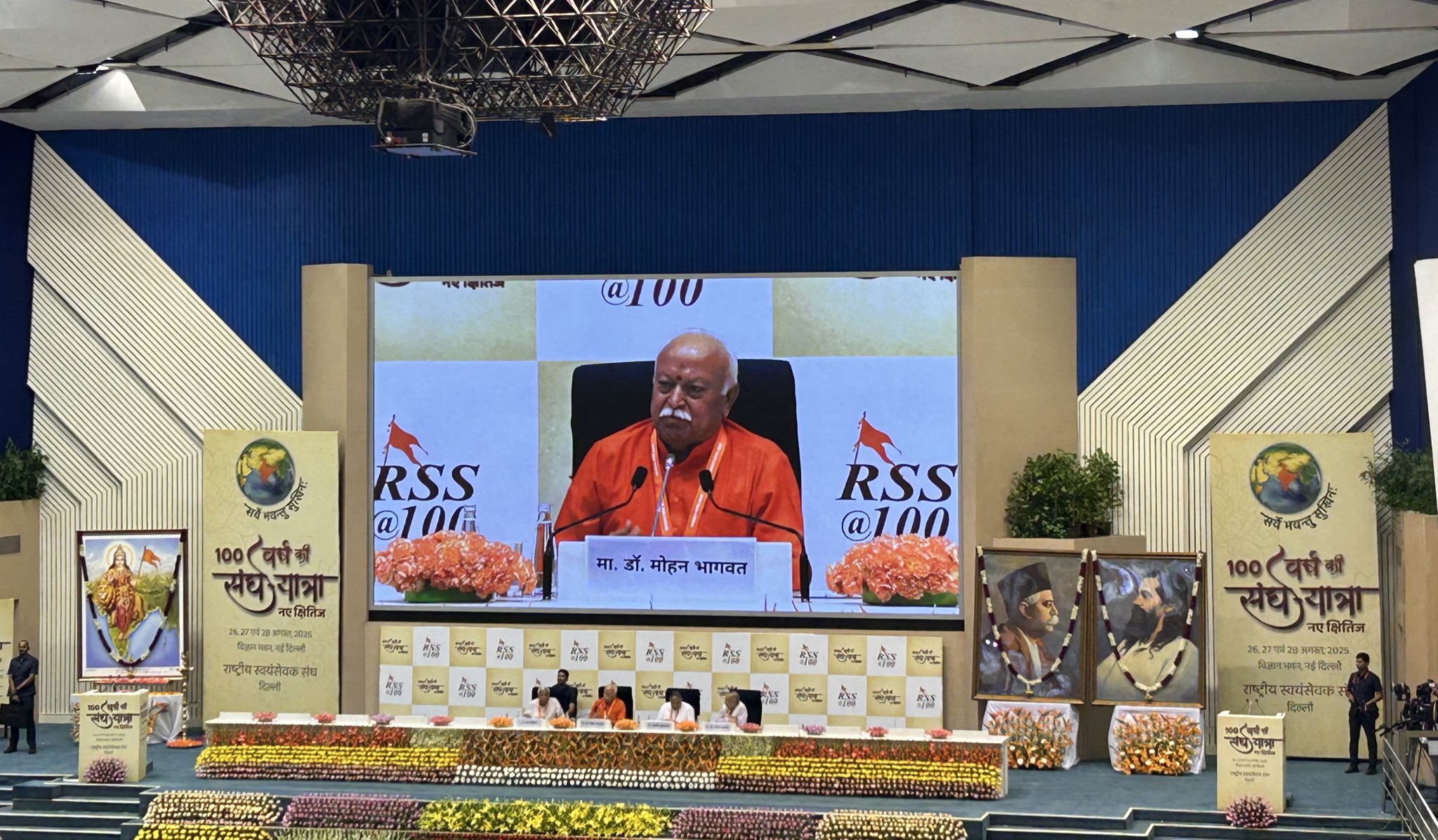
New Delhi, 29th August: When Mohan Bhagwat, the Sarsanghchalak of the Rashtriya Swayamsevak Sangh (RSS), declared that there is “struggle but no quarrel” with the Narendra Modi-led government, he captured the complex yet symbiotic relationship between the Sangh and the Bharatiya Janata Party (BJP). His words, spoken during the Sangh’s centenary celebrations, attempted to douse speculation of a rift while reaffirming the shared ideological foundation that binds both organisations.
Rather than conflict, Bhagwat’s message was one of dialogue, balance, and national purpose. By stressing cooperation without control, he highlighted the RSS’s role as a cultural guide and the BJP’s role as a political executor. This subtle yet critical distinction continues to shape the contours of Bharat’s governance and public discourse.
Dialogue Over Domination

Bhagwat’s assertion that differences are resolved through consensus rather than confrontation underscores a philosophy of deliberation over diktat. By clarifying that the RSS does not dictate BJP decisions—such as leadership appointments—he reinforced the idea that while the Sangh inspires, it does not govern. This careful balancing act ensures that the BJP retains political autonomy, while the RSS continues its mission of social and cultural awakening.
In this light, J.P. Nadda’s earlier comment that the BJP is capable of managing its own affairs gains new meaning. Bhagwat’s reassurance acted as a cooling response, reminding both supporters and critics that ideological synergy is not the same as organisational dependence.
Addressing the Hard Questions: Caste, Manusmriti, and Equality

One of the most striking aspects of Bhagwat’s remarks was his candid dismissal of the Manusmriti as a guide for modern society. “We don’t believe in it as we don’t promote casteism. Everybody is equal,” he said, firmly distancing the Sangh from discriminatory interpretations of scripture.
This intervention is significant in a country where caste continues to be both a social reality and a political flashpoint. By calling for a new “smriti” adapted to contemporary values, Bhagwat positioned the RSS as an organisation willing to evolve without abandoning its cultural roots. It was as much an ideological stance as it was a strategic outreach to younger Bharatiya who view caste hierarchies as outdated and unjust.
Akhand Bharat: Memory, Vision, and Politics

Bhagwat’s reiteration of the RSS’s belief in Akhand Bharat—a united Bharat—was another moment that resonated strongly. While acknowledging that the RSS was too weak in 1947 to prevent partition, he framed the idea of unity not in territorial terms but in civilisational ones.
This vision appeals to cultural pride, linking present anxieties about demographics, conversions, and infiltration to the unfinished historical wound of partition. For the RSS, Akhand Bharat is less about redrawing borders and more about rekindling a shared cultural consciousness across South Asia.
Population, Infiltration, and the Controversial Three-Child Policy

Perhaps the most debated point in Bhagwat’s remarks was his call for a three-child policy. He argued not only from the perspective of demographic stability but also from family dynamics, suggesting that children from larger families develop healthier social skills.
At its core, however, his concern was about population imbalance, echoing Prime Minister Modi’s warnings about demographic changes. Bhagwat insisted that Bharat’s ethos of “Vasudhaiva Kutumbakam” should not mean unchecked immigration or illegal settlement. While some may view this as a necessary safeguard for national security, others see it as a potentially divisive stance in an already resource-constrained country.
Culture, Education, and the National Language Debate

Another recurring theme in Bhagwat’s comments was the need to decolonize Bharat’s education system. He criticized the persistence of British-era frameworks and called for curricula rooted in Bharatiya traditions, values, and contemporary needs.
On the sensitive subject of language, Bhagwat struck a conciliatory tone, asserting that all Bharatiya-origin languages are national languages. By urging against unnecessary conflict, he attempted to neutralize a debate that often pits Hindi against regional languages, reinforcing instead the pluralism inherent in Bharat’s identity.
Leadership, Retirement, and Trust in Institutions

Bhagwat also addressed speculation about his earlier comments on political retirement at 75, clarifying that it was more jest than prescription. By doing so, he distanced himself from political gossip while reaffirming the Sangh’s ethos of service over ambition.
On legislative debates such as the removal of tainted Prime Ministers and Chief Ministers, he deferred to Parliament, signalling faith in democratic institutions rather than overstepping into political prescriptions. His stance reinforced the RSS’s self-image as a moral compass rather than a parallel authority.
The Tightrope Between Ideology and Governance

Bhagwat’s statements reveal the RSS’s delicate balancing act. On the one hand, it asserts strong positions on unity, population, and cultural revival. On the other, it avoids overreaching into direct governance, leaving political execution to the BJP.
This balance, however, is not without its tensions. The call for a three-child norm, while ideologically framed as fostering unity, risks criticism in a country still battling poverty, inequality, and resource scarcity. Similarly, while rejecting casteism is progressive, the RSS’s historical baggage means its statements will always be scrutinized for consistency.
Ultimately, Bhagwat’s comments reveal a strategy of cautious engagement: advancing bold cultural positions while carefully maintaining distance from political micromanagement.
Struggle Without Quarrel, Unity Without Control
Mohan Bhagwat’s intervention can be distilled into a guiding principle: dialogue without dominance. By acknowledging disagreements while reaffirming shared goals, he reminded observers that the RSS and BJP are bound by ideology but separated by function.
For Bharat, this message carries weight. It suggests a political culture where ideological guidance coexists with institutional autonomy, and where unity is pursued not through coercion but through conversation.
As the RSS steps into its second century, its real challenge will be to sustain this balance—upholding cultural continuity while adapting to the realities of modern governance. Struggles may continue, but quarrels, as Bhagwat insists, need not define the relationship.
