
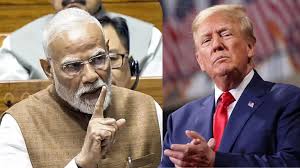
Trump 50% tariffs kicks on August 27, Modi calls for self-reliance

By Anjali Sharma
WASHINGTON – United States on Tuesday released a draft notice from the Department of Homeland Security detailed plans to impose 50% tariff on Indian goods, after an earlier announcement by President Donald Trump, media reported.
US will enforce a 50% tariff on Indian goods from August 27, 2025, penalized New Delhi over Russian oil imports.
PM Modi urged self-reliance and Swadeshi to withstand external pressure from Washington.
The notice said that the increased levies would hit Indian products “that are entered for consumption, or withdrawn from warehouse for consumption, on or after 12:01 AM eastern daylight time on August 27, 2025.”
Trump had put high tariffs amounting to 50% on Indian goods penalize New Delhi over its continued purchase of Russian oil.
The announcement takes the level of tariff to 50 per cent for many products among the highest on any American trading partner.
Modi inaugurated a series of development projects and reiterated his government’s stance on self-reliance, asserted that India would not bow to external pressures.
“For me, the welfare of farmers, cattle rearers, and small industries comes first. The world may try to mount pressure, but we will endure it for the nation’s good,” he said.
He urged citizens and businesses to place swadeshi products at the core of their choices.
US will enforce a 50% tariff on Indian imports an increase from the existing 25% starting on August 27, 2025.
External Affairs Minister S Jaishankar has pushed to increase trade with Russia, encouraged Russian companies to engage “more intensively” with their Indian counterparts.
He noted India’s rapidly growing economy and initiatives like ‘Make in India’ that have opened up new windows for foreign businesses.
Jaishankar said that these dimensions represent an invitation for Russian companies to engage more.
“An India with a GDP of USD 4 trillion plus growing at 7% for the foreseeable future has an obvious need for large resources from dependable sources. In some cases, it could be assured supplies of essential products, fertilizer, chemicals, and machinery, being good examples. Its rapidly growing infrastructure offers business openings to enterprises with an established track record in their own country,” said Jaishankar.
“The ‘Make in India’ and other such initiatives have opened up new windows for foreign businesses. The modernisation and the urbanisation of India generate their own demands, flowing from shifts in consumption and lifestyle. Each of these dimensions represent an invitation for Russian companies to engage more intensively with their Indian counterparts. Our endeavour is to encourage them to rise to that challenge,” he added.
He noted that India and Russia have nurtured one of the steadiest relationships between major nations, Jaishankar pushed for more “strenuous efforts” to diversify and balance trade between both nations.
“India and Russia have nurtured one of the steadiest relationships between major nations in current times is now widely recognized. However, that did not automatically translate into significant economic cooperation. Our trade basket remains limited and till recently, so did our trade volume. It may have grown in recent years, but then, so too has the trade deficit. Both the diversification and balancing of trade now urgently mandate more strenuous efforts on our part. At the end of the day, they are essential not just to reach higher trade targets but even to sustain the existing levels,” he said.
Jaishankar pushed for deeper cooperation to promote growth and accelerate development and expressed India’s willingness to contemplate more investments, joint ventures and other forms of collaboration.
“It is reasonably evident that there is much that India and Russia can do for each other in promoting growth and accelerating development. What we seek to do as Governments is to provide the guidance and create conditions for economic activities to take place. Clearly much centres around trade but there is growing willingness to contemplate more investments, joint ventures and other forms of collaboration. First DPM Manturov and I are here amongst you to encourage those processes. We want to send a clear message that an enduring strategic partnership must have a strong and sustainable economic component.” he said.
Jaishankar was speaking about India signing Terms of Reference for the India-Eurasian Economic Union on a Free Trade Agreement, said,” We have today concluded the Terms of Reference for the India-Eurasian Economic Union FTA. That will surely make a difference when concluded. We spoke about motivating joint ventures in key areas where the demand is already established. Some initiatives of significant investment levels were also spoken about. Our skilling and mobility endeavours have started to take off. The desire to improve connectivity is also expressed through multiple options.”
“But in the final analysis, what we really need is for businesses to step forward confidently. Not just that, also ensure that there is a close collaboration between what Governments are discussing and businesses are planning,” he added.
Jaishankar positive push to increase trade with Russia came after US levied an ad valorem duty of 25 per cent on Indian goods, but has announced an additional 25 per cent tariff that will take effect from August 27, raising the total duty to 50 per cent.
