
Education Minister Urges IITs to Lead ‘Atmanirbhar Bharat’ Vision
Government Support Through Fellowships and Research Parks

-
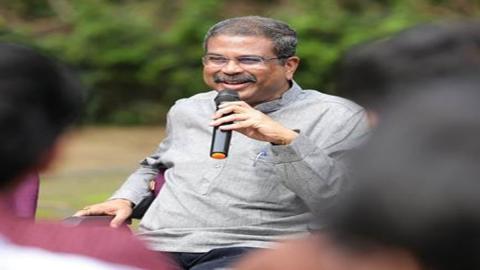
Union Education Minister Dharmendra Pradhan urged IITs to lead the vision of Atmanirbhar Bharat by focusing on innovation, translational research, and job creation.
-
The 56th IIT Council meeting at IIT Delhi discussed reforms in PhD education, global rankings, and the IITs@2047 roadmap.
-
IITs have already nurtured over 6,000 start-ups, 56 unicorns, and nearly 5,000 patents, emerging as engines of entrepreneurship and economic growth.
-
The Council resolved to promote regional languages, boost international outreach, and frame a policy to accelerate self-reliant research and product development.
GG News Bureau
New Delhi,26th August-Union Education Minister Dharmendra Pradhan on Monday called on Indian Institutes of Technology (IITs) to become the key drivers of Prime Minister Narendra Modi’s vision of an “Atmanirbhar, Samriddha Bharat.” He urged the premier institutes to move beyond incremental changes and spearhead a “quantum jump” in innovation, entrepreneurship, and inclusive growth.
Mr. Pradhan was speaking at the 56th Council of IITs, which was convened at IIT Delhi and had participation from senior policymakers, technologists, industry leaders, and academicians. Pointing towards the central role of IITs in nation-building, the minister told these institutes that they need to be “catalysts for civilisational resurgence and global leadership.”
Focus on Job Creation and Real-World Solutions
The Education Minister emphatically underscored that IITs need to change their emphasis from being job seekers to being job creators. He emphasized enhancing translational research in key national technologies and making sure that academic knowledge is converted into actionable solutions for industry and society.
He also stressed the expansion of inclusiveness in higher education through encouragement of regional languages as much as English as a medium of instruction so that IITs become more inclusive for students from all over India.
Innovation and Start-up Ecosystem
Highlighting IITs’ role in India’s start-up revolution, Mr. Pradhan pointed out that the institutions have already produced over 6,000 start-ups, 56 unicorns, and approximately 5,000 patents. He was certain that IITs will keep on converting India’s national vision into results, creating large-scale employment, and building a “Viksit Bharat by 2047.
He also emphasized the encouragement by the government through programs like the Prime Minister’s Research Fellowship, Centres of Excellence in Artificial Intelligence, and research parks that have made IITs into drivers of economic growth in sync with the appeal to “Reform, Perform, Transform.”
MoS Majumdar: IITs as Engines of Transformation
Minister of State for Education and DoNER, Dr. Sukanta Majumdar, asserted that IITs are now not only centers of academic brilliance but also drivers of “Innovation, Inclusion, and Transformation.” He added that with 23 IITs, overseas campuses, and a rich startup ecosystem, the institutions are creating global leaders while having India keep rising through Research, Innovation, Skills, and Entrepreneurship (RISE).
Roadmap Towards IITs@2047
Main discussions during the Council meeting centered on revising PhD education, improving world rankings, and commercializing research yields. Senior participants included former ISRO Chairman Dr. K. Radhakrishnan, Zoho CEO Sridhar Vembu, former UGC Chairman Prof. M. Jagadesh Kumar, AICTE Chairman Prof. T.G. Sitharam, and a few IIT chairpersons.
The Council also informed the establishment of a Task Force to prepare an action plan for higher and school education according to the IITs@2047 vision. Matters regarding mental well-being, industry-academia connections, and aligning curricula with upcoming technologies such as Artificial Intelligence were also put on the agenda.
Regional Languages and Global Outreach
The session also emphasized the need to push Indian languages in technical education, building alumni connections for mentorship and industry collaborations, and increasing assistance to international students and faculty. The most significant resolution was to raise the annual IIT R&D Fair to a global innovation exhibition and to draft a policy within a month for streamlining translational research and product development towards self-reliance.
With these programs, the government and IITs want to make India’s top institutes nerve centers of innovation and entrepreneurship that will drive the country’s journey in becoming a global leader by 2047.
