
Poll Rolls in Focus: ECI Clarifies, Modi Accuses Congress of Hypocrisy
“As the Election Commission dismisses Opposition charges of voter list manipulation, Prime Minister Narendra Modi escalates the political battle by accusing Congress of betraying Babasaheb Ambedkar’s legacy and enslaving the poor through decades of unjust laws.”

Paromita Das
New Delhi, 19th August: In a democracy as vast and diverse as Bharat, trust in electoral institutions is the foundation of political stability. Yet, recent weeks have seen a stormy exchange between the Election Commission of India (ECI) and the Opposition, particularly the Congress party, over allegations of large-scale voter fraud in the 2024 Lok Sabha elections.
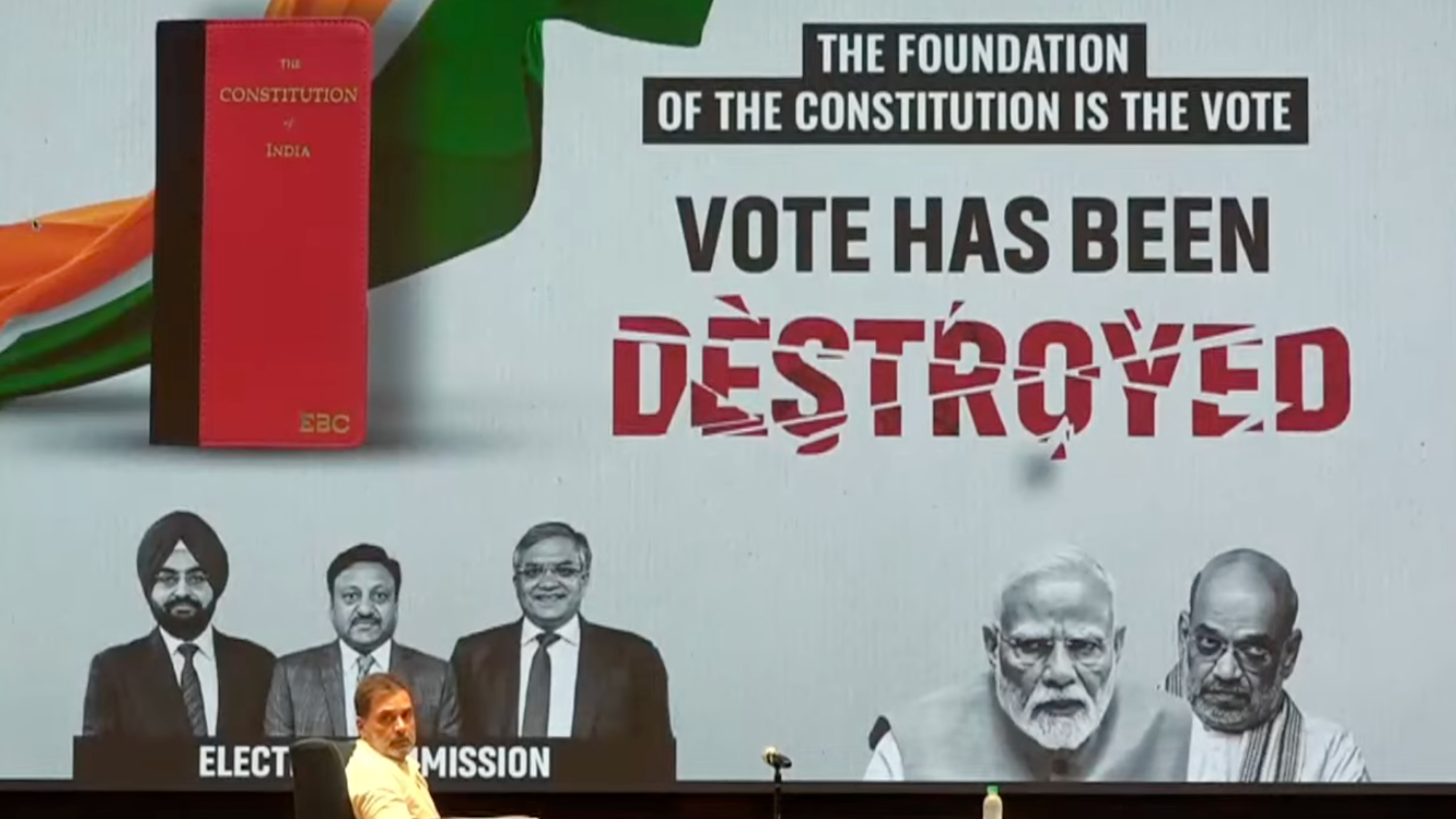
While Congress leader Rahul Gandhi accused the Commission of allowing “vote theft” across several states, the ECI strongly rebutted the charges, insisting that established mechanisms exist for parties to raise objections to electoral rolls well before voting takes place. Almost simultaneously, Prime Minister Narendra Modi launched a sharp attack on the Opposition, accusing them of hypocrisy on constitutional values and social justice. Together, these developments reflect not only the turbulence of Bharat’s political discourse but also the deeper contest over credibility, governance, and public trust.
The Election Commission’s Defence: Transparency and Accountability
The Election Commission, long regarded as one of Bharat’s most trusted institutions, issued a press release clarifying its position after the Opposition claimed manipulation in voter lists. According to the ECI, political parties are provided with both digital and physical copies of draft electoral rolls before every election. A one-month window is then given for scrutiny and objections.
This “Claims and Objections” period, the Commission emphasized, is the appropriate stage for identifying errors such as duplicate entries or missing names. After corrections, the final electoral rolls are again shared with political parties and made publicly available on the Commission’s website. In short, the ECI argued that the system is designed for transparency, but political actors often fail to engage with it in time.
Election Commission of India says, "Recently, some Political Parties and individuals are raising issues about errors in the Electoral Rolls, including those prepared in the past. The appropriate time to raise any issue with the Electoral Rolls would have been during the Claims… pic.twitter.com/0Q2e9brBES
— ANI (@ANI) August 16, 2025
The Commission even went a step further, directly asking Rahul Gandhi to submit the names of voters he believes were wrongly added or removed, along with a signed declaration. By shifting the burden of proof back on the Opposition, the ECI positioned itself as an institution open to scrutiny but unwilling to accept blanket accusations without evidence.
Opposition’s Stand: “Vote Theft” and Public Mobilization

For the Opposition, however, the issue is not merely procedural but political. Rahul Gandhi, in a press conference on 7 August, accused the Commission of presiding over a “vote theft” operation. Citing Karnataka’s Mahadevapura constituency, he alleged that more than one lakh votes had been duplicated through fake addresses and multiple registrations.
“These are figures from the Election Commission itself,” Gandhi said, arguing that the silence of the poll body only strengthened suspicions of complicity. His remarks, amplified by other Opposition leaders, sought to tap into a broader sentiment of distrust among sections of the electorate.
This clash highlights the widening gulf between Bharat’s largest Opposition party and an institution it once defended. At stake is not just a list of names on a voter roll but the credibility of the electoral process itself—a theme that carries immense weight in the world’s largest democracy.
Modi’s Counter-Narrative: Accusing the Opposition of Hypocrisy

Even as this confrontation dominated headlines, Prime Minister Narendra Modi offered a sharp counter-narrative. Speaking at the inauguration of national highway projects in Delhi, Modi accused the Congress and other Opposition parties of betraying the spirit of the Constitution while now posturing as its defenders.
He pointed to provisions in the Delhi Municipal Corporation Act of 1957, under which sanitation workers could be jailed for skipping work without prior notice. “Those who now dance with the Constitution on their heads had trampled it for decades,” Modi said, arguing that his government was the one systematically repealing unjust laws.
In addition, Modi attacked past Congress governments in Haryana, alleging that corruption once dominated job appointments in the state, whereas the BJP government had created a transparent system that provided employment to lakhs of youth. By invoking Babasaheb Ambedkar and citing specific examples of past neglect, Modi positioned his party as the true custodian of both social justice and constitutional integrity.
Framing the Battle: Institutions vs. Narratives

Placed side by side, these two episodes—the ECI’s defence of its procedures and Modi’s attack on the Opposition’s past record—reveal a larger political battle. On one hand, the Opposition seeks to frame the ruling establishment and its institutions as complicit in undermining democracy. On the other, the BJP leadership attempts to flip the narrative by questioning the Opposition’s credibility and showcasing itself as the reformist force.
This is not merely an electoral skirmish. It is about narrative ownership. If the Opposition succeeds in convincing voters that elections themselves are compromised, it could weaken trust in democratic institutions. If the BJP succeeds in portraying the Opposition as hypocritical, it reinforces the party’s image as the sole guarantor of transparency and governance.
The Real Test Lies in Institutional Credibility

Bharat’s democracy thrives on both strong institutions and robust opposition. But the current debate reflects a troubling trend where political battles are being fought at the cost of institutional credibility. The Election Commission, despite its clarifications, risks being drawn deeper into partisan contestation.
While the Opposition is right to demand accountability and transparency, it must also engage meaningfully with the processes already in place. Blanket allegations without evidence can undermine the very democratic framework it seeks to protect. Similarly, while Modi’s attacks on historical injustices may resonate with his base, they cannot substitute for a clear commitment to strengthening present-day safeguards against electoral malpractice.
Restoring Trust in Bharat’s Democratic Machinery
The controversy around electoral rolls and Modi’s counter-charge against the Opposition are not isolated incidents—they represent the ongoing struggle for narrative supremacy in Bharatiya politics. But beneath the rhetoric lies a more urgent question: how to restore and sustain trust in Bharat’s democratic machinery.
The Election Commission must ensure that its systems of transparency are not only robust but also widely understood by the public. The Opposition must pursue its allegations with concrete evidence rather than rhetorical flourish. And the ruling party must go beyond attacking past governments to demonstrate, in practice, that institutions remain free, fair, and accountable.
For a democracy of 1.4 billion people, the credibility of elections is non-negotiable. The future of Bharatiya politics may well depend on whether leaders can rise above short-term narratives and commit to strengthening the institutions that sustain the republic
