
Chip Power 2025: Modi’s Big Bet on Bharat’s Tech Future
"Once crippled by the mysterious 1989 Mohali fire that derailed its chip ambitions, Bharat is now scripting a bold comeback—Prime Minister Modi’s 2025 Independence Day pledge of ‘Made in India’ semiconductors signals a new era of self-reliance and global competitiveness."

Paromita Das
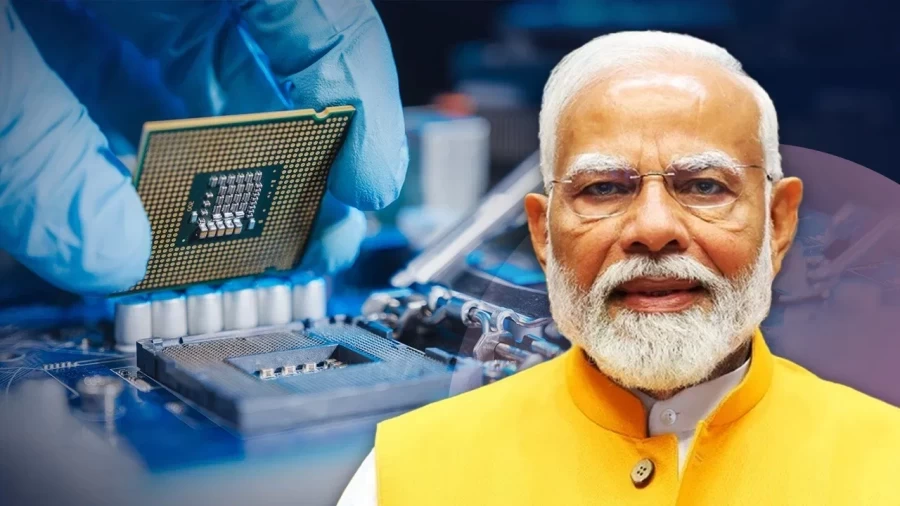
New Delhi, 19th August: When Prime Minister Narendra Modi addressed the nation on Independence Day 2025, his words carried more than patriotic fervor — they carried a promise of technological sovereignty. He announced that by the end of 2025, “Made in India” semiconductor chips would roll out of domestic factories. It was more than just a policy update; it was a turning point in Bharat’s decades-long struggle to carve out space in one of the most strategic industries of the 21st century.
This announcement was not born in isolation. It carried with it the weight of history — a story of ambition, tragedy, missed opportunities, and finally, resurgence.
The Forgotten Dream: Bharat’s Early Foray into Chips

Bharat’s tryst with semiconductors began long before the world woke up to the centrality of chips in everything from smartphones to satellites. In 1984, the government established Semiconductor Complex Limited (SCL) in Mohali, Punjab. With the ability to manufacture 64K DRAM chips, Bharat was not just dabbling but competing at the global frontier of semiconductor innovation.
Then came 1989 — the year ambition went up in flames. A mysterious fire broke out at the SCL facility, igniting simultaneously at multiple points. The blaze gutted production lines and R&D infrastructure, causing losses estimated at ₹60 crore. Some whispered sabotage, others called it negligence, but the truth never came out. What did emerge was a void — Bharat’s semiconductor dream smoldering under the ashes of Mohali.
A Generation Lost to Inertia

The fire was not just a physical tragedy but a metaphor for Bharat’s lost momentum. Efforts were made in the 1990s to revive SCL, including significant funding in 1997, but the global race had already moved ahead.
While Taiwan’s TSMC, founded in 1987, grew into the world’s most powerful chip manufacturer, and China began pouring billions into fabs and R&D, Bharat stagnated. Lack of vision, inadequate investment, and an industrial ecosystem too fragile to support cutting-edge manufacturing left Bharat decades behind. By the 2000s, Bharat was seen not as a semiconductor hub but as an IT services powerhouse — good at software, weak in hardware.
The result was dependency. Every smartphone, automobile, and defense system carried within it chips designed or produced abroad, exposing Bharat’s vulnerability.
The India Semiconductor Mission: Turning the Tide

Change began with the launch of the India Semiconductor Mission (ISM) in 2021. Unlike earlier half-hearted attempts, ISM was structured as a national movement, with government support, private sector partnerships, and international collaboration at its core.
By 2025, the results were visible. Four new assembly and testing plants were approved in Odisha, Punjab, and Andhra Pradesh with a combined outlay of ₹4,594 crore. These plants, along with planned fabrication units, form the backbone of Modi’s 2025 vision.
The mission also seeks to replicate the success of platforms like UPI, proving that Bharat can build indigenous, globally competitive systems. Just as UPI disrupted digital payments, the ISM aims to create a domestic chip ecosystem capable of fueling Bharat’s digital economy — from AI to 5G to defense technologies.
Learning from the Ashes of Mohali

The ghost of 1989 continues to haunt Bharat’s semiconductor journey. BJP IT cell convener Amit Malviya recently reflected on how the fire at SCL not only destroyed infrastructure but also robbed Bharat of decades of technological advancement. His comments struck a chord — the incident wasn’t just about a factory, but about a nation’s vulnerability when strategic infrastructure is left fragile.
This time, however, the government is betting on resilience. With lessons from Mohali etched in memory, the focus is on redundancy, security, and scale. Investments are being directed not just toward production but also toward R&D, skill development, and partnerships with global giants to ensure Bharat doesn’t merely assemble but innovates.
Beyond Chips: Building Indigenous Platforms

What makes Modi’s 2025 declaration more ambitious is its broader vision. Semiconductors are not just an industry; they are the backbone of digital sovereignty. Bharat’s push includes developing homegrown social media platforms, indigenous defense tech, and AI-driven solutions that reduce dependency on foreign ecosystems.
In essence, chips are the foundation of a much larger ambition — a self-reliant Bharat that controls its technological destiny rather than renting it from global powers.
A Critical Yet Optimistic Lens

It would be naïve to believe that Bharat’s semiconductor story will transform overnight. Building a chip ecosystem is one of the most complex industrial challenges in the world. Even with billions in subsidies, nations like the US and Europe struggle to compete with Taiwan’s scale or China’s state-backed aggression.
Bharat’s hurdles are real: infrastructure gaps, skilled workforce shortages, and the enormous capital needed for cutting-edge fabs. The success of ISM will depend not just on government announcements but also on execution, global tie-ups, and industry innovation.
Yet optimism is justified. Unlike the half-hearted revivals of the past, the current effort is backed by political will, economic necessity, and a growing digital economy that demands self-reliance. If Bharat can make UPI a global fintech marvel, there is reason to believe it can build a competitive chip ecosystem too.
From Fire to Future
Bharat’s semiconductor journey mirrors its broader struggle with modernity — a story of ambition, loss, delay, and resilience. From the fiery ruins of Mohali in 1989 to Modi’s 2025 promise of “Made in India” chips, the arc is long but instructive.
This time, the stakes are higher. Semiconductors are not just about industry; they are about sovereignty, security, and survival in the digital age. If Bharat succeeds, it won’t just reduce dependency on imports — it will cement its place as a technological power capable of shaping the future.
And perhaps, when the first chips roll out at the end of 2025, the ghosts of Mohali will finally find peace.
