

Poonam Sharma
The British-Indian connection is among the most contested legacies of colonialism. Even several decades after independence, the discourse on exploitation, cultural pilferage, and political manipulation continues to dominate impressions in both nations. The critique developed here does not present Britain as a selfless empire but a power that flourished on pillage, disintegration, and domination. Most importantly, it captures the manner in which the legacies of colonialism continue to influence India’s domestic strife and its relations with global powers. This essay analyses the colonial legacy, the paradoxes of Indian society, and the wider theme of power and hypocrisy in world politics today.
Colonial Legacy and Contradictions
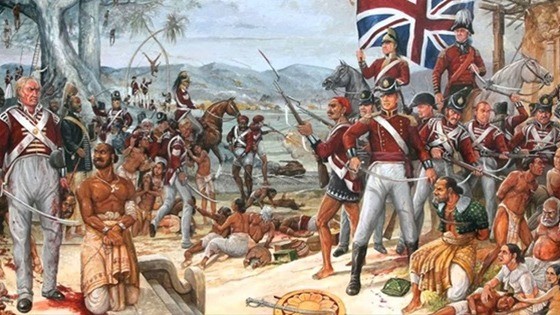
The premise for this critique begins with the contention that Britain’s role in India was overwhelmingly exploitative. Rather than a civilizing empire, the British Raj appears as an age of organized plunder. India, which was among the richest civilizations in the world, was bled white and left with poverty and weaknesses. Popular accounts of the British “bestowing” modern education, law, and administration on India are cast as a veil. Rather, these institutions were intended to uphold domination, reinforce divisions, and protect the empire’s interests.
The consolidation of caste hierarchies, the mandating of English as the language of domination, and the restructuring of local systems of governance are regarded not as reforms but as domination strategies. British museums, where artifacts of India and other colonies continue to be exhibited, symbolize cultural theft that epitomizes this plunder. While Britain now sees itself as the custodian of civilization, the reality of its past is very much linked to appropriation and exploitation. This tension still breeds resentment, especially when Britain takes on a moral high ground in global forums.
Indian Society and Internal Contradictions
Where colonialism planted deep fault lines, post-independence India too has struggled with contradiction. Caste politics, corruption, and socio-economic disparity continue as nagging issues. The critique is that India’s elites—intellectual and political—have been “pawns” in a game, preferring Western paradigms rather than developing homegrown solutions. This dependency is a colonial hangover, in which sanction by Western powers continues to be the test of legitimacy.
Concurrently, the strength of India’s cultural and spiritual heritage provides a different vision of unity. Religion, democracy, and identity politics are both the country’s strengths and weaknesses. They root India’s sense of heritage but also create space for manipulation by domestic and foreign interests. For the ordinary citizen, it leads to cycles of poverty and disillusionment as advances are often thwarted by internal competition and external pressures.
Britain, Global Power, and Hypocrisy
The criticism goes beyond the colonial past to Britain’s global role today. Though its power has waned, Britain is blamed for hanging on to influence through words and selective accountability. Its role as a champion of democracy and openness is undermined by accusations of hidden crises, like unreported nuclear accidents in Scotland. The argument is that Britain sets standards of governance and accountability for others without adhering to them at home.
This is the duality which makes the people of former colonies resentful, such as India, where individuals remember how their own soldiers and resources were used for the wars and survival of Britain. The rhetorical question posed—whether Britain would be relevant without the contribution of its colonies?—reverses the narrative of empire. Instead of being the giver, Britain is presented as existing on the silent toil, brains, and sacrifice of the peoples it once dominated.
The Question of Cultural Superiority
Perhaps the most moving aspect of this criticism is Britain’s repudiation of its cultural claims. British culture is portrayed as superficial and materialistic in contrast to India’s civilizational richness. Britain exported its legal systems and bureaucracies, but these are presented as empty institutions that undermined settled traditions of education, governance, and spiritualism in India.
The writer points out the contradiction of a society that boasts of order and advancement while burdened with cultural vacuity. Foodways, artistic expression, and daily life are shown to be shallow against the layered and long-lasting ethos of India. It is not mere cultural pride; it is an appeal to India to desist from comparing itself to the West and relearn its own intellectual and spiritual paradigms.
International Politics and Covert Agendas
The criticism also targets Britain’s involvement in contemporary geopolitics gameplay. Side by side with its allies like the United States, it is blamed for stirring up conflicts in South Asia for strategic gain. The connectivity between Britain, Pakistan, terrorism, and nuclear politics is characterized as proving evidence of covert agendas that sustain tensions in the region.
India, meanwhile, is described as intellectually constrained by Western universities, think tanks, and policy frameworks. Even as a sovereign nation, it remains entangled in systems that privilege Western priorities. This intellectual dependency is perhaps the most enduring form of colonial influence, keeping India within a framework where its ideas require external validation.
Toward Self-Reliance and Confidence
In spite of the angry tone, the analysis concludes on an optimistic course: India’s requirement for self-reliance. The appeal is not only for economic independence but also intellectual and cultural self-confidence. By tapping its scientific manpower, defense prowess, and spiritual heritage, India can redefine its destiny without outside intrusion.
This transformation calls for shedding colonial stories of subservience and reasserting native vigor. The criticism implies that India’s civilization pedigree gives it the means to transcend Western hegemony, if only it has faith in itself. The battle is as much against outside manipulation as against inside self-doubt.
Conclusion
The fervent criticism of Britain’s colonial past is not only a historical complaint—it is also a lament over the incomplete agenda of decolonization. Britain is not shown as a benevolent power but as a duplicitous empire which continues to hold on to power through rhetoric and deception. India, on the contrary, is presented as a civilizational giant with its real potential in shaking off dependency and asserting its independence.
The critique articulates a twinned emotion: fury at the past’s exploitation and hope for an autonomous future. It reminds us that colonialism’s effects did not stop in 1947 but linger in insidious form, influencing systems of knowledge, politics, and identity. To progress, India will need to neither just reveal Britain’s contradictions nor develop its own confidence, converting wounds of the past into the building blocks of a more autonomous and resilient future.
