
Rahul Gandhi’s Stray Dog Stand: Compassion or Contradiction?
"Rahul Gandhi’s outcry against the Supreme Court’s stray dog removal directive reveals a curious mix of political grandstanding, selective compassion, and deep contradictions within Congress — raising questions about whether his stance is rooted in genuine empathy or calculated optics."

Paromita Das
New Delhi, 14th August: The Supreme Court’s latest directive on removing stray dogs from Delhi-NCR localities has triggered a political and social firestorm. While the two-judge bench’s order sets a tight timeline and lays out detailed requirements — including professional shelters, sterilization, vaccination, CCTV monitoring, and a dedicated helpline — the court made it clear that obstructing the operation would invite strict legal action. The directive explicitly stated that dogs should not be released back into public spaces, a position that has sharply divided opinion.
Predictably, the loudest political criticism came from Congress leader Rahul Gandhi, who used social media to frame the court’s decision as a moral regression. But when examined against the backdrop of his political conduct, public contradictions within his own party, and personal lifestyle, Rahul’s “compassion” narrative begins to look far less convincing.
Rahul’s Statement and Congress’s Internal Contradiction

On X (formerly Twitter), Rahul Gandhi condemned the Supreme Court’s order as a “step back from decades of humane, science-backed policy,” arguing that stray dogs are “voiceless souls” and not problems to be erased. He advocated for community care, sterilization, and vaccination as a means to keep streets safe without cruelty, dismissing blanket removals as “short-sighted” and “inhumane.”
Yet, in a twist that underlined the lack of a unified stance within the Congress party, senior leader P. Chidambaram publicly backed the court’s position. Calling for implementation across all cities, Chidambaram described practical measures to relocate strays to enclosed shelters on municipal land, prioritizing public safety for children and the elderly. His statement directly contradicted Rahul’s criticism, underscoring Congress’s inability to present a cohesive, credible position on issues that demand both empathy and pragmatism.
The Moral Standing Question

Rahul’s public defence of stray dogs also invited sharp scrutiny of his own lifestyle. Social media erupted with posts highlighting what critics labelled “selective compassion.” Images of Rahul feasting on meat, cooking mutton with RJD leader Lalu Yadav, and posing with plates of non-vegetarian food resurfaced.
One user sarcastically noted, “So eating animals killed in factory farms is fine, but removing strays for public safety is cruel? Selective compassion isn’t compassion at all.” Another quipped, “Rare picture of Rahul helping voiceless souls by eating them up.” The optics were hard to ignore: while Rahul champions compassion for strays in public, his personal choices leave him vulnerable to charges of hypocrisy.
A History of Political Optics with Dogs

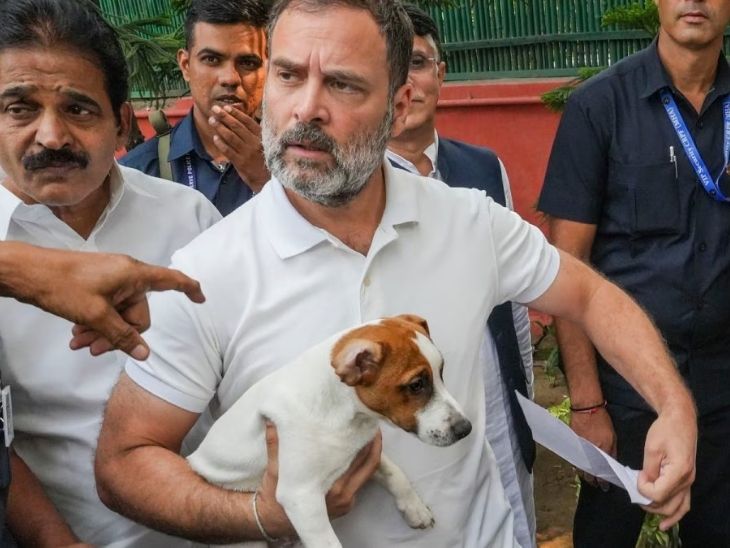
Rahul’s connection to dogs is not new. His pet beagle “Nuri” and his earlier companion “Pidi” have been minor social media celebrities, often featuring in informal Congress posts. During the Bharat Jodo Yatra, Rahul frequently brought his dog to the office, and videos of him and Sonia Gandhi playing with Nuri circulated widely.
Yet, political opponents have seized on moments where his dog-related gestures clashed with public sensibilities. BJP leaders once posted a video of Rahul offering a biscuit — first to his dog, then to a supporter after the dog rejected it — a clip that quickly became political ammunition against him.
The Bigger Picture: Compassion vs. Public Safety

The Supreme Court’s directive is not about cruelty for cruelty’s sake; it is about reconciling two equally important priorities — human safety and animal welfare. Delhi-NCR has seen a rise in stray dog attacks, particularly against children and the elderly. While sterilization and vaccination programs exist, enforcement has been inconsistent, and shelter facilities remain inadequate.
Rahul Gandhi’s call for humane solutions is laudable in principle. However, by ignoring the urgency of the safety issue and by failing to propose a workable immediate solution, his statement risks being perceived as political posturing rather than genuine problem-solving. The contradictions within his own party further weaken the moral force of his argument.
A Case of Lost Political Compass

This episode is symptomatic of a deeper problem in Rahul Gandhi’s political approach — the tendency to frame himself as the moral compass of the nation without ensuring his own positions are grounded in consistency or practical feasibility. His reflex to oppose central or institutional decisions often appears less about constructive critique and more about political branding.
Moreover, the mismatch between his professed compassion for stray dogs and his personal dietary choices exposes a vulnerability that his critics will continue to exploit. In an age where political credibility is built on perceived authenticity, such contradictions can be more damaging than outright policy disagreements.
Beyond the Politics of Compassion
The stray dog issue in Delhi-NCR is a complex challenge that requires both empathy and urgency. The Supreme Court has taken a clear stand for public safety, backed by enforceable mechanisms. Rahul Gandhi’s objections might resonate with animal rights activists, but without a practical roadmap, they risk being seen as hollow rhetoric.
If Rahul wishes to be taken seriously as a leader who can balance compassion with governance, he must ensure his words, actions, and personal example align. Selective outrage and lifestyle contradictions only undermine his credibility, giving opponents ample room to dismiss his positions as politically motivated rather than sincerely principled.
In the end, the conversation we should be having is not about Rahul Gandhi’s personal choices, but about building a humane, effective, and enforceable animal welfare system that also protects human life. Until that happens, both the politics and the policy around stray dogs will remain mired in conflict, contradiction, and missed opportunities.
