
India’s First Geothermal Power Well in Ladakh
A Symbol of Self-Reliance in Ladakh

Poonam Sharma
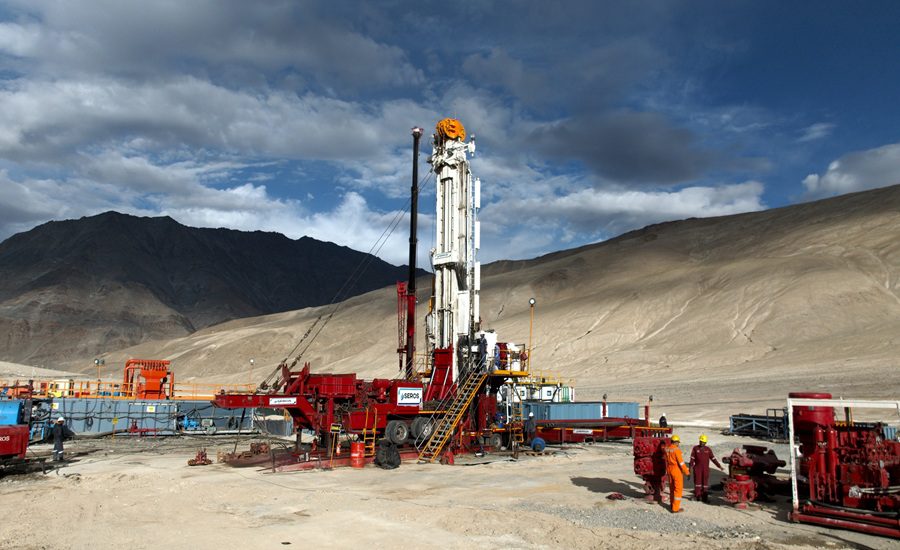
In a demonstration of grit, science, and national pride, India has drilled its first geothermal power well in one of the geologically and climatically toughest locations on the planet—the unconsolidated Himalayas. The project, undertaken by the Oil and Natural Gas Corporation (ONGC), is a testament to India’s engineering prowess, done totally with indigenously developed technology, without foreign aid.
The Toughest Terrain, the Narrowest Window
The site of this pathfinder project is not merely inaccessible—it is an engineering nightmare. The unconsolidated Himalayan landscape allows for ongoing geological instability, whereas the harsh high-altitude environment of Ladakh restricts the working season to only a few months a year. Temperatures could drop well below freezing point, and oxygen levels are low. But in these restrictive circumstances, ONGC’s engineers and geoscientists were able to drill the geothermal well in record time.
The geology of the Himalayas here is new and delicate, more susceptible to landslides and changing formations, and so precision drilling has been very challenging. Combine this with the logistical difficulty of moving heavy machinery to elevations of over 10,000 feet, and the feat becomes all the more remarkable.
A 24/7 Renewable Power Source for Remote Villages
The largest benefit of geothermal energy is that it can supply a constant 24/7 power supply—solar or wind energy cannot, as it’s dependent on weather. It has zero carbon emissions, less maintenance, and long-term stability.
For Ladakh’s citizens, this translates into a revolutionary change. Many villages in the area still have no access to continuous electricity and depend on fuel-burning diesel generators. Now, with this geothermal venture, Ladakh is able at last to put the noisy, expensive, and pollution-spewing era of diesel power behind it.
A Global Technology, Now with an Indian Stamp
On the global front, geothermal technology has been only somewhat available to nations like Iceland, New Zealand, and the United States. These countries have tapped geothermal power for decades, however, but in landscapes much less rugged than Ladakh’s. With this feat, India becomes the elite club of geothermal-driven countries—albeit with one qualification: the project was completed entirely by indigenous expertise.
Even more revealing is the fact that China never even tried a geothermal power project at such elevations, even though it has been the world leader in infrastructure. This, therefore, does not just make India’s achievement a technological triumph but also a strategic declaration.
A Message of Capability and Confidence
This geothermal project is not merely an energy project—it’s a statement. It makes a statement to the world that India is now capable of overcoming any obstacle—whether environmental, geological, or technological—on its own terms.
At a time when the world is hurrying to decarbonize, India has demonstrated its capability to innovate in renewable energy even in the most hostile climes. This is a confidence boost not just to the energy security of the nation but also to its climate commitments in international agreements.
From an Isolated Valley to a Symbol of Atmanirbhar Bharat
The drilling location is no longer an isolated corner of the Himalayas—it’s now a testament to India’s self-dependent future. This project is the epitome of the vision for Atmanirbhar Bharat (Self-Reliant India), demonstrating that world-class infrastructure and cutting-edge clean energy projects can be constructed without relying on foreign technology.
For the ONGC team, the achievement is not just about technical mastery, but also about national service—bringing power to remote communities while pushing the boundaries of Indian engineering.
Geothermal Energy: A Carbon-Free Future
The environmental benefits of geothermal energy cannot be overstated. It is:
Continuous – Generates electricity 24/7, year-round.
Carbon-Free – No greenhouse gas emissions.
Weather-Independent – Works regardless of sunlight, wind, or temperature changes.
Low-Maintenance – Less moving parts than other renewable sources.
In the Ladakh context, what this implies is that even in the long, brutal winters—when solar energy production declines—geothermal power will light houses and warm them, and vital services will continue.
Why This Matters for India’s Energy Future
India’s electricity demand is likely to increase exponentially over the next few decades, catalyzed by industry development, increasing living standards, and transport electrification. Renewable energy is inevitable, but solar and wind cannot deliver reliable baseload power.
Geothermal power, as yet untapped, may prove to be a game-changer—particularly in areas with geothermal hotspots like Ladakh, Himachal Pradesh, and the Northeast regions. This pilot scheme can open doors to more such attempts, lowering India’s dependence on fossil fuels and foreign energy sources.
Global Implications and Strategic Edge
At the international level, this success raises India’s stature as a serious new energy innovator. This informs the world that India is not just emulating the clean energy shift but also showing that it has what it takes to lead the way in conditions where others have hesitated to experiment.
By doing this independent of foreign technical assistance, India sends a powerful message regarding its increasing technological sovereignty. This has potential far-reaching effects on its strategic positioning in energy diplomacy, especially as nations look for steady partners in renewable technology cooperation.
A Turning Point for Ladakh and Beyond
For Ladakh, the project holds out more than electricity—it holds out economic possibilities, improved living standards, and less reliance on costly fuel imports. For India, it marks a new era in renewable energy development.
The way forward from here is to increase the production capacity, identify other geothermal-rich regions, and feed this power into the national power grid. If this high-altitude geothermal project is successful, it will be used as a model for clean energy operations in the future.
In short, the ONGC-crafted geothermal well in Ladakh is not only a technological success—it is a declaration of determination, ingenuity, and self-reliance. At the center of the world’s youngest mountain range, in the most adverse circumstances, India has opened up a clean, perennial, and carbon-free source of energy. It is a break-through that declares to the world: India can, and India will, overcome any adversity—be it of nature, technology, or geopolitics.
