
Robert Vadra Accused in ₹58 Crore Gurugram Land Deal by Enforcement Directorate

Paromita Das
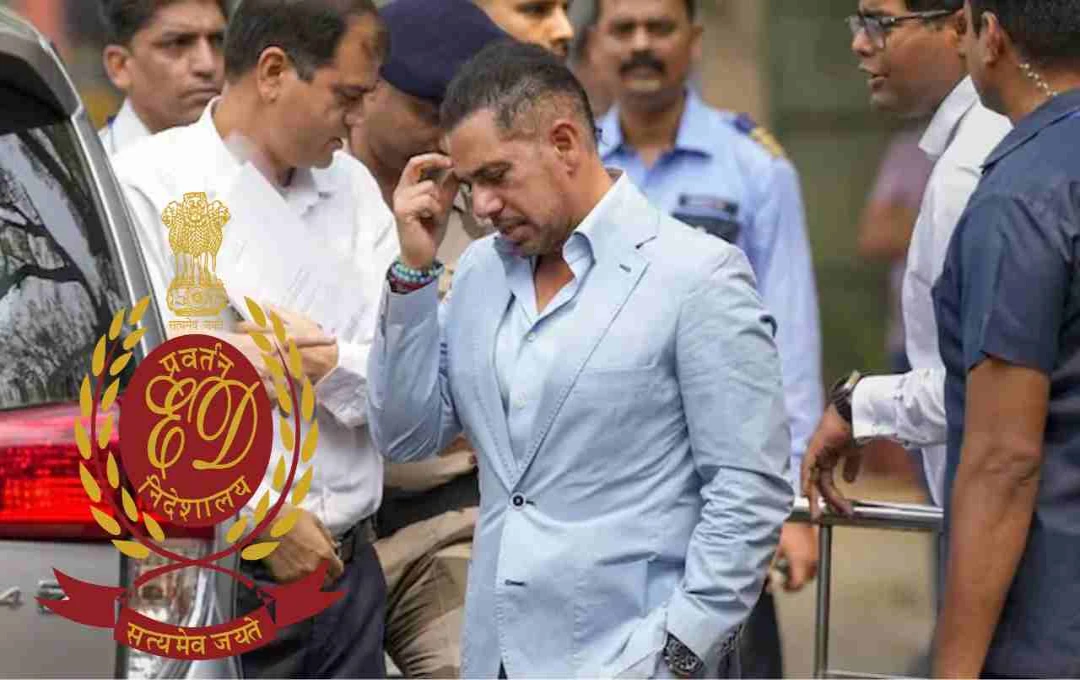
New Delhi, 13th August: In a political climate where allegations of corruption can shift electoral narratives overnight, the Enforcement Directorate’s (ED) latest chargesheet against businessman Robert Vadra, husband of Congress MP Priyanka Gandhi Vadra, is a political thunderclap. Filed under the Prevention of Money Laundering Act (PMLA), the case accuses Vadra of amassing an illicit profit of ₹58 crore from a fraudulent land transaction in Gurugram’s Shikohpur village.
The ED’s chargesheet not only targets Vadra but also implicates two of his close associates, Satyanand Yajee and Kewal Singh Virk, along with several companies allegedly tied to him. The agency is seeking a prison term ranging from three to seven years, alongside confiscation of assets it says are “proceeds of crime.”
A Land Deal Steeped in Influence and Manipulation

The roots of this controversy stretch back to 2018, when the Haryana Police registered an FIR also naming former Haryana Chief Minister Bhupinder Singh Hooda and real estate giant DLF Ltd. According to ED investigators, Vadra’s company, M/s Sky Light Hospitality Pvt. Ltd. (SLHPL), acquired 3.5 acres from Onkareshwar Properties Pvt. Ltd. for ₹7.5 crore as per the official sale deed.
But here lies the twist: the ED alleges that the true agreed price was ₹15 crore, and that the payment recorded in the sale deed was never actually encashed — suggesting no real exchange of money. Instead, the transaction is alleged to be part of a quid pro quo. In exchange for Vadra’s influence, Onkareshwar Properties allegedly secured a commercial licence in the same village, despite the land not meeting the eligibility criteria.
The Directorate of Town and Country Planning (DTCP) is accused of manipulating records, including wrongly adding land reserved for a sector road, to create an illusion of compliance.
From Licence to Windfall — The ₹58 Crore Leap

Once the commercial licence was granted at what ED calls an “extraordinary pace,” the land was sold to DLF Ltd. for ₹58 crore, creating what investigators describe as a windfall rooted in fraud.
The ED’s financial trail paints a detailed picture:
- ₹5 crore flowed through M/s Blue Breeze Trading Pvt. Ltd.
- ₹53 crore went through SLHPL.
This money was allegedly used to acquire properties, make investments, extend loans, and clear corporate liabilities. A provisional attachment order has already been issued for 43 immovable properties worth ₹38.69 crore, spread across Bikaner, Gurugram, Mohali, Noida, and Ahmedabad.
The Defence: Political Vendetta or Legal Reckoning?

Robert Vadra’s office has fiercely rejected the ED’s charges, calling them “an extension of the political witch-hunt by the present government.” According to his defence team, every transaction was legal and transparent, and the case is rooted in political vendetta rather than genuine law enforcement.
However, the ED insists its case rests on hard evidence — including documentary records, bank trails, and witness statements. Investigators claim that DTCP officials themselves admitted to being “pressured by higher authorities” to approve the licence.
A Bigger Picture: Politics, Power, and Property

If these allegations are proven in court, the Vadra case could become one of Bharat’s most high-profile money laundering convictions. But beyond the courtroom drama lies a larger story — one about the intersection of political influence, real estate fortunes, and bureaucratic pliability.
Bharat’s urban land deals, particularly in rapidly growing regions like Gurugram, have long been marred by accusations of manipulation, under-the-table arrangements, and fast-tracked approvals. The Vadra case, therefore, isn’t just about one transaction; it’s about a system where power often dictates process.
Why This Case Matters Beyond the Accused

The Robert Vadra land deal controversy is not just a legal battle; it’s a test of Bharat’s ability to hold the politically connected accountable. If the ED can prove its allegations, it could send a powerful signal about the reach of anti-corruption laws — and the limits of political immunity.
On the other hand, if the case collapses due to procedural lapses or lack of conclusive proof, it will fuel perceptions that high-profile investigations are often timed for political gain rather than genuine reform. The credibility of both investigative agencies and political opponents is on the line.
All Eyes on the Special PMLA Court
The Special PMLA Court will now decide the course of this high-stakes case. For Robert Vadra, the trial could either be a career-defining acquittal or a crushing blow with legal and political fallout. For Bharat’s political ecosystem, it’s another reminder that land, money, and power remain deeply entangled — and that every high-profile scandal is also a mirror to the nation’s governance challenges.
Whatever the outcome, the Vadra case will be remembered not just as a headline-grabbing scandal, but as a benchmark for how Bharat confronts the intersection of politics and illicit wealth in the years ahead.
