
Tamil Nadu Defies Nep 2020 With Own Education Blueprint
"In a bold defiance of the Centre’s NEP 2020, Tamil Nadu’s new State Education Policy champions equality, safeguards linguistic identity, and challenges the federal balance—setting the stage for a high-stakes legal and political showdown."

Paromita Das
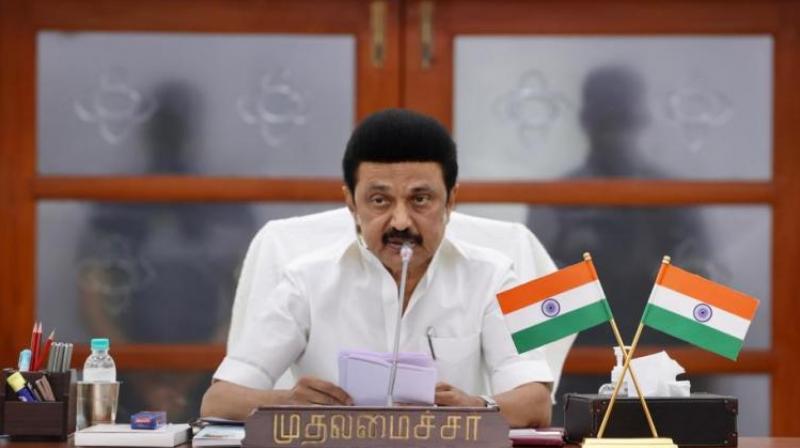
New Delhi, 13th August: In a move that underscores Tamil Nadu’s defiance of central diktats and its deep-rooted cultural identity, Chief Minister M.K. Stalin on Friday unveiled the State Education Policy (SEP) — a blueprint that rejects the National Education Policy (NEP) 2020 and reiterates the state’s long-standing commitment to the two-language formula. The announcement, coming after months of expert consultations led by retired High Court Judge Justice D. Murugesan, is both a political statement and a policy framework aimed at preserving Tamil Nadu’s unique educational ethos.
A Vision Anchored in Equality and Rationality

Unveiling the SEP, Stalin declared that the policy was shaped by samathuva kalvi (education for equality) and pagutharivu kalvi (education with rational thought). These terms are not mere slogans — they reflect a century-old Dravidian movement legacy that views education as a tool for dismantling caste hierarchies and empowering the marginalized.
“We will not allow pirooku (reactionary thinking) in our education. Our State Education Policy will serve as a platform for students to compete with international standards,” Stalin asserted. His words came as he honored 901 government school students who secured seats in IITs, NITs, and other top-tier universities.
The state’s higher education enrollment rate — already at 75% for Class XII graduates — is set to become a benchmark. Stalin has set an ambitious target: 100% enrollment in higher education in the near future.
The Heart of the Dispute: Language and Identity

The cornerstone of Tamil Nadu’s resistance lies in the language policy. The NEP 2020 promotes a three-language formula, which, while ostensibly flexible, is viewed in Tamil Nadu as a backdoor attempt to impose Hindi. The state’s two-language policy — Tamil and English — has been in place for decades, born out of the fiery anti-Hindi agitations of the mid-20th century.
For the DMK-led government, the language issue is not just about communication; it is about cultural preservation and political autonomy. Adopting the NEP’s three-language model would mean diluting a hard-won linguistic identity that has shaped Tamil Nadu’s modern political consciousness.
From Policy Disagreement to Legal Battle

Tamil Nadu’s opposition to NEP 2020 is no longer confined to political rhetoric; it has reached the Supreme Court. In May, the state accused the Union government of withholding nearly ₹2,200 crore in central education funds — allegedly as retaliation for refusing to implement the NEP.
The state’s petition argues that the Centre’s actions are unconstitutional, violating federal principles by linking unrelated funding schemes like Samagra Shiksha and PM SHRI Schools to NEP compliance. Clause 4.13 of NEP 2020, which mandates the three-language system, has been singled out as particularly unacceptable.
Tamil Nadu is now seeking immediate release of ₹2,291.30 crore, along with 6% annual interest on delayed amounts. It has also urged the Court to ensure the Centre fulfils its obligations under the Right to Education Act, releasing its 60% share of grants in advance of each academic year.
Political Stakes and the Federal Undercurrent

The SEP’s release is not just an educational move — it is a reaffirmation of federalism. By openly challenging the NEP, Tamil Nadu is asserting the right of states to design policies suited to their sociocultural realities. The DMK government has consistently framed this as a struggle between central overreach and state autonomy.
The BJP-led Centre, however, frames the NEP as a transformative framework aimed at raising national educational standards. This ideological clash — central standardization vs. state-specific diversity — is increasingly defining Bharat’s federal tensions.
More Than a Language War

While the headlines focus on the language dispute, the deeper battle is over who gets to decide the future of education in a diverse federal nation. Tamil Nadu’s stand is not an isolated act of political defiance; it is part of a broader resistance to homogenization in policy-making.
The NEP’s intent to standardize educational practices nationwide may have merit in promoting mobility and uniform quality, but it risks bulldozing over regional histories, linguistic identities, and existing models of success. Tamil Nadu, with its high literacy rates, robust higher education system, and history of social justice-driven policies, argues — with some justification — that it should be allowed to chart its own path.
The Centre’s alleged withholding of funds, if proven, sets a troubling precedent where financial levers are used to enforce ideological compliance. This undermines the cooperative spirit of Bharatiya federalism and could embolden other states to push back in equally confrontational ways.
The Road Ahead

The SEP is expected to focus on equitable access, digital learning, teacher training, and international competitiveness — all within the framework of Tamil Nadu’s language and social justice priorities. However, the confrontation with the Centre is unlikely to cool down anytime soon.
The Supreme Court’s eventual verdict on the funding dispute will have far-reaching implications, not just for Tamil Nadu but for the balance of power between state and central governments across Bharat.
Education as the New Battleground for Federalism
The Tamil Nadu-NEP clash is a microcosm of a larger question confronting Bharat: Can a nation of such vast cultural and linguistic diversity be governed through uniform policy blueprints? The SEP is as much a manifesto of identity as it is a roadmap for education. By choosing to stand apart from the NEP, Tamil Nadu is staking a claim for policy pluralism in the Bharatiya Union.
If the state succeeds in its legal and political battle, it could open the door for other states to demand customized education policies. If it fails, the precedent could tilt power further towards centralization. Either way, the debate sparked in Chennai will echo far beyond Tamil Nadu’s borders — shaping the contours of Bharat’s federal future.
