

By Anjali Sharma
WASHINGTON – US President Donald Trump on Friday imposed the threatened tariff of 25 per cent on India started August 1 as the prolonged negotiations appeared to have stalled as the deadline for tariffs approaching.
His executive order, issued late Thursday, did not include penalty tariffs on buying Russian energy or for BRICS membership, which he had also threatened.
Trump initially threatened the 25 per cent tariff.
India said defiantly that it “will take all steps necessary to secure our national interest”.
Trump claimed he was acting because “large and persistent annual US goods trade deficits constitute an unusual and extraordinary threat to the national security and economy of the United States” in the order setting the tariff rates for various countries.
Media reported that 25 per cent tariff for India was higher than the rate ranged between 15 per cent and 19 per cent he imposed on most countries listed in the order, which takes effect at midnight.
India was one of the first countries to start negotiations with the US, the talks appeared to have foundered and Trump made the threat of 25 per cent on Wednesday, but later that day, he held out a ray of hope, stated “We’re talking to India now, we’ll see what happens”.
He did not issue a formal letter to India as he had to other countries.
But it appears that last-minute negotiations did not lower the tariffs, media reported.
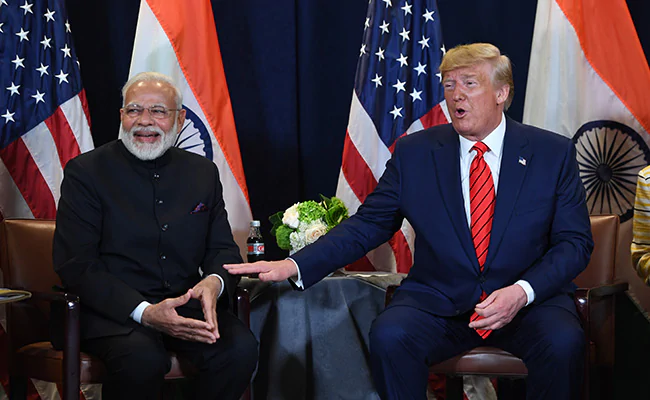
The negotiations were taking place, Trump repeatedly called Prime Minister Narendra Modi and India his friends.
He said a week before that a deal was imminent.
India’s Commerce Minister Piyush Goyal voiced optimistic, said that the negotiations were making “fantastic” progress.
The part of his executive order that would apply to India said that some “trading partners, despite having engaged in negotiations, have offered terms that, in my judgment, do not sufficiently address imbalances in our trading relationship or have failed to align sufficiently with the United States on economic and national-security matters”.
The highest tariff imposed in the order was for Myanmar, which was set at 41 per cent, and the lowest was 10 per cent for Brazil and Britain.
Brazil’s rate was a surprise because Trump had threatened 50 per cent over a dispute over Brazil’s prosecution of its former President Jair Bolsonaro.
Trump agreed to extend the deadline for Mexico in a last-minute reprieve, agreeing to continue negotiations.
He is embroiled in a heated fight with Canada and did not appear on the order, but separately, he had set the tariff at 30 per cent.
Trump administration said that the talks are continuing with China, and under a temporary arrangement set to expire on August 12.
The rate is temporarily 30%much lower than his initial threats of as much as 145 per cent.
Trump’s executive order set the tariff for Pakistan at 19 per cent, and Sri Lanka and Bangladesh at 20 per cent.
India was the US’ insistence on opening the floodgates to US agriculture and dairy.
That could have serious consequences for India’s agricultural sector, which employs nearly half the country’s working population.
India’s statement responded to Trump’s threat alluded to this factor, stated “The government attaches the utmost importance to protecting and promoting the welfare of our farmers, entrepreneurs, and MSMEs (Micro, Small, and Medium Enterprises)”.
European Union and Japan, mollified Trump by offering to invest hundreds of billions of dollars in the US, India was not in a position to make offers of that magnitude.
India also appears to have been caught in the heightened tension between Trump and Russia, after President Vladimir Putin refused to heed the US president’s call for a ceasefire in the Ukraine War.
India was in the crossfire in a war of words between Trump and former Russian President Dmitry Medvedev, even though India had nothing to do with it.
Trump attacked Mededev in the Truth Social post wrote “I don’t care what India does with Russia. They can take their dead economies down together, for all I care”.
He declared India the “Tariff King”, an appellation Finance Minister Nirmala Sitharaman has strongly refuted.
She substantially lowered the tariff on premium motorcycles that would cover Harley Davidson, the duties on which were Trump’s pet peeve since his first term.
Trump will have to take separate action on India’s pharmaceutical exports valued at $12.7 billion last year, as they form a significant portion of the generic medicines in the US, and any increase in prices would hit the already high medical costs.
He said India buying oil from Russia and the tariff would be 100% Trump avoided answering and instead talked of a penalty for membership of the BRICS.
If there is to be a penalty for buying Russian oil — known as a secondary tariff applying to all buyers — it will be linked to the deadline for Moscow to end the Ukraine War, which will probably be on August 7.
China buy Russian energy, the imposition of secondary sanctions will be complicated as Washington and Beijing try to avoid an all-out trade war.
