
UNSG calls for action on two-State solution, says “breaking point’ reached in Mid-East conflict

By Anjali Sharma
UNITED NATIONS – UN head António Guterres on Monday has warned that the Israeli-Palestinian conflict has reached a breaking point, called for bold political action on the two-State solution and halt what he described as the systemic dismantling of peace efforts.
Guterres was speaking at the high-level conference on the peaceful settlement of the question of Palestine and the implementation of the two-State solution meeting and he pointed a grim picture of a conflict that continues to “take lives, destroy futures, and destabilize the region and our world”.
He said “We know that the Israeli-Palestinian conflict has endured for generations, defying hopes, defying diplomacy, defying countless resolutions, defying international law,”.
“But, we also know its persistence is not inevitable. It can be resolved. That demands political will and courageous leadership, and it demands truth.”
“The truth is: we are at a breaking point. The two-State solution is farther than ever before.”
He denounced the 7 October Hamas attacks on Israel and hostage-taking as acts of terror he has “repeatedly condemned”.
Guterres said “nothing can justify the obliteration of Gaza that has unfolded before the eyes of the world.”
He also spoke out against the starvation of civilians, the killing of tens of thousands, mass displacement, settler violence and the “creeping annexation” of the occupied West Bank a move he called “illegal”.
“Unilateral actions that would forever undermine the two-State solution are unacceptable and they must stop,” he said.
“These are not isolated events. They are part of a systemic reality that is dismantling the building blocks of peace in the Middle East.”
Three-day conference, mandated by the General Assembly through resolutions ES-10/24 and 79/81, is co-organized by France and Saudi Arabia.
It includes plenary sessions and thematic roundtables on issues such as security arrangements, humanitarian needs, reconstruction and the economic viability of a future Palestinian state.
Mr. Guterres in his speech urged Member States not to let the event become “another exercise in well-meaning rhetoric”.
“It can and must serve as a decisive turning point, one that catalyses irreversible progress towards ending the occupation and realizing our shared aspiration for a viable two-State solution,” he said.
He reiterated the long-standing UN position, Guterres said the two-State solution remains the only viable path to peace, with Israel and Palestine living side-by-side within secure, recognized borders, based on the pre-1967 lines, with Jerusalem as the capital of both States.
“It is the sine qua non [Latin for indispensable or absolutely essential for peace across the wider Middle East,” he concluded.
Guterres in his closing remarks urged all parties to choose peace not as an aspiration, but as a duty.
“This conflict cannot be managed. It must be resolved. We cannot wait for perfect conditions. We must create them. We cannot defer peace efforts until suffering becomes unbearable. We must act before it is too late,” he said.
He called for peace not as a concept, but a commitment.
“Not as a dream, but as a reality for Palestinians, for Israelis, for the people of the Middle East, and for the world.
UN General Assembly President Philémon Yang also addressed the session said the Gaza war and the wider crisis have made it “painfully clear – we cannot go on like this.”
He called for “decisive change” and warned that further delay would deepen suffering and destroy any remaining hopes for peace.
“This conflict cannot be resolved through permanent war, nor through endless occupation or annexation We simply cannot afford more excuses, more delays. We must act now.”
He reiterated the Assembly’s recent demands, including an immediate and unconditional ceasefire, the release of all hostages and full humanitarian access.
PGA also highlighted growing global recognition of Palestinian statehood, citing President Emmanuel Macron’s announcement that France will extend formal recognition.
Mr. Yang urged action towards a peaceful settlement of the Israeli-Palestinian conflict.
“The focus of this conference must therefore be concrete and action-oriented, identifying steps the international community must take to realise the two-State solution,” he said.
He concluded “One that upholds international law, the UN Charter and relevant UN resolutions. And especially one that achieves justice for Palestinians and Israelis. One that ensures a peaceful, prosperous, and equitable future for everyone in the Middle East.”
Jean-Noël Barrot, Minister for Europe and Foreign Affairs of France; Faisal bin Farhan Al Saud, Minister of Foreign Affairs of Saudi Arabia; and Mohammad Mustafa, Prime Minister of the State of Palestine also spoke at the meeting.
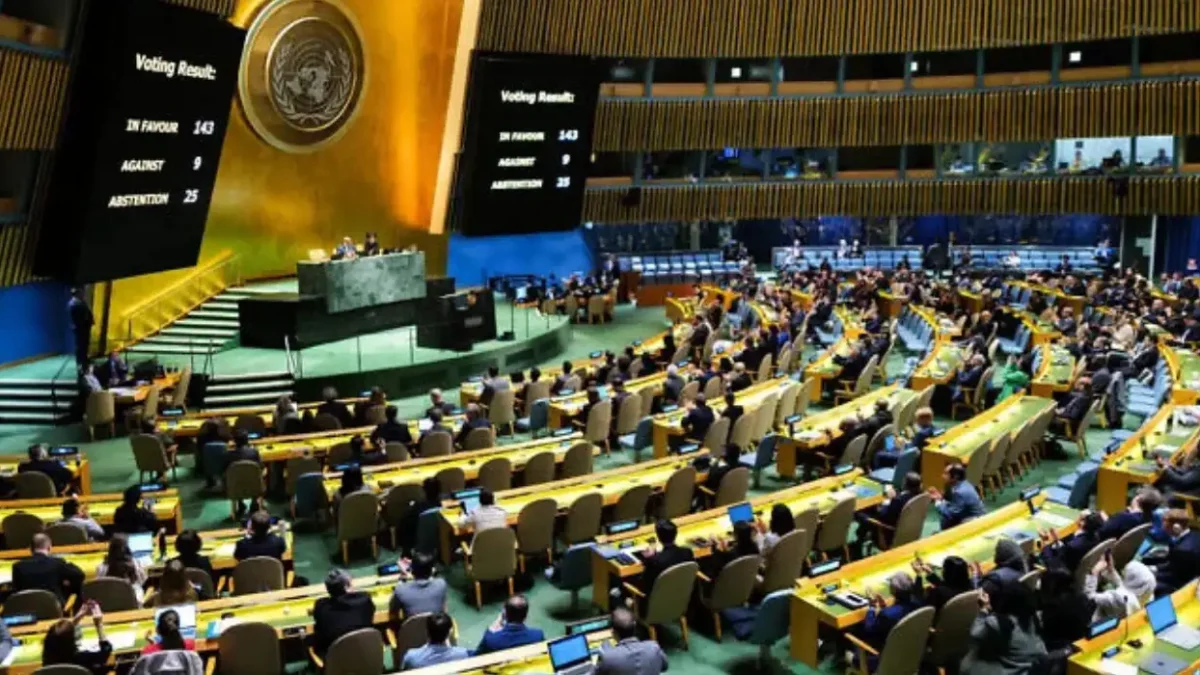
The meeting ended sessions with the thematic roundtables. And a plenary meeting in the General Assembly Hall also took place in New York on Monday
Canadian Ambassador to the UN, Bob Rae said “It’s not a peace conference,” ahead of the event, mandated by the UNGA in which Canada is playing a leading role.
Rae said “It’s a way of trying to maintain the debate and get beyond the sticking points to the solutions. We hope there’ll be some listening, and we hope there’ll be some learning on the basis of what we hear.”
He stated the organizers of the event urged Israel and Palestine to engage with the conference, they understand the difficult situation they both find themselves in.
“Many citizens [of Israel] are still being held as hostages by Hamas. They’ve suffered this tremendous attack, the worst attack on the Jewish population anywhere in the world since 1940. And now we’re having to deal with the outcome of that which has been the war in Gaza, which is hugely traumatic for the Palestinians and for many members of the Arab community.”
The conference was held in the Trusteeship Council in New York, was convened as a result of the adoption of a GA Resolution (Resolution ES-10/22) in 2024.
UNGA in a concept note released ahead of the event, the two nations declared that international consensus on the two-State solution “still enjoys near-universal support,” and that it is “clearly the only way to satisfy the legitimate aspirations, in accordance with international law, of both Israelis and Palestinians…and create the conditions for regional peace and stability.”
The note stressed that in a swipe at the failure of previous efforts to bring about peace, the statement declares that “the aim of this international conference would not be to ‘revive’ or to ‘re launch’ another endless process, but to implement, once and for all, the two-State solution.”
In a preparatory meeting for the conference held in May, Anne-Claire Legendre, Middle East and North Africa advisor to French President Emmanuel Macron, said that “ the prospects of a Palestinian State must be maintained. Irreversible steps and concrete measures for the implementation thereof are necessary.”
She called for a lasting ceasefire, an immediate influx of humanitarian aid and the release of hostages.
Saudi Arabia Manal bint Hassan Radwan, head of the Saudi Arabian negotiating team, added that efforts to end fighting and secure release of hostages and detainees must be “anchored in a credible and irreversible political plan that addresses the root cause of the conflict and offers a real path to peace, dignity and mutual security.”
“There has to be the basis for a broader political solution. It’s not just about saying there’s going to be a ceasefire and that will solve the problem. How do we reconstruct Gaza? How do we change the governance of Gaza? How do we approach the West Bank? How do we deal with issues which have long been the source of a lack of agreement between the parties? Let’s not forget that there has been one really successful negotiation, which was based on the 1993 Oslo Accords, and since that time we have not had a lot of substantive agreements. We’ve got to try to find a way to create a framework for actual discussion.”
