
Pahalgam Massacre Political Storm As Chidambaram Speaks Out
Just Days Before Parliament Acts, Congress Casts Doubt—Again Siding with Silence Over Sacrifice

Paromita Das
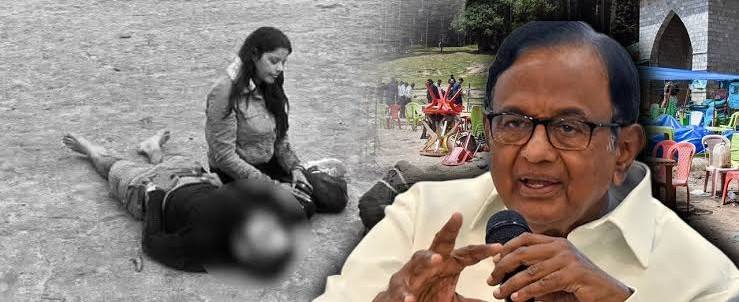
New Delhi, 29th July: Just days before Parliament is set to debate Operation Sindoor—Bharat’s decisive retaliation after the brutal killing of 26 pilgrims in Pahalgam—senior Congress leader and former Union Home Minister P. Chidambaram has ignited a fresh controversy that Bharat didn’t ask for, and certainly didn’t need. At a time when the nation is mourning its dead and rallying behind its armed forces, Chidambaram chose to cast doubt on the nationality of the terrorists—suggesting they might have been homegrown rather than Pakistan-sponsored.
This wasn’t just a misjudged statement—it was a deliberate provocation. It reopened old wounds of skepticism and political deflection that the Congress has employed repeatedly in the past, from questioning the authenticity of surgical strikes to sowing doubt after the Balakot airstrikes. By choosing this moment, just before a critical national debate on security, to float unverified theories, Chidambaram has once again prioritized political point-scoring over national solidarity. In doing so, he not only undermines Bharat’s counterterrorism narrative but also provides talking points to those across the border who seek to destabilize us.
The real question is—what purpose does this serve, and who does it benefit? Certainly not the grieving families, not the soldiers on the frontlines, and definitely not the credibility of Bharat’s democratic resolve.
Echoes of “Saffron Terror” Redux
In a widely shared interview with The Quint, Chidambaram questioned the widely accepted conclusion that Pakistani terrorists carried out the April 22 massacre. “For all we know, they could be homegrown terrorists. Why do you assume they came from Pakistan? There’s no evidence of that,” he said. These remarks go beyond speculation—they signal distrust toward Bharat’s armed forces, intelligence apparatus, and the entire foundation of Operation Sindoor.
History now repeats itself. During the UPA regime, Congress advanced the discredited “Saffron Terror” narrative, deflecting Islamist terror onto alleged Hindu fringe groups—despite overwhelming counter-evidence. Now, nearly two decades later, Chidambaram is again deflecting from external threats to internal controversies, questioning Bharat’s national strategy during a critical operation.

A Pattern of Deflection and Denial
The BJP’s reaction was sharp and immediate. Party spokesperson Amit Malviya accused Congress of playing Islamabad’s defense lawyer. Taken together, this behavior forms a pattern: during major security crises—26/11, Balakot, Galwan, Surgical Strikes—Congress leaders have repeatedly questioned the government’s narrative, demanding proof, and often undermining national unity in moments when the country was grieving.

In the current context, Operation Sindoor seeks to send a clear message to perpetrators and Pakistan: Bharat will act swiftly and decisively. But Chidambaram’s doubts risk demoralizing the Indian forces and muddying public perception at a time when clarity and solidarity are crucial.
Why Question the Government, Not the Enemy?
Chidambaram went further—accusing the government of suppressing casualty data, avoiding comprehensive public statements, and even rewriting the strategy mid-operation. He claimed the US, under Donald Trump, brokered a ceasefire—an assertion ungrounded in reality and in stark contrast to official Bharatiya accounts.

Instead of honoring the victims and supporting a military response, he focused on criticizing the government’s approach. The question arises: why does the first instinct of Congress leaders seem to be questioning Bharat’s government rather than condemning terrorism and supporting Bharatiya resolve?
When Critique Becomes Collusion
Constructive dissent is the lifeblood of democracy. But when such critique aligns with enemy narratives—or when it sows doubt at a time of national trauma—it transforms into strategic sabotage.** Shehzad Poonawalla** of BJP warned, “From 26/11 to Pahalgam, Congress’s refrains echo Pakistan’s talking points.”

As Parliament prepares to debate Operation Sindoor, Chidambaram’s stance will inevitably come under scrutiny. Families of the 26 pilgrims have a right to clarity—not conjecture. And the nation, fatigued by terror, deserves solidarity more than unsolicited skepticism.
Time to Prioritize Country Over Party
This is not about suppressing debate. It is about timing. When terror strikes, unity strengthens resolve. Congress’s persistent hesitancy to unequivocally name and oppose Pakistan-funded terror only empowers adversaries. While political competition is vital, national security is non-negotiable.
If Chidambaram’s statements reflect a broader party mindset—that questioning Bharat is more important than confronting terrorism—then the party faces an existential dilemma. Does it truly stand with the nation or with narratives that erode its security?
No Neutral Ground in Terror’s Shadow
Bharat stands at a fork: either reaffirm its belief in intelligence conclusions, judicial clarity, and operational integrity—or let insinuations dilute public faith. In moments of national trauma and military action, speculation isn’t dissent—it’s disservice.
Congress must ask: does it wish to be remembered as a party that defended the nation’s interest—or as one that consistently questioned its soldiers? When national security is at stake, ambiguity is betrayal. And history will judge harshly those who lent voice to doubt rather than devotion in Bharat’s darkest hours.
