
“Cooperation is the Future” – Home Minister Amit Shah
Amit Shah Launches Visionary Policy to Drive Rural Prosperity and Economic Growth.

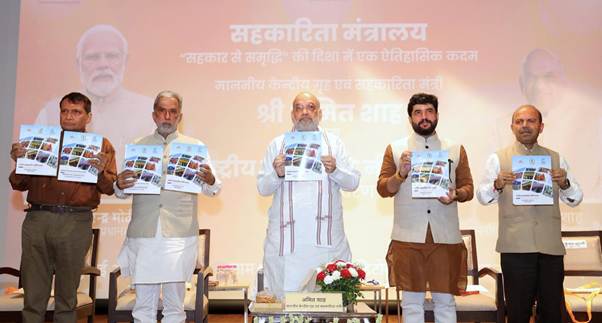
- Amit Shah unveiled the National Cooperative Policy – 2025 in New Delhi.
- The policy aims to triple cooperatives’ GDP contribution and reach 50 crore members by 2034.
- It expands cooperatives into new sectors like tourism, taxi services, insurance, and green energy.
GG News Bureau
New Delhi, 25th July: Union Home and Cooperation Minister Amit Shah on July 24, 2025 unveiled the National Cooperative Policy – 2025 in New Delhi, terming it a historic step towards fulfilling Prime Minister Shri Narendra Modi’s vision of ‘Sahakar Se Samriddhi’ (Prosperity through Cooperation). The policy, described as far-sighted, practical, and result-oriented, aims to significantly transform India’s cooperative sector.
Addressing the inauguration event, Minister Shah highlighted that a 40-member committee, led by former Union Minister Suresh Prabhu, meticulously drafted the policy after extensive consultations with numerous stakeholders, including cooperative leaders, experts, academicians, and various ministries. This comprehensive process involved receiving approximately 750 suggestions and conducting 17 meetings, culminating in finalization after consultations with RBI and NABARD.
Shah recalled that the first cooperative policy in India was introduced in 2002 under the government of then-Prime Minister Atal Bihari Vajpayee, noting the significance of their party once again launching such a policy under Prime Minister Narendra Modi. He emphasized that only governments understanding India’s development needs truly prioritize the cooperative sector.
The new policy is designed to align with India’s goal of becoming the world’s third-largest economy by 2027 while ensuring the inclusive development of all 140 crore citizens. Shah stressed that the cooperative sector uniquely possesses the capacity to develop the nation’s economy by bringing together small capital contributions from many individuals to establish large enterprises. He stated that the policy’s core focus is on villages, agriculture, rural women, Dalits, and tribals.
Policy Vision and Goals
The National Cooperative Policy – 2025 envisions achieving a developed India by 2047 through cooperative prosperity. Its mission is to foster professional, transparent, technologically equipped, responsible, and economically independent small cooperative units, aiming for at least one cooperative unit in every village. The policy is structured around six pillars: strengthening the foundation, promoting vibrancy, preparing cooperative societies for the future, enhancing inclusivity and expanding reach, expanding into new sectors, and preparing the younger generation for cooperative development.
Key targets for the cooperative sector by 2034 include tripling its contribution to the nation’s GDP and engaging 50 crore active members, including those currently outside the cooperative fold. The policy also aims for a 30% increase in the number of cooperative societies, ensuring at least one primary cooperative unit—such as Primary Agricultural Credit Societies (PACS), primary dairy, or primary fisheries societies—in every panchayat. This expansion is expected to generate significant employment opportunities for youth.
Expanding Horizons and Implementation
The Ministry of Cooperation has developed detailed plans for cooperative societies to venture into new sectors like tourism, taxi services, insurance, and green energy, with a swift launch expected in the taxi and insurance sectors. This initiative will enable successful cooperative units to form new ventures, ultimately channeling profits back to members at the rural level through PACS, thereby creating a robust cooperative ecosystem.
Shah stated that the government is fully prepared to assist cooperative institutions, having identified 83 intervention points, with 58 already addressed. Initiatives include computerization of PACS, establishing 45,000 new PACS, and linking them to 25 new functions. For instance, 4,108 PACS have been approved for PM Jan Aushadhi Kendras, 393 have applied for petrol/diesel retail outlets, and over 100 for LPG distribution. PACS are also now involved in managing ‘Har Ghar Nal Se Jal’ (tap water to every home) and PM Surya Ghar Yojana.
To ensure professional manpower, the foundation for Tribhuvan Cooperative University has been laid. Furthermore, efforts are underway to launch “Sahakar Taxi” by the end of this year, a model designed to directly benefit drivers. Three multi-state cooperative societies have been established for exports, seeds, and branding/marketing of organic products. Shah also highlighted the emphasis on increasing women’s participation in the upcoming White Revolution 2.0.
Shah expressed confidence that the policy will make the cooperative sector relevant, contributive, and a future-oriented field for the next 25 years, aligning with the vision of ‘Aatmanirbhar Bharat’ (Self-reliant India) and achieving balanced cooperative development across states. He concluded by asserting, “A time when people said, ‘Cooperation has no future,’ today I say ‘Cooperation is the future’.”
