

Poonam Sharma
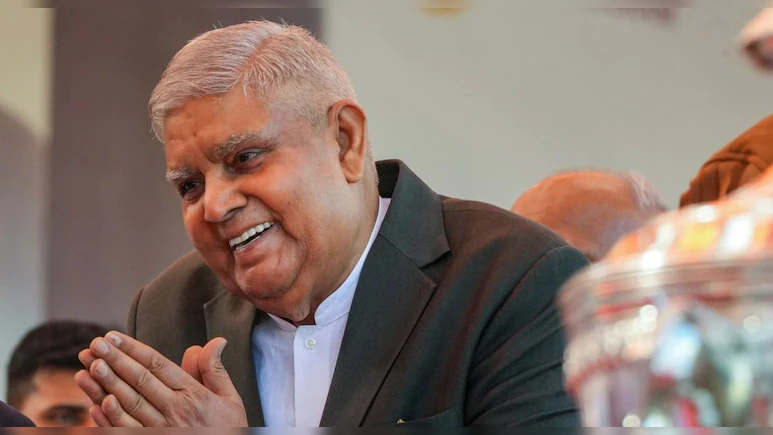
In a sudden and unexpected turn of events, Vice President Jagdeep Dhankhar tendered his resignation, sending political circles and constitutional observers into a frenzy. The decision, announced just ahead of the 2025 Monsoon Session of Parliament and Prime Minister Modi’s foreign visit, has sparked questions about timing, motive, and constitutional propriety. Was it truly a matter of health, or a calculated political maneuver?
Although formal communications mention “health concerns,” political quarters buzz with another reading: that Dhankhar was acting as a constitutional counterbalance — even a tacit nonconformist — to a government attempting to corner the judiciary and water down parliamentary checks.
A Precedent Breaking Resignation?
Dhankhar’s resignation is only the third time in India’s history that a Vice President resigned short of finishing their term. But unlike the previous instances, this case is different because of the context and emerging institutional strains it suggests.
Only a few days ago, Dhankhar was himself actively taking part in state functions, joining one in Uttarakhand and having organized a visit to Rajasthan. Indeed, the Rashtrapati Bhavan’s own release had declared that he would be accompanying the President on an official state visit — leaving no hint of any sudden health crisis. However, within hours, there was a resignation letter citing health reasons presented and accepted by President Droupadi Murmu.
Was it truly all about individual welfare?
Parliament on the Move, Crisis in the Shadows
His resignation has come on the eve of the Monsoon Session 2025, which commenced amid heated debates on some contentious issues, including amendments to the Constitution, judicial accountability, and impeachment motions.
Significantly, there was an ongoing impeachment motion in the works against Justice Yashwant Varma, with more than 150 Lok Sabha MPs and 63 Rajya Sabha members appending their signatures — enough to initiate the second phase of scrutiny. This motion was to be brought up in the Business Advisory Committee meeting on Monday, July 21. The Vice President, being the Chairperson of the Rajya Sabha, would have had a key role in the admissibility and procedural move of such a motion.
But what further raised eyebrows was an accompanying rumour — that the Opposition was contemplating tabling a similar motion against Justice Shekhar Yadav, a judge who had also expressed support for Sanatan Dharma at a private gathering. While unrelated to judicial performance, such remarks were politically sensitized and had become a flashpoint between the BJP and the Opposition.
If Dhankhar had remained, he could have been forced to approve or deny such motions, an action that would certainly have national and historical repercussions.
An Institutional Flashpoint?
Dhankhar’s resignation is a political development — it may be a symptom of institutional tension. In recent months, there have been evident tensions between the judiciary and the executive, with the government apparently eager to test constitutional limits.
This is not the first instance of a head of institution resigning pre-emptively in the face of mounting conflict. Political observers remember the example of the now-suspended CJI Dipak Misra, who was the target of the Opposition during 2018 for the case of Ram Janmabhoomi. Even then, an impeachment notice was mooted but did not make it due to absence of numbers and political will.
What sets Dhankhar’s case apart is that he is a constitutional figure with dual positions — both that of Vice President and that of Rajya Sabha Chairperson. In the duality lies the crux of the tension: Was he attempting to avert a constitutional collapse, or was he refusing to be complicit in what he regarded as political overreach?
A Game of Strategic Timing?
Dhankhar’s resignation has come at a time when Prime Minister Modi is also set to embark on a crucial overseas tour, both in the UK and Maldives, in a bid to drive the India-UK Free Trade Agreement. The President, meanwhile, is set to travel to Rajasthan for a state function.
This leaves a fascinating vacuum in Delhi — the President and Prime Minister both briefly out of station, while the Vice President makes a subtle exit stage left. A symbolic coincidence, or a strategic move?
It’s also interesting that nominated members were included in the Rajya Sabha mere days prior to the resignation, a step viewed by some as electoral mathematics or parliamentary balancing. Without the Vice President, Deputy Chairperson Harivansh Narayan Singh could fill in to chair Rajya Sabha, but legally he cannot play the role of President if needed.
What Happens Next
Under Article 65 of the Constitution, if the Vice President resigns, the President of India continues all duties, and the Deputy Chairperson assumes Rajya Sabha responsibilities temporarily. However, there’s no defined timeline for electing a new Vice President. The process can stretch, unless Parliament collectively demands swift action.
On the other hand, speculation is rampant regarding the possible choice of the government for the vacant seat. In light of Opposition being strengthened by Dhankhar’s resignation, they can attempt to force a consensus candidate or at least postpone the election to bargain.
But if Dhankhar’s resignation is the preamble to a longer-term strategic realignment — possibly even of the judiciary — it is a sign of a far greater realignment in Indian politics: one in which even constitutional functionaries might start resisting, symbolically or subtly, executive overreach.
Final Thought
The actual tale of Dhankhar’s resignation may never officially be revealed. Personal health could be a neat explanation, but the coincidences, timing, and political backdrop suggest there is more drama playing out — a drama that sees the judiciary, legislature, and executive at war with each other in a quiet struggle for power.
Was this a solo departure, or the opening scene of a larger institutional pushback? India will be following closely.
