
Mamata vs Himanta: Clash Over Assam’s Anti Encroachment Drive
Border Tensions Ignite Political Storm as Leaders Lock Horns Over Land Rights"

Paromita Das
New Delhi, 22nd July: Illegal encroachment has emerged as one of Bharat’s most pressing and politically sensitive challenges. As urbanization expands and migration intensifies—both legal and illegal—the pressure on public lands, forests, and grazing areas has grown manifold. Across several states, from Delhi to Assam, unauthorized occupation of government land is not just a law-and-order issue; it’s a ticking demographic, ecological, and national security concern.
In border regions like Assam, illegal encroachments—often by undocumented migrants—pose even graver risks. These aren’t isolated land grabs but part of a complex matrix involving identity politics, religious affiliations, and cross-border infiltration. When left unchecked, such encroachments can alter local demographics, increase communal tensions, and erode state resources. With the Bharatiya government pushing for secure borders, transparent land rights, and ecological preservation, clearing these encroachments has become essential—not just for governance, but for sovereignty.
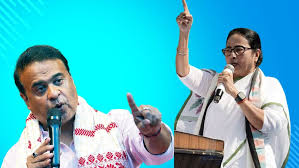
Tensions flared between West Bengal Chief Minister Mamata Banerjee and Assam Chief Minister Himanta Biswa Sarma on June 19 as Assam intensified its anti-encroachment operations. What began as a land restoration initiative has turned into a political battlefield, with both leaders drawing sharp lines over identity, migration, and regional autonomy.
Restoring State Lands in Assam
Chief Minister Sarma’s government has ramped up efforts to reclaim state-owned forests and grazing lands from illegal squatters, many alleged to be migrants from Bangladesh. This drive targets vast tracts of land believed to be encroached upon over years, aiming to restore environmental balance and uphold legal property rights.
Mamata’s Accusation: Attack on Bengalis?
Responding from Kolkata, Mamata Banerjee claimed on June 19 that the encroachment drive disproportionately affects the Bengali-speaking population in Assam. In a social media post, she called it “discriminatory” and “unconstitutional,” urging solidarity with those she said were defending their linguistic and democratic rights.
“This divisive agenda has crossed all limits and people of Assam will fight back,” Mamata vowed, signaling her intent to defend Bengali identity ahead of West Bengal’s 2026 assembly elections
The second most spoken language in the country, Bangla, is also the second most spoken language of Assam.
To threaten citizens, who want to coexist peacefully respecting all languages and religions, with persecution for upholding their own mother tongue is discriminatory and…
— Mamata Banerjee (@MamataOfficial) July 19, 2025
Sarma’s Rebuttal: Sovereignty Over Solidarity
Assam Chief Minister Himanta Biswa Sarma fired back, insisting the drive is not about community targeting but safeguarding Assam’s heritage. “We are resisting unchecked infiltration that threatens our demographic balance,” he asserted, stressing that the operation defends national sovereignty—not stokes communal tension.
Sarma emphasized inclusion, declaring, “Assamese, Bangla, Bodo, Hindi—all communities coexist here,” while warning against threats to cultural foundations.
Didi, let me remind you—
In Assam, we are not fighting our own people. We are fearlessly resisting the ongoing, unchecked Muslim infiltration from across the border, which has already caused an alarming demographic shift. In several districts, Hindus are now on the verge of… https://t.co/mwqs398RKE
— Himanta Biswa Sarma (@himantabiswa) July 19, 2025
Election Politics and Identity Lines
Political observers note Mamata’s timing: consolidating Bengali-Hindu support amid a heated campaign season. Conversely, Sarma’s stance resonates with Assamese voters sensitive to illegal immigration and cultural change. Their public clash reflects a broader tension—between regional identity politics and administrative enforcement.
Government and Good Governance
Both leaders are addressing valid concerns: Mamata highlights minority rights and linguistic inclusion; Himanta emphasizes the rule of law and territorial integrity. Yet, both must avoid rhetorical excess that fuels mistrust. Assam’s drive must be transparent and fair; West Bengal’s response should encourage cooperation, not exacerbate division.
Ultimately, solving such complex issues demands collaboration, not confrontation. States could coordinate on rehabilitation, legal support, and cross-border engagement to balance justice with humanity.
Governance over Grandstanding
The Mamata-Himanta showdown captures a faultline in Bharatiya polity: balancing democratic rights with national security. While Assam must enforce the law, West Bengal should ensure nobody faces discrimination. As Bharat marches toward its 2026 state elections, leadership grounded in facts, fairness, and dialogue—not in polarizing speeches—will best preserve unity and trust across its diverse landscape.
