
Jaishankar Meets Xi: Bharat-China Diplomatic Reset Begins

Paromita Das
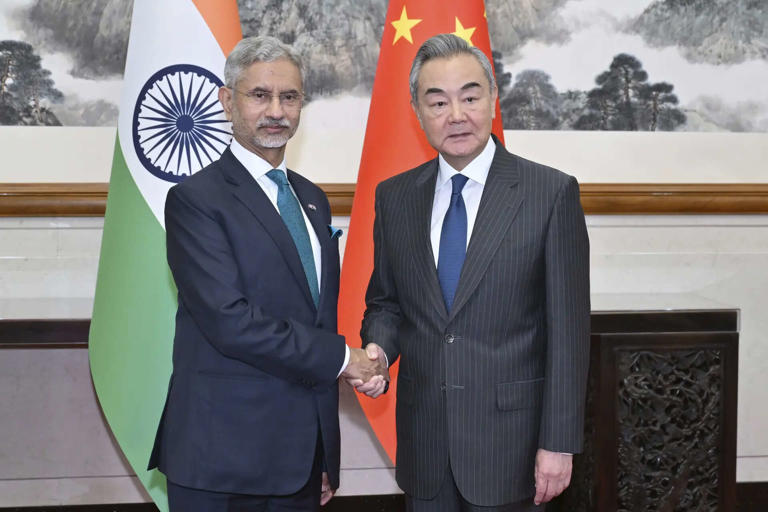
New Delhi, 16th July: Amid a world brimming with geopolitical churn, Bharat and China have quietly taken a meaningful step towards mending strained ties. In a significant diplomatic moment, Bharat’s External Affairs Minister S. Jaishankar met Chinese President Xi Jinping in Beijing on Thursday — the first top-level meeting between the two Asian giants since their tense military standoff began in Ladakh in May 2020.
Held on the sidelines of the Shanghai Cooperation Organisation (SCO) ministerial gathering, the meeting carried weight far beyond the photo op. Jaishankar, carrying greetings from Prime Minister Narendra Modi and President Droupadi Murmu, conveyed Bharat’s clear message: progress is possible if both sides show continued leadership and a commitment to steady dialogue.
From the Border to Beijing: A Fragile Trust
For nearly four years, Bharat-China ties have hovered at a precarious crossroads. The violent Galwan clash of 2020 left scars on both the diplomatic and military fronts. Trade survived, but trust suffered.

Jaishankar’s sit-down with President Xi — followed by talks with Vice President Han Zheng and Foreign Minister Wang Yi — shows that the frost might finally be melting. Central to Bharat’s message was the call for de-escalation along the Line of Actual Control (LAC). Without peace at the border, Delhi insists, no real partnership is possible.
Trade Friction and Economic Hopes

Beyond the border, Jaishankar’s visit tackled another sticking point: economic ties. Bharat’s concerns about China’s restrictive trade measures — from barriers to auto parts to limits on rare earth magnets — have long irked domestic industries eager to compete fairly.
By urging Beijing to ease these barriers, Jaishankar underlined New Delhi’s push for balanced trade. He also pressed for more connectivity, smoother people-to-people exchanges, and cooperation on managing shared rivers — a quiet but critical issue for millions living downstream.
A Spiritual Bridge: Kailash Mansarovar Returns
Amid the tough talk on border patrols and trade restrictions, a softer story emerged too: the resumption of the Kailash Mansarovar Yatra after five long years. Suspended during the pandemic and border tensions, the pilgrimage’s return is more than symbolic. It signals that Bharat and China still see value in cultural bridges that reconnect people when politics frays ties.

For countless pilgrims, the sacred journey to the holy site in Tibet is a life-long dream. Its reopening — coinciding with the 75th anniversary of Bharat-China diplomatic ties — is a small but meaningful gesture that politics alone cannot replicate.
A Reset That Demands Caution
It’s tempting to view these high-level meetings as a sign that all is well — but the reality is more nuanced. Despite the handshakes and polite statements, the deep distrust bred by unresolved border issues won’t vanish overnight.

Yet, by engaging directly with Xi Jinping — instead of just mid-level envoys — Bharat has shown strategic clarity. The Kazan Summit last October, where Prime Minister Modi and President Xi agreed to fresh de-escalation protocols, laid the foundation. This visit builds on that fragile momentum.
In the last nine months, the choreography has been clear: National Security Advisor Ajit Doval, Defence Minister Rajnath Singh, and Foreign Secretary Vikram Misri have all made quiet but crucial visits to Beijing. It’s a sign that both countries know endless stalemate helps neither side — and only empowers rivals elsewhere.
A Shared Responsibility in an Unstable World
As Jaishankar rightly said, stable Bharat-China ties aren’t just an Asian need — they’re a global necessity. The world’s two largest populations can’t afford to drift into conflict when they have the power to shape trade flows, climate goals, and regional stability.
There will be hurdles. Border patrols won’t vanish, nor will trade disputes or the lingering shadow of strategic mistrust. But a willingness to sit across the table, raise the hard questions, and restart people-centric exchanges — like the Kailash Yatra — proves both sides understand that dialogue is still the best tool to steady this delicate relationship. Measured Optimism for a Complex Road Ahead
Jaishankar’s meeting with Xi marks an important chapter in Bharat’s diplomacy — clear-eyed, cautious, but constructive. As both nations navigate an unpredictable world, their choice to re-engage at the highest levels is a sign that neither wants differences to calcify into disputes.
Whether it’s de-escalating at the LAC, reopening cultural routes, or balancing trade, the message is the same: Asia’s two giants can compete — but they must never stop talking.
If this spirit holds, Bharat and China may yet find a path where competition spurs progress — not conflict.
