
Hungary Breaks Ranks
Hungary’s Defiance Exposes Cracks in NATO Over Ukraine Strategy

GG News Bureau
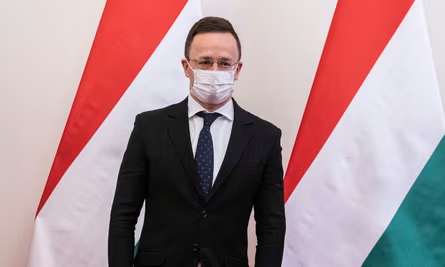
New Delhi 15th July -In a striking deviation from the collective stance of NATO and the European Union, Hungary has declared its refusal to support former U.S. President Donald Trump’s proposed plan to deliver weapons to Ukraine. Hungarian Foreign Minister Peter Szijjarto, in a firm and unequivocal statement from Budapest, reiterated Hungary’s long-held position of non-involvement in the Russia-Ukraine war, emphasizing that no Hungarian money, weapons, or soldiers will be sent to Ukraine under any circumstances. This latest announcement comes at a time when Trump’s foreign policy approach, should he return to the White House, remains a subject of concern and speculation across European capitals.
Hungary’s Stand: Consistent and Defiant
Hungary’s stance is not new but it is becoming increasingly isolated in the West. Since the beginning of the Russia-Ukraine conflict in 2022, Hungary, under Prime Minister Viktor Orbán, has repeatedly adopted a more cautious, often pro-neutrality position compared to its NATO and EU allies. While the rest of Europe has rallied around Ukraine with weapons, funds, training, and diplomatic support, Hungary has refused to send military aid and has often used its veto power to delay or block EU sanctions against Russia.
Foreign Minister Szijjarto’s latest remarks reinforce this trend. He made it clear that even if Donald Trump’s new initiative is officially tabled at the European Union level, Hungary will not participate. This refusal is significant because it not only opposes the collective push by Western powers to increase Ukraine’s military capability but also sends a political message to Washington — particularly to Trump and his supporters — that Hungary’s foreign policy is shaped by its national interests, not external pressures.
Trump’s Ukraine Strategy and European Tensions
Although Trump is not currently in office, his influence on U.S. foreign policy discourse remains substantial, especially as he seeks re-election in 2024. Trump has often questioned the scale and necessity of U.S. support to Ukraine, suggesting that he could end the war swiftly through negotiations — a claim viewed with skepticism by many foreign policy experts. His broader approach seems aimed at reducing direct U.S. military involvement while pressuring European nations to shoulder more responsibility.
Trump’s latest proposal reportedly involves urging NATO allies to fund and deliver more weapons to Ukraine in place of the U.S., thus shifting the financial and strategic burden. However, Hungary’s swift rejection of this idea reflects deep divisions within the Western alliance about how the Ukraine conflict should be managed and what endgame is desirable or achievable.
Hungary’s Alignment and Russia Connection
Critics argue that Hungary’s consistent refusal to align with the broader NATO and EU consensus indicates a tilt toward Moscow. Prime Minister Orbán has maintained cordial relations with Russian President Vladimir Putin, and Budapest has repeatedly warned against steps that could escalate the war or bring NATO into direct confrontation with Russia. Hungary continues to import Russian gas, maintains economic ties with Moscow, and has expressed suspicion of Western escalation strategies.
This position, while controversial within Europe, plays well domestically. Orbán’s government has portrayed itself as defending Hungarian sovereignty by refusing to become entangled in what it considers a foreign war. According to government officials, Hungary’s interest lies in peace, not war, and its refusal to contribute militarily does not mean it supports Russia, but rather that it opposes turning Ukraine into a proxy battlefield.
NATO’s Unity Under Strain?
Hungary’s defiance presents a challenge to NATO’s unity at a crucial juncture. As the alliance holds its annual summit and debates future strategy — especially in light of the U.S. presidential election — Hungary’s outlier status complicates efforts to present a unified front against Russia. While NATO decisions generally require consensus, Hungary’s veto power has been a constant thorn in the side of more hawkish members like Poland, the Baltic states, and the United Kingdom.
Moreover, Hungary’s position could encourage other EU-skeptic or Russia-friendly politicians in Europe to take similar stances. There are growing concerns in Brussels and Washington that Orbán’s Hungary is becoming a Trojan horse within NATO, undermining the alliance from within by obstructing sanctions, delaying decisions, and weakening resolve.
The Broader Implications
Hungary’s refusal to back Trump’s Ukraine weapons plan has broader geopolitical consequences. Firstly, it indicates that Trump’s future foreign policy, should he return to office, may not enjoy automatic support from even key NATO allies. Secondly, it highlights the internal cracks within the Western bloc as the war in Ukraine drags on with no clear resolution in sight.
For Ukraine, the Hungarian stance is yet another reminder that its support in the West, while vast, is not unanimous. For NATO and the EU, the challenge lies in balancing unity with diversity of opinion — especially when that diversity threatens core strategic objectives.
Hungary’s decision to abstain from any involvement in a renewed weapons supply initiative to Ukraine — even one potentially spearheaded by Donald Trump — reinforces its image as a maverick within NATO and the EU. Whether this is a principled stand for peace or a silent endorsement of Russian interests is a matter of debate. What is clear, however, is that Hungary is prepared to go its own way, regardless of political pressure or diplomatic isolation. In a world increasingly divided by war, power, and influence, Hungary’s position adds yet another layer of complexity to the West’s response to one of the most dangerous conflicts of our time.
